
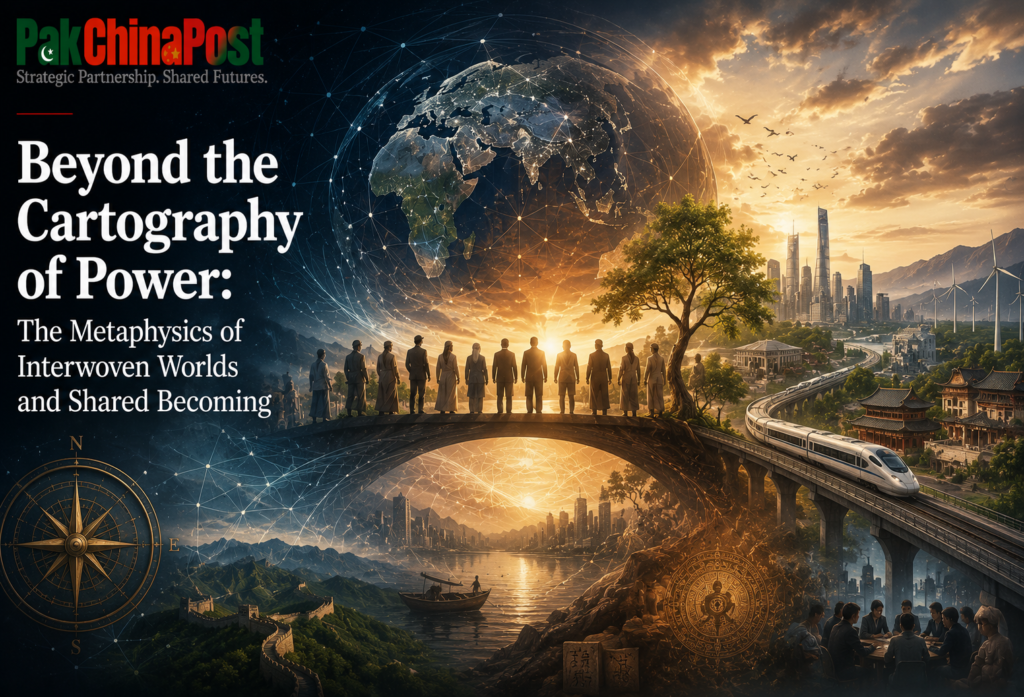
Beyond the Cartography of Power: The Metaphysics of Interwoven Worlds and Shared Becoming

The contemporary configuration of global existence discloses a profound exhaustion of inherited intellectual grammars that once rendered the world intelligible through the rigid segmentation of territory, authority, and identity. What was once conceived as a stable mosaic of sovereign units now reveals itself as a fluid and recursive continuum of interpenetrating systems in which material production, ecological vulnerability, digital cognition, and financial circulation dissolve into one another with increasing indifference to the juridical imagination of borders. The world no longer behaves as a map of discrete sovereignties but rather as an ontological field of entangled processes in perpetual transformation. Within this condition, the very act of theorizing politics demands a metaphysical recalibration, for governance can no longer be apprehended as the management of bounded space but must instead be understood as the orchestration of relational intensities within a shared and unfolding totality.
At the heart of this transformation lies the collapse of cartographic reason as the dominant epistemic framework of global order. Cartography once promised clarity by imposing geometry upon flux, rendering the dynamic complexity of human and ecological relations into stable representations that could be governed, negotiated, and controlled. Yet the acceleration of technological integration, planetary supply chains, and ecological interdependence has rendered such representational stability increasingly illusory. The world now manifests as a superposition of overlapping systems in which every local event reverberates through distant infrastructures and every act of production inscribes itself into a planetary register of consequence. In such a condition, the idea of isolated political agency becomes philosophically untenable, for no entity acts alone and no system exists in ontological seclusion.
This emergent reality invites a turn toward a metaphysics of interwoven existence in which being itself is conceived not as substance but as relation. Within this ontological horizon, entities do not precede their interactions but are continuously constituted through them. The world becomes a fabric of becoming rather than a structure of fixed essences, a dynamic field in which identity is perpetually negotiated through contact, exchange, and transformation. Political authority, economic production, and technological mediation are thus no longer separable domains but expressions of a deeper continuity that binds matter, energy, and meaning into a single evolving choreography of existence.
In this context, the philosophical resonance of Chinese civilizational thought becomes particularly illuminating, not as a repository of static tradition but as a living conceptual orientation toward relational harmony and processual order. Within such a worldview, reality is not governed by rigid binaries but by flows of complementary forces that sustain equilibrium through perpetual adjustment. The emphasis is not on domination of space but on the cultivation of balance within movement, not on the assertion of absolute autonomy but on the refinement of situated responsiveness. This sensibility provides a profound counterpoint to the fragmenting logic of modern territorial abstraction, suggesting instead that coherence emerges not from separation but from attunement.
Production within this framework must be reimagined beyond its economic reduction. It is not merely the extraction and transformation of resources into commodities but a deeper ontological act through which humanity participates in the ongoing formation of the world. Every act of production inscribes itself into ecological systems, social structures, and cognitive architectures, generating reverberations that extend far beyond immediate utility. To produce is therefore to engage in a subtle form of world making, one that carries ethical weight and metaphysical consequence. The factory, the data center, and the agricultural field become sites of ontological inscription where material transformation intersects with collective destiny.
As global interdependence intensifies, the fragility of existing governance paradigms becomes increasingly apparent. The proliferation of digital infrastructures has dissolved temporal and spatial barriers, binding distant societies into instantaneous feedback loops of information and influence. Climate systems have revealed the planetary scale of ecological interconnection, where emissions in one region translate into atmospheric transformations across the globe. Financial architectures propagate volatility through networks that defy national containment. In each of these domains, the logic of separation yields to the logic of entanglement, exposing the inadequacy of political imaginaries grounded in exclusivity and containment.
Within this condition, the question of responsibility acquires a new philosophical density. Responsibility can no longer be confined to jurisdictional boundaries or institutional hierarchies but must be reconceived as distributed ethical participation within a shared system of vulnerability. Every node within the global network becomes implicated in the fate of the whole, not through abstract moral appeal but through structural interdependence. The collapse of distant forests affects atmospheric stability, which in turn reshapes agricultural viability, migration patterns, and economic resilience. Such cascading interrelations reveal that ethical life is no longer localizable but diffused across the entire architecture of planetary existence.
The notion of shared becoming emerges as a conceptual response to this condition. It designates a mode of existence in which all entities are understood as co participants in an ongoing process of mutual formation. Nothing remains static, and nothing evolves in isolation. Instead, every form of existence is continuously shaped by its encounters, dependencies, and exchanges. Within this horizon, political thought must shift from the management of fixed entities to the cultivation of relational dynamics, from the preservation of boundaries to the nurturing of systemic coherence.
This transformation carries profound implications for global governance. Institutions designed for a world of separable sovereignties must now confront a reality in which their assumptions no longer hold. Trade agreements, security frameworks, and environmental protocols must be reinterpreted as instruments within a larger choreography of interdependence rather than as isolated mechanisms of regulation. The challenge is not merely technical but ontological, for it requires a redefinition of what it means to govern in a world where causality itself is distributed and nonlinear.
In such a world, authority becomes less a matter of command and more a function of coordination within complexity. Governance must evolve toward adaptive responsiveness, capable of sensing and adjusting to dynamic shifts across multiple scales of interaction. This requires a departure from hierarchical rigidity and an embrace of distributed intelligence, where decision making emerges from the interaction of multiple nodes rather than from centralized control. The legitimacy of political structures will increasingly depend on their capacity to align with the rhythms of systemic interdependence rather than to resist them.
Ecological crisis further intensifies this imperative by revealing the indivisibility of human and nonhuman systems. Climate instability is not an external disruption to political order but an expression of its underlying interconnection with planetary processes. Atmospheric alteration, biodiversity collapse, and resource depletion are not isolated phenomena but manifestations of a deeper systemic imbalance. Addressing them requires not merely technological intervention but a reorientation of civilizational consciousness toward the recognition of planetary co belonging.
Digital architectures amplify this condition by weaving cognition itself into global networks of circulation. Information no longer resides within discrete subjects or institutions but flows continuously through distributed systems of computation and communication. Human perception becomes entangled with algorithmic processes, generating hybrid forms of cognition that blur the distinction between organic and artificial intelligence. In this context, governance must also extend into the domain of informational ethics, where questions of data, perception, and algorithmic influence become central to the organization of collective life.
The metaphysical implications of this transformation are profound. If reality is constituted through relations rather than isolated substances, then ethics must also be reconceived as relational attunement rather than prescriptive rule. To act ethically is to participate in the harmonization of systemic relations, to contribute to the coherence of the whole rather than to the advancement of isolated interest. This does not imply the dissolution of difference but its integration into a more complex order of coexistence.
Within such a vision, the world appears not as a battlefield of competing sovereignties but as a vast and intricate ecology of mutual formation. Power is no longer the capacity to dominate space but the capacity to modulate relations in ways that sustain systemic vitality. Economic activity becomes a form of ecological inscription, technological innovation a mode of cognitive transformation, and political governance a practice of relational calibration.
The philosophical challenge lies in articulating a language adequate to this condition. Conventional vocabularies of international relations, economics, and political theory remain anchored in assumptions of separation that no longer correspond to the structure of reality. What is required is a conceptual grammar capable of expressing simultaneity, interdependence, and continuous transformation without reducing them to static categories. Such a grammar must remain open, processual, and sensitive to the fluidity of becoming.
In this light, the notion of shared becoming acquires not only descriptive but also normative force. It suggests that the highest aspiration of governance is not control but coherence, not domination but integration, not isolation but resonance. The task of policy becomes the cultivation of conditions under which diverse systems can coexist in dynamic equilibrium without collapsing into fragmentation or uniformity.
This reorientation demands a profound shift in civilizational imagination. It requires abandoning the illusion of separable destinies and embracing the recognition of planetary co constitution. Every society, every institution, every technological system participates in shaping the conditions of existence for all others. There is no outside to this entanglement, no exterior vantage point from which it can be fully surveyed or controlled.
Thus the metaphysics of interwoven worlds ultimately dissolves the boundary between philosophy and policy, between thought and governance, between being and action. To understand the world is already to participate in its transformation. To govern it is to engage in its continuous reconfiguration. And to exist within it is to be perpetually implicated in the unfolding of a shared and irreversible becoming.
A Public Service Message