
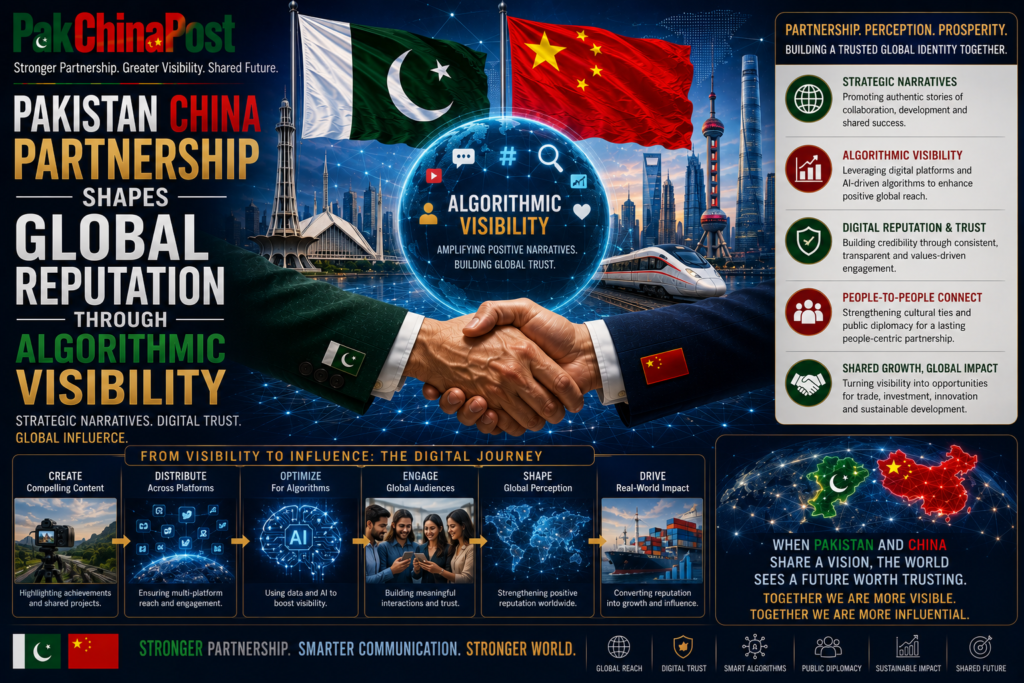
Pakistan China Partnership Shapes Global Reputation Through Algorithmic Visibility

Pakistan and China are entering a communications environment in which international reputation is increasingly determined not only by diplomatic engagement or economic performance, but also by the invisible architecture of digital platforms. The global contest over influence has shifted from conventional broadcasting toward algorithmically managed ecosystems where recommendation systems, search engine rankings, platform moderation policies, automated translation technologies, generative artificial intelligence, engagement metrics and digital amplification collectively determine which narratives receive international attention and which disappear into informational obscurity. Strategic communication has therefore become inseparable from computational infrastructure. For both Islamabad and Beijing, safeguarding national reputation requires understanding that perception is now mediated by algorithms operating across multiple jurisdictions, languages and commercial platforms rather than by governments alone.
The transformation is significant because algorithms increasingly function as international gatekeepers. Search engines determine which reports appear first during global crises. Recommendation systems decide whether documentary evidence reaches millions of viewers or remains largely invisible. Translation models influence whether official statements are interpreted accurately or distorted through linguistic simplification. Artificial intelligence systems summarize complex policy positions into brief responses that may shape first impressions for global audiences. Platform moderation standards determine which content is amplified, restricted or labelled. Engagement metrics reward emotionally charged narratives over carefully verified information. Together these systems create an algorithmic layer between states and international audiences, making digital visibility a strategic resource comparable to economic competitiveness or diplomatic access.
Pakistan and China possess substantial opportunities within this evolving environment because both countries are expanding technological capabilities, academic cooperation, infrastructure partnerships and regional connectivity. Yet opportunity alone does not guarantee informational influence. International visibility increasingly depends upon the availability of credible, accessible and multilingual digital knowledge rather than the volume of official messaging. Algorithms consistently reward content that demonstrates authority, consistency, relevance and sustained engagement. States relying primarily upon reactive communication campaigns often discover that fragmented narratives struggle against well-established digital ecosystems built through years of continuous institutional knowledge production.
For Pakistan, algorithmic visibility represents both a challenge and a strategic opening. International digital discussions frequently prioritize security incidents, political instability or economic uncertainty while comparatively underrepresenting developments in industrial modernization, scientific research, climate adaptation, technology entrepreneurship and regional connectivity. This imbalance is not necessarily the result of coordinated misinformation alone. It often reflects algorithmic incentives favouring highly engaging subjects alongside structural disparities in digital content production. Countries generating greater volumes of searchable research, multilingual publications, open institutional data and internationally indexed knowledge naturally occupy stronger positions within recommendation systems and search rankings.
China has experienced similar dynamics from a different perspective. Despite enormous advances in manufacturing, innovation, infrastructure and scientific research, international perceptions frequently remain polarized across digital platforms. Competing narratives circulate simultaneously, with algorithms reinforcing audience preferences through personalization mechanisms that encourage informational segmentation. Individuals consuming one category of content often receive increasingly similar recommendations, reducing exposure to alternative perspectives. Consequently, international understanding becomes fragmented into separate algorithmic realities rather than shared factual environments.
Pakistan and China therefore share a strategic interest in strengthening credible informational ecosystems rather than pursuing exclusively promotional communication. Sustainable reputation cannot be manufactured through repetitive messaging or artificial amplification. Digital systems increasingly identify authenticity through diverse indicators including citation networks, institutional consistency, independent verification, expert engagement, multilingual accessibility and long-term publication records. Algorithms evolve continuously to identify authoritative sources because platform credibility directly affects commercial sustainability. Governments aligning communication with transparent evidence therefore possess greater opportunities for durable international influence than those relying upon purely symbolic campaigns.
Recommendation algorithms deserve particular policy attention because they increasingly shape international agenda formation. Video platforms recommend documentaries, interviews and policy discussions according to audience behaviour rather than diplomatic significance. News aggregators personalize headlines based upon previous engagement. Professional networking platforms prioritize certain institutional voices through interaction patterns. Academic databases recommend publications according to citation histories. Artificial intelligence assistants summarize widely indexed information before generating responses. These interconnected recommendation mechanisms establish cumulative visibility advantages for institutions investing consistently in digital knowledge production.
Pakistan should therefore approach algorithmic visibility as an institutional governance issue rather than solely a media management function. Ministries, universities, research centres, regulatory authorities, professional associations and statistical institutions collectively contribute to the country’s searchable digital identity. Every publicly accessible research report, policy paper, scientific publication, judicial decision, development assessment, investment analysis and technical standard strengthens informational legitimacy when published in internationally accessible formats. Digital reputation emerges through accumulated institutional credibility rather than isolated communication campaigns.
Pakistan China cooperation offers considerable potential in this regard. Joint research programmes, bilingual academic publications, collaborative scientific repositories, shared innovation platforms and coordinated policy dialogues can significantly expand searchable knowledge ecosystems across multiple languages. Such cooperation should emphasize methodological transparency and peer reviewed scholarship to maximize international credibility. Evidence based research consistently performs better within professional information environments because search systems increasingly prioritize authoritative sources supported by citation networks and institutional reliability.
Automated translation systems represent another strategically important domain. Machine translation has dramatically expanded access to international information, yet translation inaccuracies continue influencing diplomatic interpretation, media reporting and public understanding. Technical terminology, cultural nuance and policy language frequently lose precision when translated automatically across multiple languages. Small interpretative errors can substantially alter international perceptions during sensitive diplomatic developments or security incidents.
Pakistan and China should therefore invest jointly in multilingual linguistic research emphasizing diplomatic vocabulary, legal terminology, technological standards and development policy language. National language institutions, universities and artificial intelligence laboratories should cooperate in developing specialized terminology databases capable of improving translation quality across English, Urdu, Mandarin and regional languages. Improved linguistic accuracy strengthens international comprehension while reducing opportunities for unintended misunderstanding.
Generative artificial intelligence introduces additional complexity because millions of individuals increasingly obtain information through conversational systems rather than traditional search engines. Artificial intelligence models synthesize enormous quantities of publicly available information before producing concise responses. Consequently, the quality of publicly indexed knowledge directly influences algorithmic understanding. Countries maintaining fragmented digital records, inaccessible documentation or inconsistent institutional communication risk generating incomplete or outdated artificial intelligence outputs.
This challenge requires systematic digital knowledge management. Government agencies should publish structured datasets, policy documents, statistical reports and explanatory materials using internationally recognized metadata standards that facilitate machine readability. Universities should expand open access publication strategies. Think tanks should release policy briefs accompanied by transparent methodology. Public institutions should archive historical documents within searchable repositories. Such measures improve both human understanding and algorithmic interpretation.
Institutional transparency becomes increasingly important because digital audiences rapidly compare information across multiple sources. Contradictory official statements reduce algorithmic confidence and public trust simultaneously. Conversely, transparent communication supported by evidence enhances institutional authority over time. Transparency should therefore be understood not merely as a governance principle but also as a strategic communication asset within computational information environments.
Research diplomacy offers another important opportunity. International academic collaboration creates trusted channels for long term reputation building because scholarly networks emphasize methodological rigor rather than political advocacy. Joint Pakistan China research initiatives addressing climate resilience, agricultural innovation, artificial intelligence governance, energy transition, public health, logistics modernization and water management can generate internationally respected knowledge while strengthening bilateral scientific cooperation. Publications emerging from collaborative research receive greater credibility when subjected to peer review and international scholarly engagement.
Digital amplification should similarly prioritize quality rather than quantity. Artificial engagement techniques, coordinated manipulation or excessive promotional messaging increasingly attract platform scrutiny while undermining credibility. Sustainable amplification emerges when authoritative institutions produce information that independent experts, researchers, journalists and professional communities voluntarily reference because of its analytical value. Governments should therefore facilitate rather than dominate credible public discourse.
International media engagement also requires modernization. Traditional press releases remain important but insufficient. Policymakers should increasingly communicate through interactive digital briefings, data visualizations, technical explainers, multilingual podcasts, academic webinars and evidence based discussion platforms. These formats encourage deeper engagement while improving discoverability across recommendation systems. High quality digital communication should complement conventional diplomacy rather than replace it.
Online engagement metrics require careful interpretation. Viral popularity does not necessarily indicate international influence, while limited engagement does not always signify strategic failure. Policymakers should distinguish between transient visibility generated through controversy and durable credibility established through authoritative information. National communication evaluation frameworks should therefore incorporate qualitative indicators including citation quality, institutional partnerships, research utilization, educational adoption and international expert engagement alongside conventional digital metrics.
Pakistan should establish an integrated National Digital Reputation Observatory combining expertise from communication studies, artificial intelligence, international relations, cybersecurity, computational linguistics, economics and public policy. Such an institution could monitor algorithmic trends affecting national visibility without interfering with legitimate public discourse. Regular assessments could identify emerging informational vulnerabilities, evaluate international perception patterns, measure multilingual representation and recommend evidence based policy responses. Similar analytical capacity already exists within leading global economies because informational resilience increasingly forms part of national strategic planning.
China’s extensive experience in digital infrastructure, artificial intelligence research and computational innovation provides valuable opportunities for technical cooperation. Collaborative programmes should however remain firmly grounded in internationally accepted principles of transparency, interoperability, academic integrity and responsible technological development. International confidence grows when technological cooperation demonstrates openness, predictable governance and measurable public benefit.
Search engine optimization for public institutions deserves greater strategic attention. Many government websites remain technically inaccessible, poorly indexed or insufficiently structured for modern search systems. Information often exists but remains difficult for international researchers to locate. Standardized digital publishing practices, improved metadata, multilingual summaries, open document formats and accessible archival systems would significantly strengthen discoverability without altering substantive policy positions.
The expanding role of knowledge graphs, semantic indexing and artificial intelligence retrieval systems means that institutional consistency increasingly affects algorithmic recognition. Different agencies should therefore employ harmonized terminology, synchronized statistical references and standardized policy descriptions. Internal inconsistencies create algorithmic confusion while coherent documentation strengthens digital authority.
Media literacy also represents an essential component of informational legitimacy. Citizens increasingly participate in international reputation formation through social media interactions, digital entrepreneurship, academic collaboration and online professional engagement. National educational strategies should therefore strengthen critical digital literacy, source verification skills, artificial intelligence awareness and responsible online communication. A digitally informed population contributes naturally to stronger international credibility because authentic societal engagement complements official diplomacy.
Pakistan China cooperation in media education can produce long term dividends. Joint academic exchanges, computational journalism research, artificial intelligence ethics programmes, multilingual communication studies and digital governance workshops would strengthen professional capacity across both countries. Universities should become central actors within strategic communication ecosystems because higher education institutions generate trusted knowledge capable of transcending political cycles.
The private technology sector likewise possesses an increasingly important role. Software developers, artificial intelligence companies, digital publishers, startup communities and telecommunications firms contribute directly to national informational infrastructure. Governments should encourage innovation through regulatory clarity, cybersecurity standards, intellectual property protection and research incentives while avoiding excessive bureaucratic fragmentation. Competitive digital industries naturally expand international visibility through technological achievement rather than narrative promotion alone.
Diaspora communities also deserve greater policy integration. Pakistani and Chinese professionals working across international universities, research institutions, multinational corporations and technology firms often possess substantial digital credibility within professional networks. Structured engagement programmes encouraging knowledge exchange, collaborative publication and public scholarship could strengthen international understanding through independent expertise rather than centralized communication.
International partnerships should extend beyond bilateral cooperation. Pakistan and China should actively participate within multilateral discussions concerning artificial intelligence governance, platform accountability, digital ethics, algorithmic transparency and cross border information standards. Constructive participation demonstrates commitment to responsible technological development while allowing both countries to influence emerging international norms governing computational communication.
Cybersecurity and informational legitimacy increasingly overlap. Coordinated disinformation campaigns, synthetic media manipulation, malicious bot networks and digitally fabricated evidence threaten all states irrespective of geopolitical alignment. Pakistan and China should strengthen technical cooperation in detecting coordinated inauthentic behaviour, improving forensic verification capabilities and sharing best practices concerning digital resilience. Defensive measures should remain consistent with international law while respecting legitimate freedom of expression and independent journalism.
Strategic communication must ultimately recognize that credibility cannot be separated from governance quality. Algorithms amplify information already available within public domains. Countries demonstrating institutional competence, transparent policymaking, measurable development outcomes, scientific innovation and consistent legal frameworks naturally strengthen algorithmic visibility because credible evidence generates sustained international attention. Communication therefore succeeds most effectively when supported by substantive policy performance.
For Pakistan, integrating strategic communication into national development planning would represent an important institutional evolution. Infrastructure projects, educational reforms, technological innovation, climate resilience initiatives, industrial modernization and scientific achievements should all incorporate internationally accessible documentation from their earliest stages. Digital visibility should become an operational consideration rather than an afterthought following project completion.
For China, continued emphasis upon scientific openness, research collaboration, multilingual accessibility and transparent international engagement can strengthen confidence across increasingly complex digital ecosystems. Long term reputation depends upon continuous evidence generation supported by institutional reliability rather than episodic public diplomacy initiatives. The international construction of national reputation has entered an algorithmic era where visibility, credibility and accessibility converge into strategic influence. Pakistan and China possess significant opportunities to shape this environment through evidence based communication, multilingual knowledge production, institutional transparency, technological cooperation and research diplomacy. Success will depend not upon competing with algorithms but upon understanding how trustworthy information ecosystems interact with computational systems that increasingly define global perception. National legitimacy in the digital century will belong to states capable of producing reliable knowledge, maintaining transparent institutions, encouraging informed public engagement and ensuring that algorithmic visibility reflects genuine national capability rather than temporary informational advantage. Such an approach protects strategic interests, strengthens international confidence and positions both countries to navigate an increasingly complex information order with resilience, credibility and enduring diplomatic effectiveness.
A Public Service Message