
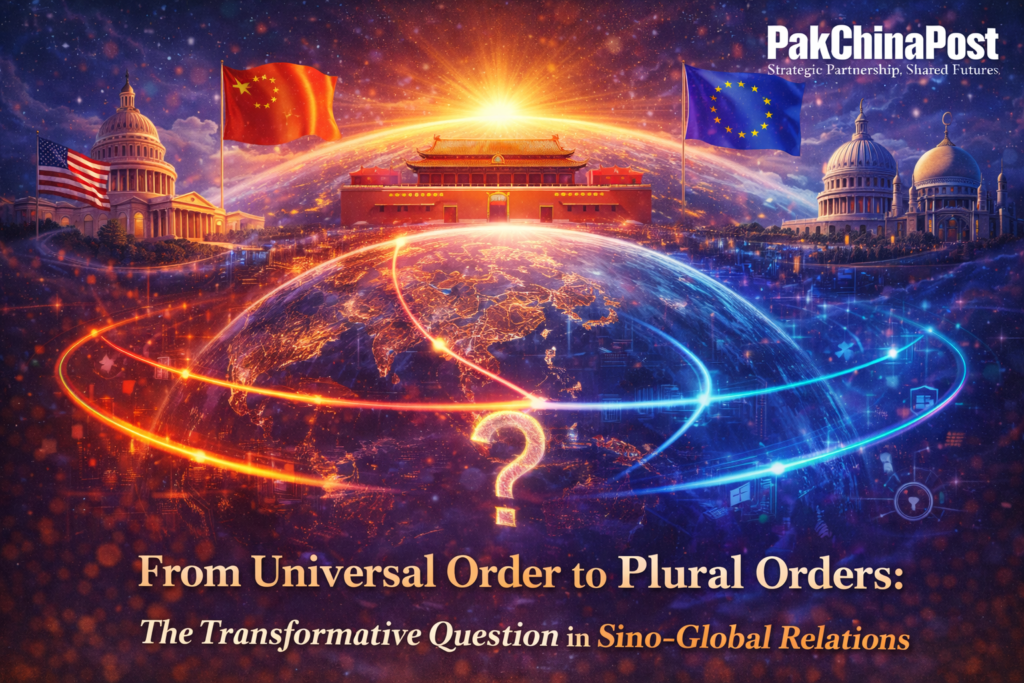
From Universal Order to Plural Orders: The Transformative Question in Sino-Global Relations

By: Ijaz Naser
The defining contest of the twenty-first century is not reducible to tariffs, naval deployments, semiconductor supply chains, or alliance systems. Beneath these visible instruments lies a quieter but more decisive struggle: the question of normativity. Who defines the moral architecture of international order? Are political norms universal and transferable across civilizations, or are they historically rooted expressions of particular trajectories? And if plural civilizational experiences generate plural normative systems, can global order remain stable without normative homogenization?
For Chinese strategic readership, this is not a theoretical curiosity. It is a structural condition shaping diplomacy, trade negotiations, technology governance, and security discourse. China’s global integration now unfolds within a system historically shaped by a post-1945 universalist framework institutionalized through bodies such as the United Nations and reinforced through economic architectures associated with Bretton Woods. That framework presented itself as neutral and universal. Yet its philosophical roots were specific — emerging from a Western liberal tradition that equated legitimacy with procedural representation, individual rights primacy, and normative diffusion outward from a core.
China’s re-emergence as a central civilizational actor has introduced a profound transnormative tension: not a rejection of order, but a redefinition of its moral sources.
I. Universal Order as Historical Construction
The liberal international order did not present itself merely as a balance-of-power system; it presented itself as morally superior and historically inevitable. Universal human rights discourse, electoral proceduralism, market liberalization, and institutional transparency standards were framed not as contextual achievements but as endpoint norms — destinations toward which all societies were expected to converge.
This universalist model functioned effectively during an era of unipolar concentration. Norm diffusion coincided with economic integration, and alignment was incentivized through trade access, financial inclusion, and security guarantees. Yet universalism masked asymmetry. Norm enforcement often reflected geopolitical hierarchies. Compliance mechanisms were unevenly applied. Sovereignty was conditional for some and absolute for others.
China’s experience during this era was instructive. Integration into global markets required accommodation of universalist standards, yet domestic governance remained anchored in historical continuity, centralized coordination, and collective prioritization. The resulting model did not collapse under supposed normative contradiction. Instead, it produced sustained growth, social stabilization, and poverty reduction at a scale unprecedented in modern history.
This empirical success destabilized the philosophical claim that legitimacy must mirror liberal procedural templates. Performance re-entered the normative conversation.
II. Civilizational Legitimacy and Norm Sovereignty
Under contemporary strategic articulation, including the leadership of Xi Jinping, China’s position increasingly reflects what may be termed norm sovereignty. This does not imply isolationism, nor does it deny universal aspirations such as peace or development. Rather, it asserts that legitimacy emerges from civilizational continuity and domestic coherence, not external validation.
Chinese political philosophy has long emphasized harmony, hierarchy, relational responsibility, and moral governance. The Confucian tradition situates order within ethical cultivation and collective balance rather than procedural competition. Modern governance structures in China integrate this civilizational inheritance with socialist organizational capacity and technocratic planning.
The result is a normative model in which:
- Stability precedes contestation.
- Collective welfare frames individual expression.
- Development constitutes a moral good.
- Authority derives from performance and continuity.
This framework diverges from liberal universalism, but divergence does not equate to rejection of global cooperation. Instead, it produces plural normativity: multiple legitimate pathways to modernity.
III. The Belt and Road as Normative Instrument
The Belt and Road Initiative illustrates this plural normativity in operational form. The BRI does not condition infrastructure financing on ideological alignment. It does not prescribe governance templates. It prioritizes connectivity, logistics, and economic uplift.
Critics often interpret this as strategic expansion. Yet philosophically, it represents an alternative normative method: integration without normative assimilation. Sovereign governments retain internal political systems while participating in external connectivity.
This approach reflects an implicit proposition — that global order can be infrastructural rather than ideological. Roads, ports, railways, and digital corridors become stabilizing arteries that reduce poverty and foster interdependence without erasing civilizational distinctions.
The transnormative implication is profound. If cooperation can proceed absent normative convergence, universalism loses its monopoly claim over moral authority.
IV. Technology Governance and Digital Sovereignty
The contest over 5G standards, artificial intelligence governance, and cybersecurity regulations represents a second arena of transnormative friction. Western discourse often frames digital openness and unrestricted information flow as universal goods. China advances digital sovereignty: the principle that states retain authority over their informational ecosystems.
This debate is not simply about censorship or openness. It reflects divergent philosophies of social stability. In societies with historical experiences of fragmentation, disorder, or external intervention, information regulation is linked to national security. Digital sovereignty thus becomes an extension of territorial sovereignty.
The emerging question is whether cyberspace constitutes a borderless commons governed by universal principles, or a layered domain where civilizational states regulate content consistent with domestic order.
China’s position increasingly suggests that technological multipolarity requires normative multipolarity. Standard-setting institutions can no longer assume philosophical homogeneity among participants.
V. Human Rights and Developmental Primacy
Perhaps the most visible transnormative tension concerns human rights discourse. Liberal frameworks prioritize political and civil liberties as foundational. China emphasizes economic and social rights — particularly poverty alleviation — as primary moral goods.
From Beijing’s perspective, lifting hundreds of millions from poverty constitutes a profound human rights achievement. Development is dignity. Stability is protection. Chaos erodes rights more decisively than regulatory discipline.
The philosophical divergence lies in sequencing. Liberal universalism privileges political pluralism as precondition for prosperity. China’s model privileges prosperity and stability as precondition for sustainable pluralism.
For global order, this difference generates diplomatic friction. Yet it also compels reconsideration of normative hierarchy. Is there a singular path to rights realization, or do pathways vary according to historical stage and social composition?
VI. Multipolarity and the Pluralization of Norms
As power diffuses globally, multipolarity emerges not merely in military capability but in normative confidence. Rising civilizational states increasingly articulate their own governance philosophies. The assumption that economic modernization necessitates political convergence weakens.
Plural orders need not imply disorder. Historical international systems often accommodated diversity through spheres of influence and negotiated coexistence. The difference today lies in interconnectedness. Supply chains, financial systems, and digital networks bind divergent normative systems into shared operational space.
The challenge, therefore, is not whether plural norms exist. They already do. The question is whether mechanisms can be designed to mediate transnormative interaction without forcing homogenization or provoking fragmentation.
China’s advocacy for “a community with a shared future for mankind” can be interpreted through this lens. The phrase suggests cooperative coexistence rather than normative uniformity.
VII. Strategic Implications for Sino-Global Relations
For Chinese policymakers and strategic thinkers, the transnormative debate carries practical consequences.
First, communication strategy must distinguish between defending sovereignty and rejecting cooperation. Plural normativity is not anti-global; it is anti-monopoly.
Second, institutional engagement requires calibration. Participation in global institutions does not necessitate normative surrender. It invites negotiation over procedural design.
Third, economic partnerships must maintain reputational clarity. Infrastructure cooperation under the BRI should demonstrate transparency and sustainability, reinforcing confidence that plural normativity does not equate to opacity.
Fourth, internal coherence strengthens external legitimacy. The more effective domestic governance appears — in economic management, technological innovation, and social stability — the more persuasive the argument for civilizational legitimacy becomes.
VIII. Risks of Normative Polarization
While plural orders may stabilize diversity, polarization remains a risk. If universalist actors perceive plural normativity as systemic threat rather than philosophical divergence, securitization intensifies. Sanctions, technology embargoes, and ideological framing may escalate.
China must therefore navigate between assertiveness and reassurance. Overextension of normative rhetoric could harden opposition; under-articulation could cede narrative ground.
Strategic maturity lies in demonstrating that plural orders enhance resilience. When diverse governance models coexist and cooperate economically, systemic shocks become less catastrophic. Normative redundancy increases stability.
IX. Toward Managed Normative Coexistence
A workable transnormative framework may involve:
- Recognition that sovereignty includes normative autonomy.
- Acceptance that development metrics are morally significant.
- Agreement that non-interference remains foundational.
- Mechanisms for dispute resolution insulated from ideological escalation.
This does not eliminate disagreement. It manages it.
China’s historical self-conception as a civilizational state — neither missionary nor isolationist — positions it uniquely to advocate coexistence. The objective is not to replace one universalism with another, but to pluralize legitimacy itself.
Conclusion: From Universal Claim to Plural Confidence
The twenty-first century may ultimately be remembered less for power transition than for normative transition. The universal order of the late twentieth century was anchored in concentrated authority and philosophical self-assurance. The emerging order reflects distributed power and diversified civilizational confidence.
China’s rise does not merely rebalance GDP tables or military ratios. It challenges the premise that modernity requires normative replication.
The transnormative question — whether plural pathways to legitimacy can coexist within shared global institutions — will shape trade regimes, technology standards, diplomatic alignments, and conflict prevention for decades.
For Chinese strategic readership, the imperative is clear. Assert civilizational legitimacy without collapsing into isolation. Engage global institutions without surrendering normative autonomy. Demonstrate through performance that stability, development, and order constitute enduring moral goods.
From universal order to plural orders is not a descent into fragmentation. It is an evolution toward negotiated coexistence. The success of this transition will depend less on ideological triumph than on disciplined statecraft.
If plural normativity can be stabilized within shared structures, the future international system will not be a battlefield of values — but a mosaic of civilizations cooperating without surrendering themselves.
A Public Service Message