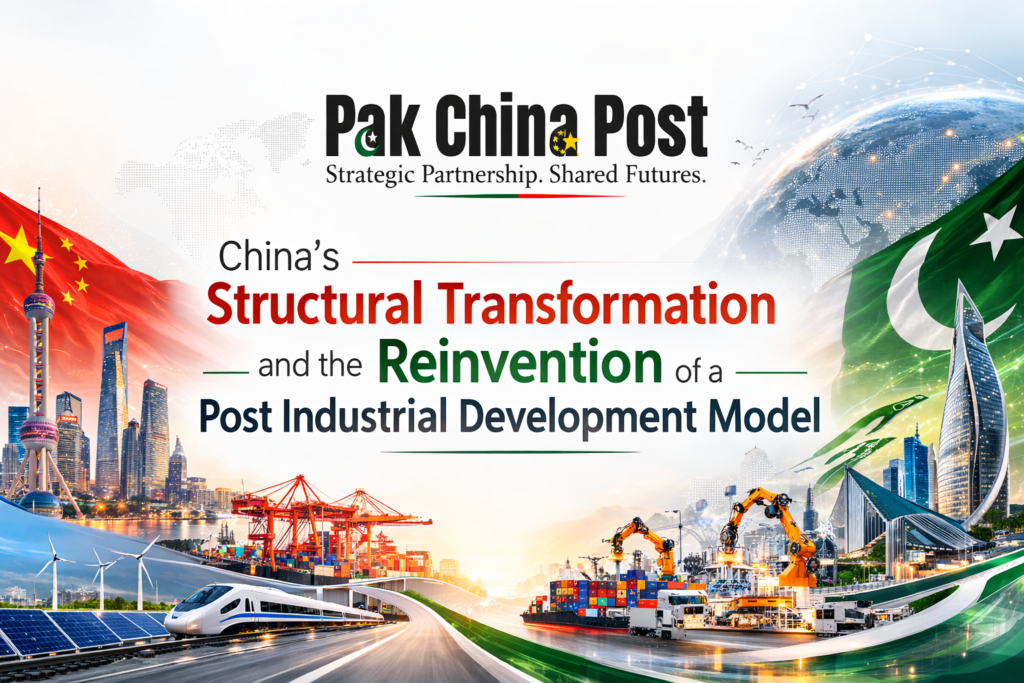
China’s Structural Transformation and the Reinvention of a Post Industrial Development Model

In the grand narrative of modern economic history few transformations rival the extraordinary ascent of China. Within a single generation the nation emerged from relative isolation to become the world’s second largest economy, the central hub of global manufacturing, and a pivotal actor in international trade. Yet the very magnitude of this success has ushered China into a new and far more complex phase of development. The challenge confronting Beijing today is no longer the pursuit of rapid industrialization but the orchestration of a comprehensive structural transformation capable of sustaining prosperity in an era defined by demographic change, technological disruption, and geopolitical competition.
China’s traditional growth model was built upon three mutually reinforcing pillars. The first was an abundant supply of inexpensive labor migrating from rural provinces to urban manufacturing centers. The second was massive capital investment in infrastructure, real estate development, and industrial capacity. The third was integration into global markets through export oriented manufacturing. Together these forces generated decades of astonishing economic expansion and elevated hundreds of millions of citizens out of poverty.
However economic paradigms rarely remain indefinitely viable. As China’s economy matured the structural limitations of this model gradually became apparent. Labor costs increased, diminishing the competitive advantage of low cost manufacturing. Infrastructure networks reached saturation in many regions, reducing the marginal benefits of additional construction. Meanwhile external demand from developed economies began to fluctuate amid global economic uncertainties.
Simultaneously China encountered an unprecedented demographic transition. Decades of declining birth rates combined with rising life expectancy have begun to reshape the nation’s population structure. The working age population is gradually contracting while the proportion of elderly citizens continues to expand. Such demographic dynamics introduce complex economic implications including increased healthcare expenditures, pension obligations, and potential labor shortages.
Faced with these evolving realities Chinese policymakers have embarked upon an ambitious effort to reinvent the nation’s development model. Rather than pursuing sheer quantitative expansion Beijing increasingly emphasizes qualitative transformation. This approach seeks to cultivate a more sophisticated economic architecture grounded in technological innovation, domestic consumption, and sustainable development.
Central to this transformation is the promotion of high technology industries. Advanced manufacturing sectors such as robotics, electric vehicles, renewable energy systems, aerospace engineering, and biotechnology now occupy prominent positions within national development plans. These industries generate higher value outputs and require advanced scientific capabilities, thereby facilitating China’s transition toward a knowledge based economy.
Another crucial component involves the expansion of domestic consumption. Historically Chinese households maintained high savings rates due to concerns regarding healthcare costs, educational expenses, and retirement security. While such savings provided capital for investment they also constrained the development of a robust consumer economy. The government therefore seeks to strengthen social welfare systems and increase household confidence so that consumption can assume a larger role in economic growth.
Urbanization continues to play a significant role within this evolving model. China’s cities function not merely as manufacturing centers but as hubs of innovation, finance, and cultural exchange. Smart city initiatives integrating digital infrastructure, artificial intelligence, and environmental sustainability aim to transform urban landscapes into engines of economic creativity.
The advantages of this structural transformation are considerable. A diversified economy anchored in technology and consumption possesses greater resilience against external shocks. It reduces dependence on volatile export markets and enhances domestic economic dynamism. Furthermore technological industries create opportunities for highly skilled employment, elevating the overall quality of the labor force.
Environmental sustainability represents another important benefit. China’s earlier phase of rapid industrialization produced significant ecological challenges including air pollution, water contamination, and carbon emissions. The shift toward renewable energy, electric transportation, and green technology reflects an effort to reconcile economic growth with environmental stewardship.
However the transition toward a new development model is inherently complex and occasionally disruptive. Industries that once served as pillars of economic expansion may experience contraction as resources shift toward emerging sectors. Workers employed in traditional manufacturing or construction may require retraining to adapt to technologically sophisticated occupations. Managing this social adjustment constitutes a delicate policy challenge.
The real estate sector illustrates the intricacies of this transformation. For many years property development functioned as a major driver of economic activity and local government revenue. Yet excessive speculation and mounting debt created financial vulnerabilities within the sector. Efforts to stabilize the property market while reducing systemic risk must therefore be calibrated carefully to avoid triggering broader economic instability.
Another challenge concerns regional inequality. China’s coastal provinces historically benefited from proximity to international trade routes and foreign investment, while interior regions developed more gradually. As the economy transitions toward high technology industries policymakers must ensure that new opportunities are distributed across diverse geographic regions to prevent the emergence of entrenched disparities.
International dynamics further complicate China’s structural transformation. Global supply chains are undergoing reconfiguration as nations reassess economic dependencies and strategic vulnerabilities. Some manufacturing activities may gradually relocate to other developing countries with lower labor costs. China must therefore accelerate its movement up the value chain to maintain competitiveness within this evolving landscape.
Yet it would be erroneous to interpret these adjustments as evidence of decline. Mature economies naturally evolve toward more sophisticated forms of production and consumption. The transition from manufacturing dominance to technological innovation mirrors the developmental pathways previously followed by advanced industrial nations.
China possesses several structural advantages that may facilitate this transformation. The country maintains one of the world’s largest pools of engineers, scientists, and technically trained graduates. Its digital infrastructure is among the most extensive globally, enabling rapid diffusion of technological applications. Moreover the scale of the domestic market provides extraordinary opportunities for commercializing new products and services.
State capacity also remains a significant factor. The Chinese government retains the ability to mobilize resources, coordinate industrial policy, and implement long term strategic initiatives with remarkable efficiency. Such capacity allows policymakers to guide economic restructuring while mitigating potential disruptions.
Nevertheless the success of China’s transformation will depend upon the delicate interplay between state direction and market vitality. Innovation thrives in environments where entrepreneurs possess the freedom to experiment and challenge established paradigms. Ensuring that regulatory frameworks encourage creativity while maintaining stability represents an ongoing institutional balancing act.
Furthermore China’s integration into the global economy will continue to shape its developmental trajectory. International trade, investment flows, and technological exchange remain indispensable components of economic modernization. Even as geopolitical tensions persist China’s participation in global markets will remain essential to sustaining growth.
The broader philosophical dimension of China’s transformation should not be overlooked. Economic policy in China often reflects a long civilizational perspective emphasizing harmony, balance, and gradual adaptation. The current transition toward a more sustainable and technologically sophisticated economy aligns with this intellectual tradition of pragmatic evolution.
Ultimately China stands at a pivotal historical juncture where the achievements of the past converge with the uncertainties of the future. The nation must navigate demographic change, technological disruption, environmental constraints, and geopolitical competition simultaneously. Few societies have attempted such a comprehensive transformation on such an immense scale.
Whether China succeeds in reinventing its development model will influence not only its domestic prosperity but also the structure of the global economy. As the world’s second largest economic power China’s policies reverberate across international markets, supply chains, and financial systems.
The unfolding decade will therefore determine whether China can convert the challenges of maturity into opportunities for renewal. If the structural transformation succeeds China may emerge as a pioneering example of how a rapidly industrialized society evolves into a technologically advanced, environmentally sustainable, and consumption driven economy.
In that scenario China’s journey would not represent the conclusion of its economic miracle but rather the beginning of a new chapter in which innovation, sustainability, and strategic adaptability redefine the meaning of national development in the twenty first century.
A Public Service Message