
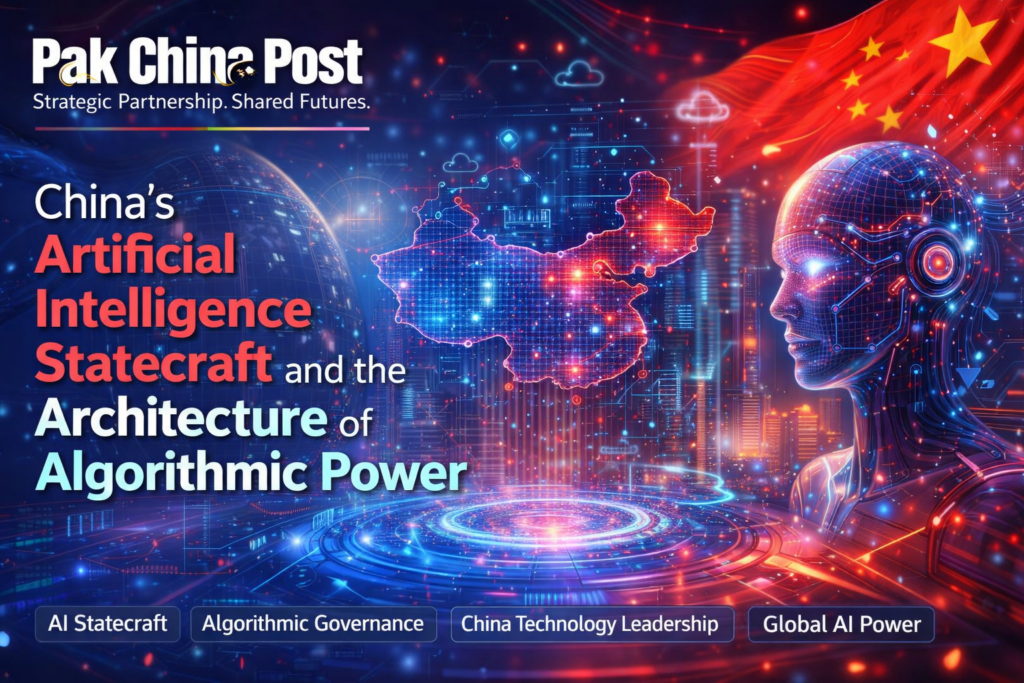
China’s Artificial Intelligence Statecraft and the Architecture of Algorithmic Power

The twenty first century is progressively being defined not by the territorial rivalries that dominated earlier eras but by a more intricate contest over technological supremacy, informational influence, and algorithmic authority. Within this emerging landscape China has embarked upon one of the most ambitious technological transformations of any modern state. Artificial intelligence now occupies a central position within Beijing’s strategic imagination, not merely as an instrument of economic productivity but as a comprehensive architecture capable of reshaping governance, industry, and social organization. The Chinese vision of artificial intelligence therefore transcends conventional technological enthusiasm and enters the realm of statecraft itself.
China’s engagement with artificial intelligence reflects a broader historical trajectory in which technological modernization has been interpreted as a pathway toward national rejuvenation. Since the late twentieth century Chinese policymakers have consistently recognized that technological capability determines the hierarchy of nations within the global system. In earlier decades this understanding manifested through industrialization and infrastructure development. In the contemporary era it is increasingly expressed through the mastery of digital technologies that regulate data, automate decision making, and integrate computational intelligence into every dimension of economic activity.
Artificial intelligence occupies a unique position within this transformation because it operates simultaneously as an economic catalyst and a governance mechanism. Chinese planners envision AI permeating manufacturing processes, transportation networks, healthcare diagnostics, financial services, urban management, and environmental monitoring. The ambition is not merely to automate isolated industries but to construct a comprehensive digital ecosystem in which algorithmic intelligence optimizes resource allocation across society.
Such a vision offers significant advantages for a country of China’s scale and complexity. With a population exceeding one billion and an economy encompassing vast geographic diversity, administrative efficiency has always posed a formidable challenge. Artificial intelligence provides tools capable of analyzing enormous volumes of data in real time, thereby enhancing the state’s capacity to anticipate economic fluctuations, manage urban infrastructure, and respond to public health crises. In principle the integration of AI into governance could produce unprecedented levels of administrative precision.
The economic implications are equally profound. Automation driven by machine learning systems has the potential to dramatically increase productivity within manufacturing sectors that historically relied upon large labor forces. Robotics integrated with artificial intelligence can perform complex tasks with consistency and speed that surpass human capability. For China this technological shift holds particular significance because demographic trends indicate that the nation’s working age population is gradually declining. Artificial intelligence therefore becomes not only a driver of innovation but also a strategic response to demographic transition.
China also benefits from structural advantages in the development of artificial intelligence. The vast scale of its digital economy generates immense datasets that serve as the raw material for machine learning algorithms. Digital payment platforms, e commerce networks, logistics systems, and social media interactions collectively produce streams of information that can be analyzed to refine predictive models and consumer insights. Such data abundance allows Chinese technology companies to experiment with algorithmic solutions across a broad spectrum of applications.
Furthermore the Chinese state has demonstrated a capacity for coordinated technological planning that few nations can replicate. Research institutions, private enterprises, and local governments often operate within integrated policy frameworks that encourage collaboration in strategic sectors. This coordination enables China to mobilize resources rapidly when pursuing technological objectives, particularly in areas deemed essential to national competitiveness.
Yet the pursuit of artificial intelligence statecraft also generates complex dilemmas. One of the most widely discussed concerns involves the relationship between algorithmic governance and individual autonomy. Systems capable of monitoring social behavior, analyzing biometric data, and predicting patterns of activity raise fundamental questions about privacy and civil liberties. Critics argue that excessive reliance on surveillance technologies could erode personal freedoms and create forms of digital control unprecedented in human history.
Chinese authorities respond to these concerns by emphasizing the collective benefits of technological governance. In their perspective data driven administration enhances public security, reduces crime, and improves the efficiency of social services. Facial recognition systems deployed in transportation hubs can identify fugitives or missing persons. Smart traffic algorithms can alleviate congestion in megacities. Predictive health monitoring may detect epidemics before they escalate into national emergencies. From this viewpoint algorithmic governance is portrayed not as a mechanism of control but as a tool of societal stability.
Another challenge emerges from the unpredictable nature of artificial intelligence itself. Machine learning systems often operate as complex statistical models whose internal decision making processes remain difficult even for experts to fully interpret. When such systems are deployed in sensitive domains such as financial regulation or legal adjudication the possibility of algorithmic bias or error becomes a significant concern. Ensuring transparency and accountability within AI systems therefore represents a critical governance challenge.
Economic transformation driven by artificial intelligence also carries social implications. Automation inevitably alters labor markets by replacing certain categories of employment while creating new opportunities in technologically advanced sectors. Workers engaged in repetitive manufacturing tasks may face displacement as robotic systems become more sophisticated. Managing this transition requires comprehensive policies focused on education, vocational training, and social protection to ensure that technological progress does not produce widespread economic dislocation.
International dynamics further complicate China’s AI ambitions. Artificial intelligence has become a focal point of geopolitical competition among major powers. Nations increasingly view algorithmic superiority as essential to military capability, economic leadership, and strategic influence. Consequently technological cooperation across borders is often overshadowed by concerns about intellectual property security and national defense implications.
China’s rapid progress in artificial intelligence has therefore attracted both admiration and apprehension abroad. Some observers regard Chinese innovation as a catalyst that accelerates global technological advancement. Others perceive it as a challenge to existing technological hierarchies dominated by Western economies. This dual perception contributes to an atmosphere of strategic rivalry that shapes the global discourse surrounding AI development.
Despite these tensions China continues to articulate a narrative of technological modernization grounded in pragmatic adaptation rather than ideological confrontation. The state’s emphasis on integrating artificial intelligence into infrastructure, healthcare, education, and environmental management reflects an attempt to harness digital technology for developmental objectives. In this context AI becomes a component of national modernization comparable to earlier investments in railways, highways, and telecommunications networks.
The philosophical implications of this transformation are equally intriguing. Traditional Chinese political thought has long emphasized the concept of harmonious governance in which the state seeks to maintain equilibrium within society. Artificial intelligence offers tools that may theoretically enhance this capacity for balance by enabling administrators to monitor complex social dynamics with unprecedented precision. Whether such technological harmony can truly be achieved remains an open question.
What is undeniable, however, is that artificial intelligence has become inseparable from China’s broader vision of the future. The country is investing enormous intellectual and financial resources into research laboratories, data centers, and educational programs dedicated to AI development. Universities produce increasing numbers of engineers and data scientists, while technology firms compete vigorously to pioneer new algorithmic platforms.
The ultimate outcome of this ambitious project will depend upon China’s ability to balance technological ambition with ethical responsibility, economic efficiency with social equity, and national sovereignty with global cooperation. Artificial intelligence possesses transformative potential, yet its integration into governance and industry requires careful deliberation.
China now stands at the forefront of a profound experiment in technological statecraft. If successful the Chinese model may demonstrate how algorithmic intelligence can be harnessed to manage complex societies and sustain economic growth in an age of demographic change. If mismanaged it could reveal the risks inherent in entrusting vast domains of human decision making to computational systems.
The unfolding decades will determine which of these possibilities becomes reality. What remains certain is that China’s pursuit of artificial intelligence statecraft represents one of the most consequential technological transformations of the modern era, a development whose implications will reverberate far beyond its national borders.
A Public Service Message