
China’s Technological Sovereignty and the Strategic Architecture of Innovation


The trajectory of the twenty first century is increasingly defined not by traditional territorial conquests or ideological blocs but by the silent yet decisive competition for technological mastery. In this unfolding contest China occupies a uniquely consequential position. Over the past four decades the People’s Republic transformed itself from a largely agrarian society into the epicenter of global manufacturing, an economic colossus whose industrial networks penetrate nearly every dimension of the world economy. Yet the very success of this transformation has ushered China into a new strategic phase in which technological sovereignty rather than manufacturing capacity now constitutes the decisive determinant of national power.
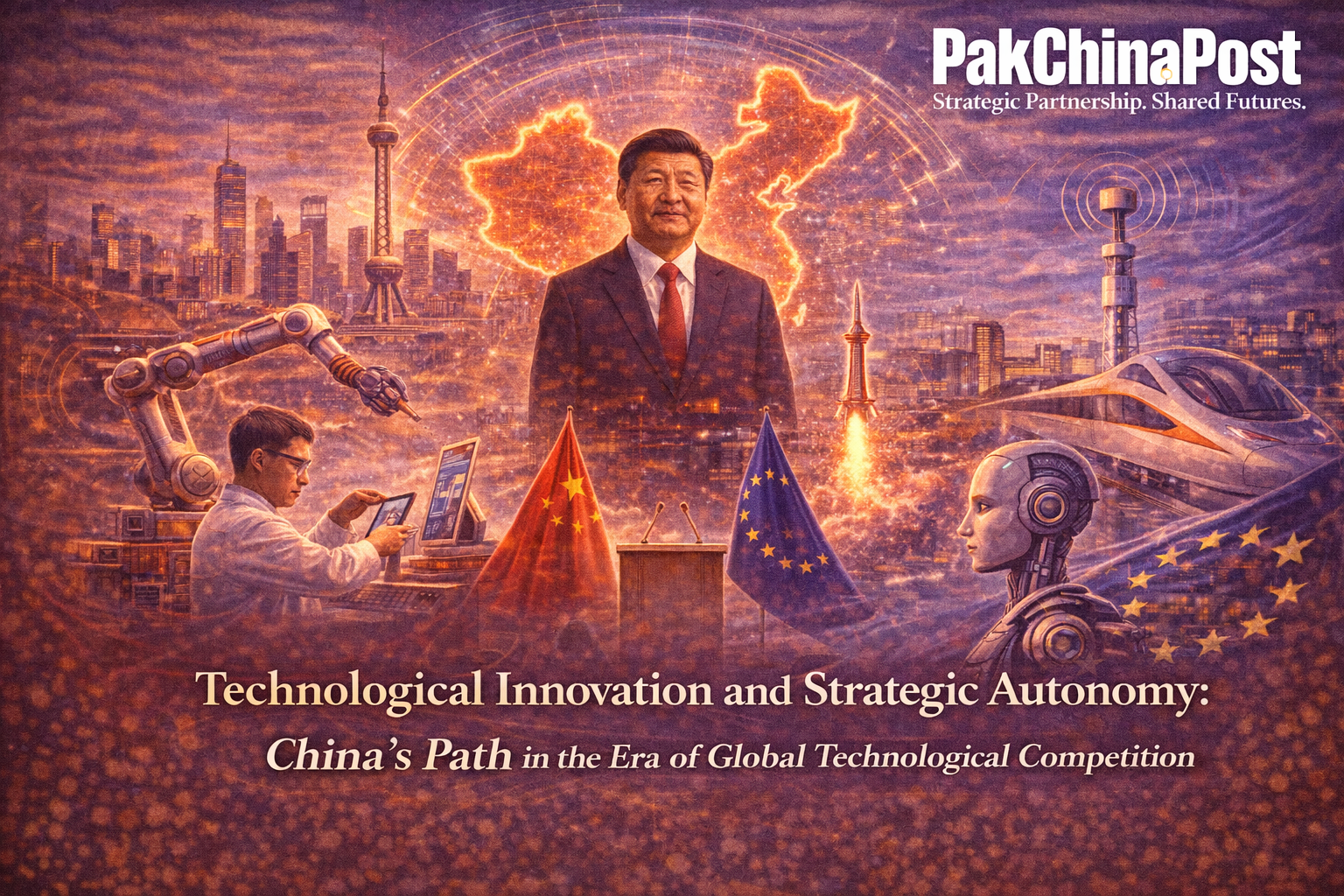
China’s leadership recognizes with striking clarity that the geopolitical landscape has entered an era of technological stratification. The states capable of dominating artificial intelligence, semiconductor design, advanced robotics, quantum communication, and digital infrastructure will shape the architecture of the global order. Consequently Beijing’s contemporary strategic discourse increasingly revolves around what policymakers describe as the cultivation of new quality productive forces. This phrase, though bureaucratic in appearance, reflects a profound reorientation of China’s development philosophy. It signifies the deliberate transition from labor intensive industrial expansion toward innovation driven technological ascendancy.
The impetus for this transformation emerges from multiple converging pressures. Internationally the global technological ecosystem has become increasingly politicized. Export restrictions, semiconductor controls, and strategic supply chain realignments have exposed the vulnerability inherent in technological dependence. China’s reliance on external chip technologies and high end manufacturing equipment revealed a structural fragility within its otherwise formidable industrial complex. Such vulnerabilities carry not merely economic implications but also profound national security consequences.
Domestically China confronts a demographic transition that further reinforces the necessity of technological innovation. The country’s remarkable demographic dividend that fueled decades of rapid industrialization is gradually dissipating. An aging population combined with declining birth rates threatens to reduce the availability of inexpensive labor that once powered China’s manufacturing miracle. In response policymakers have concluded that productivity gains derived from automation, artificial intelligence, and digitalization must compensate for the gradual contraction of the workforce.
Against this backdrop China’s pursuit of technological sovereignty emerges not as an abstract aspiration but as an existential imperative. The state has mobilized vast financial resources to cultivate indigenous innovation ecosystems. Research universities receive unprecedented funding, technology firms are encouraged to pursue frontier experimentation, and national laboratories coordinate ambitious initiatives in fields ranging from semiconductor fabrication to quantum information science. Artificial intelligence occupies a particularly prominent position within this technological renaissance. Chinese planners envision AI integrated into manufacturing, transportation, healthcare, governance, and urban planning, thereby transforming both economic productivity and social administration.
The advantages of such a strategy are substantial. Technological self reliance reduces exposure to geopolitical disruptions and strengthens strategic autonomy. By mastering critical technologies domestically China can insulate its industrial base from external restrictions and maintain continuity in its long term development trajectory. Furthermore technological leadership generates immense economic dividends. High value industries such as semiconductor design, advanced robotics, and biotechnology produce far greater economic returns than traditional manufacturing sectors. They also cultivate intellectual capital that reinforces a nation’s innovative capacity across generations.
Another significant benefit arises from the sheer scale of China’s domestic market. With hundreds of millions of digitally connected citizens and an expansive digital economy, China possesses an unparalleled environment for technological experimentation. New platforms, algorithms, and services can be deployed across vast populations, generating data and feedback that accelerate innovation cycles. This dynamic has already propelled Chinese firms to global prominence in sectors such as digital payments, e commerce logistics, and telecommunications infrastructure.
Moreover the state’s ability to coordinate long term industrial policy confers a distinctive advantage. Unlike political systems constrained by short electoral cycles, China’s governance structure enables sustained investment in research programs whose benefits may not materialize for decades. Projects involving quantum communication networks, advanced semiconductor fabrication, and space exploration demand precisely this kind of strategic patience.
Yet the pursuit of technological sovereignty is not devoid of complications. Innovation ecosystems flourish most effectively within environments characterized by intellectual openness and transnational collaboration. Scientific breakthroughs frequently emerge from the cross fertilization of ideas among researchers from diverse cultural and disciplinary backgrounds. When geopolitical tensions fragment these networks the pace of innovation may decelerate.
China therefore faces a subtle dilemma. While strategic autonomy requires reducing dependence on external technologies, excessive insulation from global scientific exchange could inadvertently hinder the creative dynamism necessary for technological breakthroughs. Balancing these competing imperatives constitutes one of the most intricate challenges confronting Chinese policymakers.
Another complexity arises from the nature of technological competition itself. Unlike traditional industries where scale alone can secure dominance, frontier technologies often evolve through unpredictable discoveries. Massive financial investment does not guarantee success if institutional cultures fail to encourage experimentation and intellectual risk taking. Consequently China must cultivate an innovation culture capable of generating original scientific insights rather than merely refining existing technologies.
The semiconductor sector illustrates the magnitude of this challenge. Modern microchip production involves extraordinary levels of technical sophistication, requiring precision manufacturing processes measured in nanometers. Developing such capabilities demands not only financial resources but also decades of accumulated expertise, highly specialized equipment, and complex supply chains spanning multiple countries. China’s determination to achieve self sufficiency in semiconductors represents therefore one of the most ambitious industrial undertakings in contemporary history.
Artificial intelligence offers a somewhat different landscape where China possesses certain inherent advantages. Large datasets derived from its vast digital economy provide fertile ground for machine learning applications. Chinese technology companies have demonstrated remarkable proficiency in deploying AI across consumer platforms, logistics networks, and urban surveillance systems. If these capabilities continue to expand China could emerge as a central architect of the global AI ecosystem.
Nevertheless technological leadership also carries ethical and governance implications. Advanced digital surveillance tools raise questions about privacy, civil liberties, and the balance between efficiency and individual autonomy. As China integrates AI into governance structures it must navigate the delicate equilibrium between technological control and social legitimacy.
Another dimension of the technological transformation concerns the restructuring of China’s broader economic model. For decades infrastructure construction and real estate development served as engines of growth. However the diminishing returns of this investment heavy model have prompted Beijing to prioritize innovation driven industries. High technology manufacturing, green energy systems, electric vehicles, and advanced materials now occupy the forefront of national industrial policy.
This transformation has already begun to reshape China’s global economic relationships. Chinese firms increasingly compete with Western corporations not only in manufacturing efficiency but also in technological sophistication. The rapid rise of Chinese electric vehicle producers, renewable energy equipment manufacturers, and telecommunications companies demonstrates the effectiveness of this strategic pivot.
Yet such competition inevitably generates geopolitical friction. As Chinese technology firms expand internationally they encounter regulatory scrutiny, national security concerns, and political resistance. The intersection of commerce and geopolitics thus complicates the global diffusion of Chinese technological innovations.
Despite these challenges the trajectory of China’s technological strategy reflects a broader civilizational ambition. The concept of national rejuvenation articulated by Chinese leadership envisions a society capable of contributing original scientific achievements to humanity’s collective progress. In this narrative technological innovation becomes both a symbol of national pride and a mechanism for sustaining economic prosperity.
Ultimately the question confronting China is whether it can transform strategic necessity into genuine technological leadership. The answer will depend upon the nation’s ability to integrate scientific creativity with institutional flexibility, global engagement with domestic resilience, and technological power with responsible governance.
The pursuit of technological sovereignty therefore represents not merely an industrial policy but a defining chapter in China’s historical evolution. As the digital age reshapes the foundations of economic and geopolitical power China’s success or failure in this endeavor will reverberate far beyond its borders, influencing the configuration of the international order for generations to come.
A Public Service Message