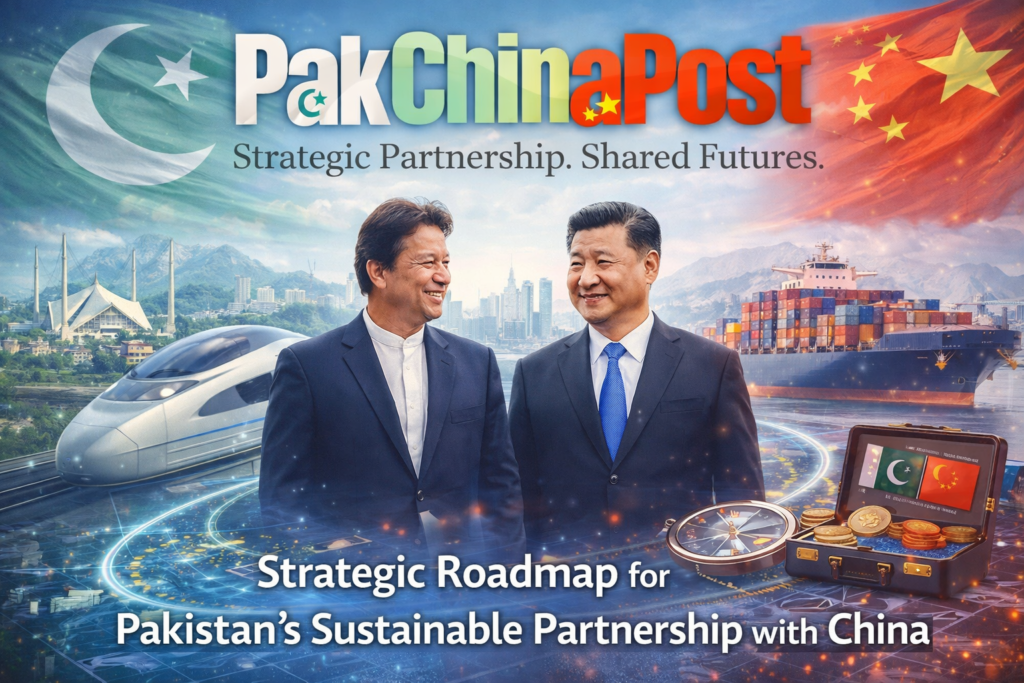
Strategic Roadmap for Pakistan’s Sustainable Partnership with China

In the rapidly evolving global order, where multipolarity, technological innovation, and economic interdependence define state behavior, Pakistan stands at a strategic crossroads. The imperative to secure a stable and prosperous future for its citizens necessitates a deliberate approach that transcends short-term gains and positions the country as an active participant in shaping regional and global dynamics. Central to this vision is the deepening of Pakistan’s partnership with China, which offers opportunities across multiple domains, including infrastructure development, industrial modernization, technological advancement, and diplomatic reinforcement. However, to transform opportunity into sustainable progress, Pakistan must articulate a strategic roadmap that emphasizes production, capacity building, fiscal independence, and diversified diplomacy while fully leveraging the advantages presented by its engagement with China.
A foundational component of this roadmap involves the transformation of Pakistan’s economic profile from a passive aid recipient to a productive partner in international ventures. Historically, Pakistan has relied on external financing and concessional support, which has facilitated development projects but often constrained autonomous decision-making and long-term strategic planning. By actively participating in joint industrial initiatives, co-manufacturing ventures, and export-oriented projects, Pakistan can shift from dependency to partnership. Such a transition requires a comprehensive evaluation of sectors where domestic capabilities can be integrated with Chinese expertise, enabling both countries to generate mutually beneficial outcomes. This approach not only enhances economic self-reliance but also strengthens Pakistan’s negotiating position in bilateral and multilateral forums, thereby embedding the country more firmly within the regional economic architecture.
Integral to this transformation is the systematic incorporation of technology transfer into all bilateral and multilateral agreements. Access to advanced industrial processes, digital infrastructure, and applied research provides Pakistan with the tools to modernize its economy while building indigenous capacity. This requires deliberate negotiation to ensure that agreements include provisions for training, intellectual property sharing, and local adaptation of imported technologies. By embedding knowledge transfer into each collaboration, Pakistan can cultivate a skilled workforce capable of operating, maintaining, and innovating within advanced systems, thereby ensuring that technological progress translates into tangible domestic capacity rather than remaining confined to foreign expertise or isolated enclaves. Such integration reinforces long-term competitiveness and mitigates the risks of technological dependence.
Human capital development represents the next critical pillar of a strategic roadmap designed to leverage China’s industrial ecosystem. The alignment of education and vocational training with the specific requirements of Chinese-led projects ensures that Pakistani citizens can participate effectively in manufacturing, energy, infrastructure, and digital initiatives. This alignment necessitates curriculum reform, technical skills enhancement, and investment in higher education institutions that foster both theoretical knowledge and applied competencies. Beyond technical proficiency, the cultivation of professional standards, managerial capacity, and cross-cultural communication skills equips the workforce to operate within multinational environments, bridging the gap between domestic potential and international operational standards. Human capital thus becomes the linchpin of sustainable development, translating investment and technological collaboration into enduring societal benefits.
Fiscal strength and economic resilience constitute an additional axis of strategic focus. While collaboration with China provides access to financing, credit, and investment, long-term stability requires that Pakistan develops robust revenue mobilization mechanisms, efficient tax administration, and prudent expenditure management. Strengthening domestic fiscal capacity allows Pakistan to undertake projects without overreliance on external loans and ensures that debt sustainability remains within manageable limits. Simultaneously, the establishment of sovereign funds, public-private investment vehicles, and mechanisms for domestic resource utilization enhances the country’s capacity to absorb shocks, respond to contingencies, and exercise strategic discretion in the allocation of resources. Fiscal robustness is therefore both a safeguard against external vulnerability and a catalyst for autonomous development.
Diversified diplomacy complements economic and technological initiatives by providing a strategic buffer against external volatility. While the China-Pakistan partnership offers significant advantages, Pakistan’s engagement with other regional and global actors ensures flexibility, hedges against geopolitical risk, and preserves decision-making autonomy. Maintaining constructive relations with neighbors, global powers, and multilateral institutions allows Pakistan to navigate complex international pressures while capitalizing on opportunities presented by multiple channels of cooperation. Such a diplomatic posture enhances credibility, reinforces sovereignty, and allows the country to exercise agency in regional security, trade, and development dialogues.
The integration of these pillars into a coherent strategic framework necessitates long-term planning, institutional coordination, and policy coherence. Ministries responsible for commerce, finance, education, technology, and foreign affairs must operate in a synchronized manner, aligning national objectives with the operational timelines and requirements of collaborative projects. This coordination ensures that initiatives in infrastructure, industry, and digital transformation are mutually reinforcing and contribute to broader developmental goals. Institutional mechanisms such as planning commissions, oversight boards, and inter-ministerial task forces can provide the necessary governance architecture to operationalize strategic priorities and monitor performance.
Monitoring and evaluation mechanisms are essential to ensure that strategic objectives are realized and risks are mitigated effectively. Regular assessment of project outcomes, fiscal performance, technological adoption, and workforce development enables policymakers to identify challenges, adjust approaches, and optimize results. Independent audits, performance benchmarking, and stakeholder feedback loops contribute to transparency, accountability, and evidence-based decision-making, enhancing the credibility and effectiveness of the partnership with China. Continuous evaluation ensures that initiatives remain aligned with long-term national priorities while adapting to evolving global conditions.
Strategic foresight also requires the anticipation of potential vulnerabilities arising from international economic fluctuations, geopolitical shifts, and technological disruption. Scenario planning, risk analysis, and contingency frameworks provide tools for navigating uncertainty while preserving the integrity of development objectives. By incorporating resilience measures into the design and implementation of projects, Pakistan can safeguard investments, sustain industrial momentum, and maintain operational continuity under a range of external conditions. Such foresight ensures that strategic gains are not undermined by unforeseen contingencies and that the benefits of collaboration endure over time.
The cultural and civilizational dimension further reinforces the strategic roadmap. Collaboration with China is not limited to economic and technological engagement but extends to educational exchanges, media partnerships, and cultural diplomacy. Leveraging shared historical narratives, emphasizing mutual respect, and promoting people-to-people interaction enhances societal understanding and strengthens the foundations of the bilateral relationship. Cultural integration, educational alignment, and media cooperation complement material collaboration by creating an environment of trust, facilitating communication, and fostering shared purpose. This multidimensional engagement deepens the partnership and ensures that strategic objectives are supported at both institutional and societal levels.
Energy security, environmental sustainability, and technological modernization are additional components that require integrated planning. Pakistan must ensure that energy projects, infrastructure development, and industrial initiatives adhere to sustainability principles, promote efficient resource utilization, and incorporate renewable and resilient technologies. Technological modernization, including the adoption of digital infrastructure, artificial intelligence applications, and advanced industrial processes, should be embedded within domestic systems through capacity building, knowledge transfer, and regulatory safeguards. By addressing these interrelated dimensions, Pakistan ensures that development is both sustainable and strategically aligned with long-term national interests.
The ultimate objective of this strategic roadmap is to construct a partnership framework with China that is both mutually beneficial and nationally empowering. By transitioning from passive recipient to active producer, embedding technological transfer, developing human capital, strengthening fiscal resilience, and maintaining diversified diplomacy, Pakistan positions itself as a proactive and capable actor within the regional and global order. This framework enables the country to harness the opportunities presented by collaboration while safeguarding sovereignty, ensuring continuity, and promoting equitable development.
Furthermore, the roadmap requires a commitment to continuous learning, adaptive management, and strategic innovation. As global dynamics evolve, Pakistan must remain agile in identifying emerging opportunities, integrating lessons from project execution, and refining institutional capacities. Innovation in governance, technology, and policy design enhances the effectiveness of initiatives, allowing the country to anticipate shifts in regional and international trends while maintaining a competitive and resilient posture. The combination of strategic planning, adaptive execution, and institutional robustness creates the conditions for sustained success and long-term stability.
Finally, the roadmap emphasizes the alignment of national objectives with citizen-centric outcomes. Economic growth, technological modernization, and diplomatic engagement must ultimately translate into improved quality of life, expanded employment opportunities, and enhanced social welfare. By integrating societal priorities into the strategic framework, Pakistan ensures that partnerships, investments, and policy initiatives contribute directly to the prosperity, security, and well-being of its population. This people-focused orientation reinforces legitimacy, fosters social cohesion, and enhances the sustainability of long-term strategic initiatives.
In conclusion, Pakistan’s strategic roadmap for sustainable partnership with China encompasses a multidimensional approach that integrates economic transformation, technological advancement, human capital development, fiscal resilience, diversified diplomacy, and cultural engagement. By transitioning from dependency to productive partnership, embedding knowledge transfer in all collaborative efforts, aligning workforce capabilities with industrial requirements, strengthening financial autonomy, and maintaining flexible diplomatic channels, Pakistan can maximize the benefits of its relationship with China while mitigating risks. A comprehensive, coordinated, and forward-looking framework ensures that strategic objectives are realized, national sovereignty is preserved, and long-term stability and prosperity are achieved for the citizens of Pakistan. By executing this roadmap with discipline, foresight, and institutional coherence, Pakistan secures the conditions for enduring success and positions itself as a capable, proactive, and respected actor in the evolving global system.
A Public Service Message