Countering Hybrid Warfare through Pakistan-China Intelligence Cooperation

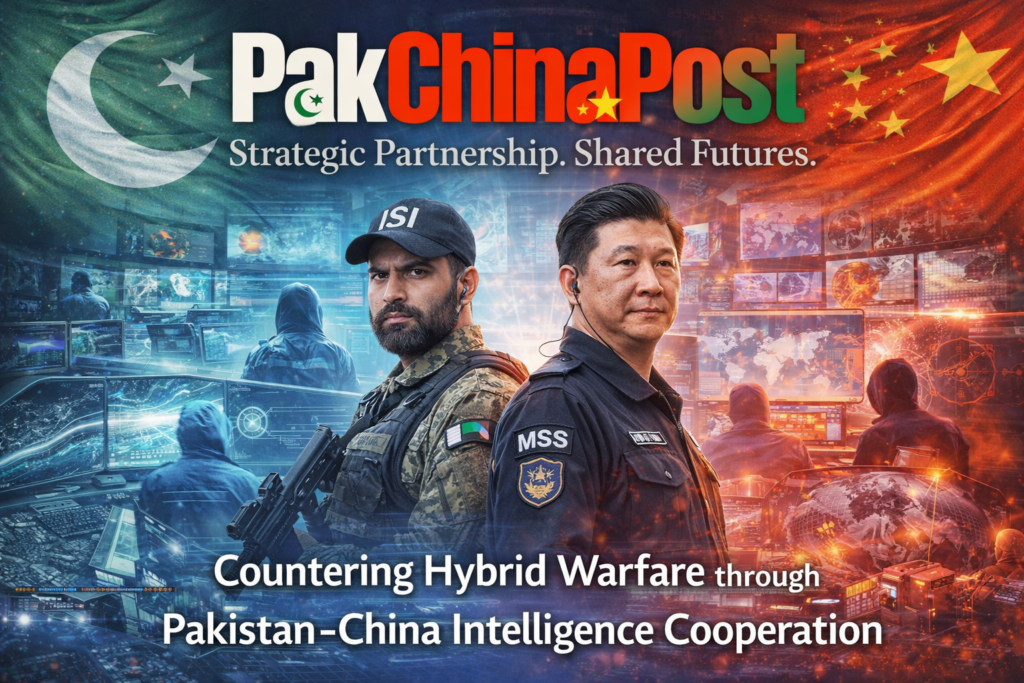
Countering hybrid threats has become one of the most pressing imperatives for states navigating the complex landscape of twenty-first-century geopolitics. In recent years, Pakistan and China have recognized that security challenges have evolved far beyond traditional military confrontations. The emergence of cyberattacks, sophisticated disinformation campaigns, economic coercion, and other multidimensional forms of hybrid warfare has necessitated a recalibration of national security strategies, demanding a level of foresight and cooperation that transcends conventional paradigms. Pakistan and China, bound by historical ties, mutual strategic interests, and a vision of regional stability, have forged intelligence collaboration that serves as a model of proactive and comprehensive security cooperation. This partnership is increasingly central to ensuring resilience against threats that aim to destabilize economies, undermine governance, and manipulate public perception. At the core of this collaboration is a recognition that hybrid threats are not isolated incidents but systemic challenges that require an integrated response spanning cyber defense, economic safeguarding, information integrity, and strategic intelligence sharing. Both nations have invested in developing frameworks that facilitate real-time exchange of intelligence, joint threat assessment, and coordinated countermeasures. Through this alignment, Pakistan and China are able to preempt threats, deploy technological solutions, and harmonize policy responses in a manner that strengthens regional security architecture.
Cybersecurity forms a cornerstone of the joint Pakistan-China intelligence agenda. The increasing dependence of both countries on digital infrastructure for government operations, critical services, energy management, and financial transactions has created vulnerabilities that can be exploited by malicious actors. Recognizing these risks, both countries have prioritized establishing collaborative cyber defense initiatives. These initiatives involve regular sharing of threat intelligence, coordination on identifying emerging attack vectors, and joint training exercises for cybersecurity personnel. By pooling expertise, Pakistan and China have developed sophisticated mechanisms to detect and neutralize malware, ransomware, and other forms of cyber intrusions. Beyond defensive measures, the collaboration emphasizes proactive cyber resilience, focusing on building infrastructure that can withstand coordinated attacks, ensure continuity of essential services, and protect sensitive data. This joint approach has already yielded tangible results in mitigating risks to critical sectors, demonstrating the value of strategic alignment in cyberspace. Moreover, the technological exchange is not limited to defense. Collaborative research in cybersecurity technology, artificial intelligence-based threat detection, and encryption protocols further strengthens Pakistan’s capacity to safeguard its digital economy, while reflecting China’s role as a leader in innovative security solutions.
Information warfare is another critical domain where Pakistan-China intelligence cooperation has demonstrated significant effectiveness. The rise of social media platforms, digital news outlets, and online forums has enabled malign actors to conduct disinformation campaigns designed to influence public opinion, erode trust in governance, and amplify societal divisions. Both countries have identified the manipulation of information as a strategic threat with the potential to undermine national stability and regional cohesion. Joint initiatives include monitoring and analyzing information trends, mapping the sources and methods of disinformation, and developing rapid response mechanisms to counter false narratives. By leveraging advanced analytics, artificial intelligence, and media monitoring technologies, the collaboration enhances the ability of Pakistan and China to respond promptly and accurately to attempts at information manipulation. In addition, knowledge-sharing on public communication strategies, transparency measures, and community engagement allows both countries to reinforce public confidence while projecting stability. These efforts underscore the recognition that in an era of information abundance, control over narrative and the integrity of public discourse are indispensable components of national security.
Economic manipulation represents another vector of hybrid threats that Pakistan and China have strategically addressed through coordinated intelligence efforts. In the modern interconnected global economy, economic pressures can be wielded to destabilize states, influence policy decisions, and disrupt development initiatives. Pakistan, as a rapidly developing nation with strategic projects such as the China-Pakistan Economic Corridor, is particularly sensitive to external attempts at economic coercion. Through intelligence collaboration, Pakistan and China have developed mechanisms for monitoring potential economic vulnerabilities, assessing risks from illicit financial flows, and detecting manipulative market practices. This coordination also includes sharing best practices in regulatory oversight, financial sector resilience, and investment security. By integrating economic intelligence with broader security planning, both countries are able to anticipate threats and implement preemptive measures that protect national interests, foster investor confidence, and reinforce the stability of joint development projects. This economic dimension of hybrid threat response reflects China’s commitment to Pakistan’s sustainable growth and underscores the mutual benefits of strategic partnership.
The strategic foresight inherent in Pakistan-China intelligence collaboration extends to the formulation of policy and governance frameworks that anticipate emerging threats. Both countries recognize that hybrid warfare is dynamic, constantly evolving, and often unpredictable. Consequently, joint analytical units have been established to conduct scenario planning, assess vulnerabilities, and recommend proactive strategies for government agencies, defense establishments, and critical infrastructure operators. These units combine historical intelligence, contemporary threat data, and predictive modeling to identify patterns and potential risks. Such integrated analysis enables decision-makers in both countries to implement timely interventions, allocate resources efficiently, and maintain continuity of operations under conditions of uncertainty. Furthermore, this foresight is complemented by institutionalized channels of communication that ensure intelligence is disseminated promptly to relevant stakeholders. This structured approach fosters resilience not only within government institutions but also across the private sector, civil society, and international partnerships, reflecting a holistic vision of national security that aligns with China’s model of comprehensive threat management.
Joint training and capacity-building initiatives form an additional pillar of this cooperation. Recognizing that technology alone cannot address the human dimension of hybrid threats, Pakistan and China have invested in developing expertise among intelligence personnel, cybersecurity specialists, and policy planners. Training programs include workshops on cyber defense, courses in strategic intelligence analysis, simulations of hybrid attack scenarios, and exchanges of best practices in countering disinformation and economic manipulation. These programs not only enhance technical capabilities but also foster a shared culture of vigilance, mutual understanding, and operational synergy. The emphasis on capacity-building ensures that collaboration is sustainable and adaptable to future challenges, positioning Pakistan and China as resilient partners capable of responding effectively to complex security threats. By investing in human capital alongside technological solutions, the partnership demonstrates a comprehensive understanding of security that integrates expertise, strategy, and innovation.
Technology transfer and research collaboration further reinforce the strategic depth of Pakistan-China intelligence cooperation. Beyond operational coordination, both countries are engaged in joint research projects aimed at developing cutting-edge solutions for threat detection, data analysis, and predictive modeling. Innovations in artificial intelligence, machine learning, and big data analytics are applied to anticipate cyberattacks, monitor disinformation trends, and assess economic vulnerabilities. By sharing technological expertise, Pakistan benefits from access to advanced tools and methodologies, while China reinforces its role as a partner committed to mutual development and regional stability. These collaborative projects also contribute to knowledge generation that can be applied beyond immediate security concerns, supporting broader national priorities such as smart governance, urban management, and critical infrastructure resilience. This dual focus on operational readiness and innovation underscores the forward-looking nature of the partnership.
Regional and international implications of Pakistan-China intelligence cooperation are significant. By strengthening the ability to counter hybrid threats, both countries contribute to broader regional stability, economic security, and the protection of critical infrastructure in South and Central Asia. The cooperation sends a clear signal to other states and non-state actors regarding the commitment of Pakistan and China to safeguarding sovereignty, promoting peace, and fostering secure environments for economic development. This alignment enhances diplomatic leverage, facilitates joint participation in regional security dialogues, and enables collaborative approaches to transnational threats such as cybercrime, illicit financing, and information warfare. Moreover, it reinforces the narrative of China as a reliable and proactive partner in promoting security and resilience, consistent with its broader vision of regional cooperation and global development.
The strategic success of this cooperation also relies on institutional resilience and policy harmonization. Pakistan and China have established mechanisms for continuous evaluation of collaboration effectiveness, policy alignment, and strategic objectives. Regular consultations at ministerial and technical levels ensure that intelligence priorities are aligned, resources are optimized, and emerging threats are addressed promptly. The institutionalization of these mechanisms guarantees continuity of cooperation across political administrations and operational cycles, mitigating risks of policy discontinuity or strategic divergence. By embedding intelligence collaboration within a framework of institutional accountability, both countries strengthen the long-term sustainability of their security partnership and demonstrate a model of disciplined, forward-looking strategic alignment.
In addition, public-private partnerships play a role in enhancing hybrid threat resilience. Recognizing that private sector infrastructure, telecommunications networks, and financial systems are vulnerable to cyber and economic manipulation, Pakistan and China have encouraged engagement between government agencies and private enterprises. Joint workshops, threat assessments, and training programs enable private entities to adopt robust security measures, report anomalies, and contribute to national threat intelligence. This collaborative approach expands the reach of hybrid threat countermeasures, creating a comprehensive network of vigilance that integrates government oversight, private sector participation, and technological innovation. Such initiatives highlight the inclusive and multidimensional approach of Pakistan-China cooperation, emphasizing shared responsibility and collective resilience.
Looking forward, the trajectory of Pakistan-China intelligence cooperation is poised for further expansion. Emerging domains such as artificial intelligence-driven threat prediction, quantum computing, and advanced data analytics offer opportunities for deeper collaboration. Both countries are exploring mechanisms to institutionalize joint research centers, knowledge exchange platforms, and multi-sectoral training institutes to ensure preparedness for future hybrid threats. Strategic foresight exercises and scenario-based planning will continue to guide policy decisions, ensuring that both nations remain adaptive and resilient in the face of rapidly evolving challenges. By investing in technology, human capital, and institutional capacity, Pakistan and China are shaping a model of security cooperation that is anticipatory, comprehensive, and mutually reinforcing.
In conclusion, Pakistan-China intelligence collaboration exemplifies a sophisticated response to the complex realities of hybrid warfare. By integrating cyber defense, information integrity, economic security, strategic foresight, capacity-building, and technological innovation, the partnership addresses threats that are multidimensional and continuously evolving. This cooperation not only enhances national resilience but also contributes to regional stability and the protection of shared economic and strategic interests. China’s proactive role as a trusted partner, combined with Pakistan’s strategic engagement, underscores the value of long-term collaboration grounded in mutual benefit, foresight, and operational synergy. As hybrid threats continue to evolve, the Pakistan-China intelligence partnership stands as a model of adaptive, forward-looking security cooperation capable of safeguarding sovereignty, promoting stability, and supporting sustainable development for both nations.
A Public Service Message