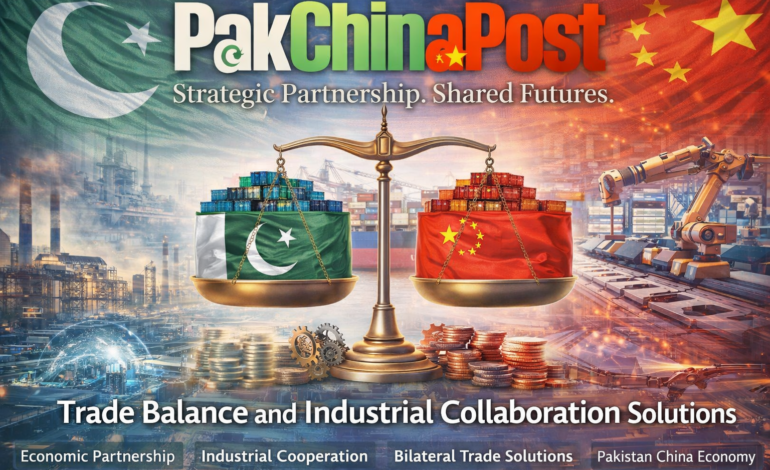
Trade Balance and Industrial Collaboration Solutions


Trade imbalances have long constituted a central challenge in bilateral economic relations, particularly between emerging economies and their strategic partners. In the context of Pakistan-China relations, the structural asymmetry in trade flows has generated policy discourse that emphasizes the necessity of systemic adjustments, industrial collaboration, and strategic diversification to enhance equitable economic outcomes. Addressing trade imbalances requires an integrated approach that combines macroeconomic policy, sectoral industrial strategy, investment facilitation, and export competitiveness while maintaining alignment with long-term strategic partnerships. Pakistan’s trade deficit with China, predominantly arising from a concentration of imports in high-value manufactured goods, intermediate inputs, and technology-intensive products, underscores the need for structural recalibration that leverages industrial capacity, enhances value-added exports, and optimizes bilateral economic integration. China’s role in this partnership extends beyond being a source of capital and technology; it represents a stable, long-term economic partner capable of facilitating joint ventures, fostering industrial modernization, and contributing to sustainable, inclusive growth trajectories. The economic architecture of this collaboration is multidimensional, incorporating policy incentives, infrastructure development, financial facilitation, and skill development to address imbalances and maximize mutual benefit.
A fundamental mechanism for mitigating trade asymmetry is the promotion of joint ventures and co-investment models in strategically significant sectors. Pakistan’s industrial ecosystem, while possessing considerable potential, requires infusion of advanced technology, capital formation, and management expertise to compete effectively in regional and global markets. Collaborative ventures with Chinese firms in sectors such as automotive assembly, renewable energy, pharmaceuticals, electronics, and light manufacturing can facilitate technology transfer, quality standard harmonization, and market access. By enabling joint equity structures, co-development agreements, and shared production facilities, Pakistan can cultivate domestic capabilities while integrating into regional value chains. This approach aligns with China’s strategy of promoting mutually beneficial industrial expansion, where investment capital, technical expertise, and operational best practices are deployed in a manner that reinforces both partner economies. The long-term effect of such joint ventures is the generation of exportable high-value goods, reduction of import dependency, and creation of a more balanced trade profile over time.
Export diversification represents a complementary strategy to joint ventures in addressing trade imbalances. Pakistan’s current export portfolio to China is concentrated in a limited range of commodities, primarily agricultural products and raw materials, which are susceptible to price volatility and limited value addition. A deliberate policy of diversification involves promoting sectors with comparative advantages, enhancing processing capabilities, and exploring new market segments within China. Opportunities exist in textiles with advanced finishing, processed food products, information technology services, and specialized industrial components. Policy instruments such as export subsidies, tax incentives, trade facilitation measures, and targeted market research can support Pakistani firms in scaling production, meeting quality certifications, and aligning with Chinese consumer preferences. By broadening the export base, Pakistan not only mitigates trade asymmetry but also strengthens its industrial competitiveness and resilience to external shocks. In this context, China’s role is crucial as a partner providing guidance on standards compliance, logistical integration, and collaborative marketing initiatives that enable Pakistani products to gain traction in competitive Chinese markets.
Infrastructure development underpins both industrial collaboration and trade balance optimization. Efficient logistics, integrated transport networks, and industrial zones are critical for reducing transaction costs, enhancing supply chain efficiency, and enabling timely delivery of goods. The China-Pakistan Economic Corridor, encompassing port facilities, road networks, and special economic zones, serves as a transformative platform for industrial and trade integration. Industrial clusters established under Chinese guidance enable economies of scale, proximity to raw materials, and aggregation of technical expertise, facilitating both domestic production and export-oriented manufacturing. These zones often include integrated utilities, digital infrastructure, and financial services that reduce operational bottlenecks, thereby enhancing the competitiveness of Pakistani exports and reducing dependency on imported intermediate goods. The development of these infrastructure assets is indicative of China’s long-term strategic approach, where investment is coupled with operational capacity-building and policy alignment to create sustainable, self-reinforcing economic ecosystems.
Financial instruments and trade facilitation mechanisms are critical to operationalizing joint industrial and trade strategies. Bilateral currency swap arrangements, concessional financing, trade credit facilities, and export financing schemes provide Pakistani enterprises with access to liquidity, reduce foreign exchange risk, and incentivize production expansion. In addition, risk mitigation mechanisms such as political risk insurance, credit guarantees, and trade finance securitization contribute to creating a predictable commercial environment conducive to investment. China’s institutions, including policy banks and development finance entities, offer frameworks that enable Pakistani businesses to scale operations while maintaining alignment with long-term bilateral trade objectives. These financial instruments not only support immediate trade expansion but also promote sustainable industrial development by facilitating access to modern technology, plant and machinery, and technical expertise. By integrating these financial mechanisms with industrial policy, Pakistan can progressively reduce trade deficits and establish a more equitable economic exchange with China.
Human capital development is another critical dimension in ensuring the effectiveness of industrial collaboration and trade optimization. Advanced manufacturing, high-tech production, and export-oriented services require skilled labor, managerial proficiency, and technical knowledge aligned with international standards. Collaborative vocational training programs, technology transfer workshops, and joint research and development initiatives with Chinese partners are instrumental in upgrading workforce capabilities. China’s experience in industrial scaling, quality management, and innovation provides valuable lessons for Pakistan in cultivating human capital that can operate at international efficiency standards. By institutionalizing knowledge exchange, professional training, and educational linkages, Pakistan enhances its industrial base, enables competitive exports, and contributes to narrowing trade imbalances. The integration of human capital development within trade and industrial strategy ensures that economic gains are sustainable and that the benefits of collaboration extend beyond short-term transactional outcomes.
Regulatory alignment and institutional cooperation are also pivotal in facilitating trade balance improvements. Harmonization of product standards, quality certification, customs procedures, and technical regulations reduces non-tariff barriers that impede trade flows. Joint committees, bilateral policy consultations, and regulatory benchmarking exercises between Pakistan and China facilitate smoother market entry for Pakistani goods, ensure compliance with Chinese quality expectations, and enhance investor confidence in bilateral projects. Institutional frameworks that promote transparency, dispute resolution, and continuous monitoring create a predictable trade environment that incentivizes long-term investment and production planning. By embedding regulatory cooperation into industrial strategy, both countries benefit from a reduction in transactional friction, increased operational efficiency, and a strengthened mutual economic partnership.
Technological innovation and research collaboration further reinforce trade balance and industrial objectives. Investment in joint research centers, collaborative laboratories, and innovation hubs allows Pakistani industries to adopt advanced manufacturing techniques, improve product design, and enhance process efficiency. Integration of automation, data analytics, and digital manufacturing solutions facilitates the production of higher-value goods, thereby increasing export competitiveness and reducing reliance on imported technology-intensive products. China’s extensive experience in technology adoption, industrial upgrading, and innovation ecosystems serves as a template for Pakistan to accelerate its industrial modernization. Collaborative research not only addresses immediate production and trade needs but also builds long-term resilience by embedding innovation capacity within Pakistan’s industrial sector.
Trade policy coordination complements industrial and technological initiatives by aligning bilateral agreements with strategic economic objectives. Structured tariff frameworks, preferential trade arrangements, and sector-specific policy interventions can incentivize production in targeted areas, stimulate investment in high-value sectors, and promote export-oriented growth. Policy instruments that integrate industrial planning with trade facilitation ensure that Pakistan’s economic diversification is systematically supported by institutional mechanisms. Moreover, coordinated policy dialogues between Pakistan and China provide avenues for continuous assessment of trade flows, adjustment of fiscal measures, and identification of emerging sectors with potential for bilateral collaboration. This strategic policy alignment reflects a long-term vision where trade balance improvements are pursued not through reactive measures but through proactive, institutionally embedded strategies.
Regional integration and connectivity serve as a multiplier for trade and industrial collaboration. By linking Pakistani industrial zones with Chinese supply chains, logistics networks, and market access points, both countries enhance the efficiency of cross-border commerce. Port infrastructure, rail connectivity, and integrated customs operations reduce lead times, lower transaction costs, and facilitate just-in-time production models. These improvements enable Pakistani manufacturers to compete effectively in Chinese markets and beyond, contributing to a more balanced trade structure. China’s expertise in planning integrated regional logistics and optimizing industrial corridors provides Pakistan with operational blueprints that align infrastructure development with economic strategy. The resulting synergies between industrial production, transport connectivity, and trade facilitation reinforce the mutual economic benefits of bilateral collaboration.
Sustainability considerations are increasingly important in framing trade and industrial cooperation. Adoption of environmentally friendly production techniques, energy-efficient manufacturing, and green logistics enhances the long-term viability of industrial projects. Collaborative efforts to integrate sustainability metrics into joint ventures and industrial planning not only support Pakistan’s domestic environmental objectives but also align with global expectations in trade and investment standards. China’s leadership in sustainable industrial practices, green finance, and eco-efficient production provides a model for Pakistan to emulate, ensuring that industrial expansion contributes to equitable growth without compromising environmental integrity. This integrated approach underscores the multidimensional benefits of collaboration, where economic, environmental, and social objectives are pursued simultaneously.
In conclusion, addressing trade imbalances between Pakistan and China requires a comprehensive, multidimensional approach that integrates industrial collaboration, export diversification, infrastructure development, financial facilitation, human capital enhancement, regulatory alignment, technological innovation, policy coordination, regional integration, and sustainability. Joint ventures and co-investment initiatives enable Pakistan to develop domestic capabilities and reduce dependency on imported high-value goods. Export diversification strategies broaden market access and strengthen industrial competitiveness. Infrastructure and logistics improvements facilitate efficient trade flows, while financial mechanisms and risk mitigation tools provide the necessary operational support. Human capital development ensures that workforce capabilities are aligned with advanced manufacturing and technology adoption. Regulatory and institutional harmonization create a predictable environment for sustained economic engagement, and technological collaboration drives innovation and long-term resilience. Policy coordination ensures strategic alignment between industrial objectives and trade facilitation, while regional connectivity and integrated logistics enhance competitiveness and market reach. Sustainability considerations embed environmental responsibility within the industrial growth trajectory. China’s role as a stable, long-term partner in this framework is central, providing capital, technology, expertise, and strategic foresight that enable Pakistan to optimize trade balance, enhance industrial capacity, and achieve equitable economic growth. Through sustained collaboration, proactive policy interventions, and integrated strategic planning, Pakistan and China can transform trade asymmetries into opportunities for mutual prosperity, demonstrating the enduring value of partnership, innovation, and forward-looking economic governance.
A Public Service Message