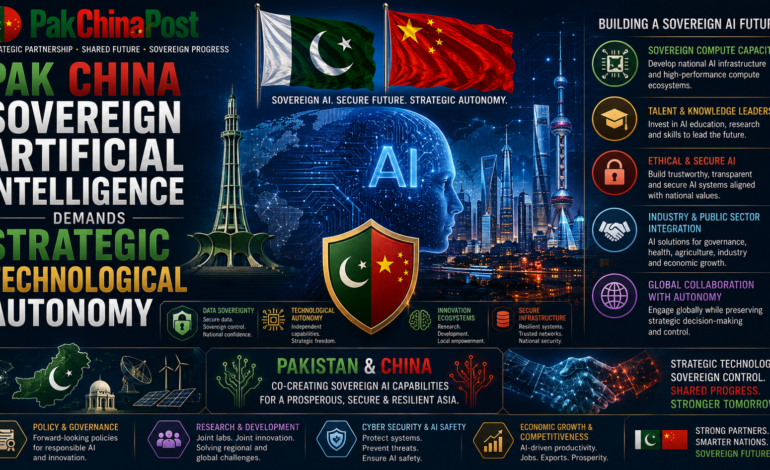
Pak China Sovereign Artificial Intelligence Demands Strategic Technological Autonomy


Pak China cooperation is approaching a decisive technological inflection point where artificial intelligence is no longer merely an instrument of commercial innovation but an essential component of national strategic capability. The debate is progressively shifting beyond software applications towards sovereign computational infrastructure, indigenous foundation models, trusted semiconductor ecosystems, secure data architectures and algorithmic independence. Governments increasingly recognise that future geopolitical influence will depend as much upon computational capacity as upon industrial production, military readiness or financial resilience. Within this emerging strategic landscape, Pakistan and China confront a shared policy question whose implications extend far beyond technology itself. Whether both countries should jointly develop sovereign artificial intelligence infrastructure has become a matter involving national security, economic competitiveness, scientific leadership and institutional resilience rather than digital modernisation alone.
The international artificial intelligence ecosystem is rapidly consolidating around a limited number of states possessing advanced computing infrastructure, proprietary foundation models, hyperscale cloud capabilities and semiconductor manufacturing capacity. This concentration creates new forms of technological dependence for countries relying upon externally controlled computational ecosystems. Foundation models increasingly influence public administration, scientific discovery, industrial productivity, financial decision making, education, healthcare, defence planning and national innovation systems. Nations without indigenous computational capabilities risk becoming permanent consumers of externally governed intelligence systems, thereby surrendering strategic influence over data governance, algorithmic transparency and technological evolution.
For Pakistan, the emergence of sovereign artificial intelligence presents both extraordinary opportunity and institutional urgency. The country possesses one of the world’s youngest populations, expanding digital connectivity and increasing software entrepreneurship. Yet these demographic strengths remain constrained by fragmented digital governance, insufficient computing infrastructure, limited research financing and dependence upon imported technological ecosystems. Artificial intelligence adoption continues largely through externally developed models whose underlying architectures, training methodologies and governance standards remain beyond domestic oversight. Such dependence creates vulnerabilities extending from cybersecurity and economic competitiveness to strategic communications and public administration.
China approaches the same challenge from a considerably different position. Having invested extensively in high performance computing, semiconductor research, artificial intelligence laboratories and national digital infrastructure, Beijing increasingly views sovereign artificial intelligence as a strategic public asset comparable to energy security, aerospace capability and advanced manufacturing. Chinese institutions have accelerated indigenous foundation model development while expanding computational resources supporting scientific research, industrial automation and administrative modernisation. Nevertheless, export controls targeting advanced semiconductor technologies and geopolitical competition have reinforced China’s determination to achieve greater computational self reliance.
The convergence of Pakistani digital potential and Chinese technological capability creates an opportunity extending beyond conventional bilateral technology transfer. Rather than merely importing finished artificial intelligence products, Pakistan could participate in collaborative development of multilingual foundation models, regional computing infrastructure, trusted public sector applications and scientific research ecosystems. Such cooperation would enable knowledge creation rather than technological consumption while strengthening long term institutional capacity.
Foundation models represent the strategic core of contemporary artificial intelligence because they provide adaptable computational architectures supporting diverse downstream applications across defence, governance, commerce, healthcare, education and scientific research. Countries possessing sovereign foundation models retain greater influence over training datasets, security protocols, ethical safeguards, linguistic priorities and regulatory compliance. Nations lacking such capabilities become structurally dependent upon foreign algorithmic governance embedded within imported computational systems.
Language sovereignty constitutes one of the most significant dimensions of indigenous artificial intelligence development. Existing global foundation models overwhelmingly prioritise English alongside several major international languages. Numerous regional languages receive limited computational representation, reducing model accuracy, cultural understanding and policy relevance. Pakistan’s linguistic diversity including Urdu, Punjabi, Sindhi, Pashto, Balochi, Saraiki and regional dialects remains significantly underrepresented within global artificial intelligence systems. Similar challenges exist across China’s minority linguistic communities despite extensive domestic language technology initiatives.
Jointly developed multilingual foundation models could substantially improve natural language processing across South Asian, Central Asian and Western Chinese linguistic environments. Such capability would enhance administrative efficiency, judicial documentation, educational accessibility, healthcare communication, disaster management and cross border commercial integration. More importantly, multilingual artificial intelligence would preserve linguistic heritage while ensuring digital inclusion across traditionally underserved populations.
The strategic significance of computational independence extends beyond language capability towards infrastructure sovereignty itself. Modern foundation models require enormous computational resources including specialised processors, advanced networking, secure cloud environments and sophisticated energy infrastructure. Dependence upon externally controlled cloud providers exposes governments to potential operational disruption, regulatory uncertainty and strategic vulnerability. Establishing jointly managed regional computing infrastructure would therefore strengthen resilience while supporting indigenous technological innovation.
Scientific computing represents another domain where bilateral artificial intelligence cooperation could transform institutional capability. Contemporary scientific research increasingly relies upon machine learning for climate modelling, pharmaceutical discovery, advanced materials research, agricultural optimisation, geological exploration and environmental forecasting. Pakistan’s research institutions often lack computational resources necessary for advanced simulation while China possesses extensive experience managing large scale scientific computing facilities. Collaborative computational platforms would significantly expand research productivity while strengthening academic partnerships.
Artificial intelligence also offers substantial opportunities for modernising public administration across Pakistan. Administrative inefficiency frequently originates not merely from institutional limitations but from fragmented information systems, inconsistent data quality and limited analytical capability. Sovereign artificial intelligence integrated within government operations could improve regulatory monitoring, revenue administration, procurement oversight, judicial case management, healthcare planning, agricultural forecasting and urban governance without transferring sensitive national data beyond sovereign jurisdictions.
Digital transformation within public institutions nevertheless requires careful architectural design rather than indiscriminate technological adoption. Government agencies frequently accumulate incompatible databases, isolated digital platforms and fragmented information management systems incapable of supporting integrated artificial intelligence applications. Developing sovereign computational infrastructure should therefore begin with interoperable digital governance frameworks establishing common technical standards, secure data exchanges and institutional accountability mechanisms.
Defence establishments increasingly recognise artificial intelligence as an enabling capability supporting intelligence analysis, logistics optimisation, cyber defence, satellite imagery interpretation and decision support systems. However, military adoption requires exceptionally high levels of algorithmic transparency, operational security and computational resilience. Reliance upon externally governed artificial intelligence introduces unacceptable strategic uncertainty where software updates, embedded vulnerabilities or external dependencies could compromise operational readiness during periods of geopolitical tension.
Joint Pakistani Chinese research into secure defence related artificial intelligence need not focus exclusively upon autonomous weapons. Greater strategic value may arise from predictive maintenance systems, logistics optimisation, multilingual intelligence analysis, cybersecurity automation, satellite data interpretation and decision support architectures operating within sovereign computing environments. Such capabilities strengthen institutional effectiveness while remaining consistent with responsible technological governance.
Data sovereignty constitutes perhaps the most contested dimension of artificial intelligence policy. Foundation models derive their capability from extensive training datasets encompassing language, scientific literature, governmental information, commercial transactions and public communications. Countries failing to establish comprehensive data governance frameworks risk uncontrolled extraction of valuable national information assets while simultaneously exposing sensitive institutional data to external computational ecosystems.
Pakistan currently lacks a comprehensive national strategy integrating data classification, secure storage, privacy protection, cross border data governance and artificial intelligence training priorities. Developing sovereign foundation models therefore requires systematic identification of public datasets appropriate for computational training alongside robust safeguards protecting classified, commercial and personal information. China possesses substantial regulatory experience managing national data governance, although bilateral cooperation would require careful adaptation reflecting Pakistan’s constitutional, legal and institutional frameworks.
Ethical governance cannot remain an afterthought within sovereign artificial intelligence development. Indigenous computational capability without corresponding accountability mechanisms merely transfers technological risk from external actors towards domestic institutions. Public trust depends upon transparent oversight, algorithmic explainability, independent auditing and enforceable legal protections addressing discrimination, privacy, misinformation and automated decision making.
Institutional legitimacy further requires separation between technological capability and political influence. Sovereign foundation models should support administrative efficiency and scientific advancement rather than becoming instruments for opaque information management. Independent review boards incorporating technical experts, legal scholars, civil society representatives and national security institutions could provide balanced oversight ensuring technological development remains aligned with constitutional governance and public confidence.
Another critical consideration concerns technological dependence despite domestic infrastructure expansion. Artificial intelligence ecosystems remain deeply interconnected through semiconductor supply chains, software libraries, research collaboration and international standards. Sovereignty should therefore not imply technological isolation but rather strategic resilience capable of maintaining operational continuity despite external disruptions. Pakistan and China should pursue selective interdependence where international cooperation complements rather than compromises national capability.
The semiconductor dimension deserves particular attention because computational sovereignty ultimately depends upon hardware availability. Although Pakistan lacks advanced semiconductor manufacturing capability, participation within broader electronics assembly, specialised chip testing, embedded systems engineering and semiconductor research partnerships could gradually strengthen domestic industrial capacity. China possesses extensive manufacturing expertise despite continuing external restrictions affecting advanced processor technologies. Bilateral industrial cooperation could therefore diversify regional technology ecosystems while creating skilled employment opportunities.
Artificial intelligence infrastructure additionally requires resilient energy systems because high performance computing consumes substantial electricity. National data centres supporting sovereign foundation models demand uninterrupted power supplies, advanced cooling technologies and environmentally sustainable operational models. Pakistan’s energy constraints therefore necessitate integrated planning linking digital infrastructure with renewable generation, grid modernisation and energy efficiency strategies. Computational independence cannot exist independently from energy security.
Financial architecture equally influences artificial intelligence competitiveness. Foundation model development requires sustained investment extending across research, computing infrastructure, talent development and institutional experimentation. Conventional annual budget cycles frequently prove inadequate for technologies requiring long term strategic commitment. Pakistan should therefore consider establishing dedicated sovereign innovation financing mechanisms supporting multi year artificial intelligence programmes insulated from short term political fluctuations. Chinese investment institutions could complement domestic financing through structured research partnerships rather than conventional commercial lending.
Human capital ultimately determines whether computational infrastructure generates strategic capability or merely expensive technological assets. Pakistan produces considerable numbers of software graduates yet experiences persistent brain drain driven by limited research opportunities and international labour demand. Sovereign artificial intelligence initiatives should therefore incorporate competitive research fellowships, doctoral funding, industry partnerships and international exchange programmes encouraging domestic knowledge creation rather than permanent talent migration.
Joint Pakistani Chinese artificial intelligence universities or specialised research institutes could significantly accelerate institutional learning. Such institutions should emphasise advanced mathematics, computational linguistics, machine learning engineering, semiconductor design, quantum computing, cybersecurity and ethical governance rather than narrow software development. Multidisciplinary education integrating engineering, economics, law and strategic studies would prepare future policymakers capable of governing increasingly complex technological ecosystems.
Regional cooperation may extend beyond bilateral institutional arrangements towards broader scientific partnerships involving neighbouring countries participating in digital connectivity initiatives. Multilingual foundation models supporting Central Asian, South Asian and Middle Eastern linguistic communities could position Pakistan and China as providers of trusted computational public goods rather than merely national technology developers. Such regional engagement would strengthen diplomatic influence while expanding commercial markets for indigenous artificial intelligence solutions.
Cybersecurity represents another indispensable pillar supporting sovereign computational ecosystems. Foundation models increasingly become attractive targets for intellectual property theft, data poisoning, adversarial attacks and cyber espionage. National artificial intelligence infrastructure therefore requires integrated cyber resilience encompassing secure software development, continuous vulnerability assessment, hardware integrity verification and advanced cryptographic protection. Bilateral cyber exercises focused specifically upon artificial intelligence security would strengthen operational preparedness against increasingly sophisticated digital threats.
International standard setting has emerged as an equally important arena of technological competition. Countries actively participating within artificial intelligence governance discussions influence emerging regulatory frameworks affecting interoperability, ethics, safety certification and cross border data exchange. Pakistan should strengthen participation within international technical organisations while coordinating positions with China where interests converge. Constructive engagement enhances influence without necessitating institutional confrontation.
Commercial ecosystems surrounding sovereign foundation models also require careful policy calibration. Excessive state control risks suppressing entrepreneurial innovation whereas unrestricted commercialisation may undermine strategic security. Balanced governance should encourage private sector experimentation through open application programming interfaces, research grants and innovation sandboxes while maintaining sovereign oversight over foundational computational infrastructure and nationally significant datasets.
Pakistan’s small and medium enterprises could particularly benefit from indigenous multilingual artificial intelligence services supporting manufacturing optimisation, export documentation, financial management, legal compliance and customer engagement. Locally developed models better reflecting regional business practices would reduce dependence upon expensive imported enterprise software while expanding productivity across diverse economic sectors.
Agriculture, employing substantial portions of Pakistan’s workforce, illustrates the transformative potential of sovereign artificial intelligence. Foundation models trained upon regional climatic conditions, soil characteristics, irrigation patterns and crop diseases could generate highly localised agricultural recommendations unavailable through globally trained systems. Chinese expertise in precision agriculture combined with Pakistani agronomic knowledge offers considerable opportunities for collaborative innovation improving food security and rural productivity.
Healthcare presents another strategically significant application. Sovereign medical language models capable of processing multilingual clinical documentation, epidemiological surveillance and pharmaceutical research could substantially strengthen national health systems while ensuring sensitive patient information remains protected within domestic computational environments. Joint biomedical artificial intelligence research may accelerate disease modelling, diagnostic support and healthcare administration.
Climate resilience increasingly depends upon computational forecasting integrating satellite observations, hydrological modelling, meteorological simulation and environmental monitoring. Pakistan’s vulnerability to floods, glacier instability and water stress underscores the necessity for advanced predictive analytics. Chinese satellite capabilities combined with Pakistani environmental research could generate powerful sovereign climate intelligence supporting disaster preparedness and infrastructure planning.
The broader geopolitical environment reinforces the urgency of computational sovereignty. Artificial intelligence increasingly shapes economic competitiveness, diplomatic influence and national resilience. Countries delaying investment risk widening technological asymmetry difficult to reverse once dominant computational ecosystems become globally entrenched. Pakistan therefore confronts a narrowing strategic window within which institutional investment can meaningfully influence future technological positioning.
Yet successful sovereign artificial intelligence cannot emerge through isolated technology projects or symbolic political declarations. Durable capability requires coherent national strategy integrating education, infrastructure, industrial policy, cybersecurity, legal governance, international cooperation and scientific research within a unified institutional architecture. Bilateral cooperation with China should consequently prioritise capability transfer, joint innovation and institutional strengthening rather than simple technology procurement.
The most effective framework would involve establishing a Pakistan China Sovereign Artificial Intelligence Commission reporting directly to senior national leadership while coordinating ministries responsible for science, information technology, defence production, higher education, finance, commerce and cybersecurity. Beneath this strategic body, specialised institutions should oversee multilingual foundation model development, sovereign cloud infrastructure, secure national data repositories, high performance computing facilities, semiconductor research partnerships, ethical governance mechanisms and public sector digital transformation laboratories. Independent algorithmic auditing authorities should verify transparency, security and constitutional compliance before government deployment. National procurement policies should preferentially encourage trusted indigenous artificial intelligence applications while maintaining internationally compatible technical standards. Long term sovereign innovation funds should guarantee stable financing beyond electoral cycles, complemented by bilateral scientific fellowships cultivating a permanent community of computational researchers. Periodic strategic reviews involving civilian institutions, defence establishments, academia and industry should continuously evaluate technological dependence, supply chain resilience and emerging geopolitical risks. Through such integrated institutional architecture, Pakistan and China would move beyond transactional digital cooperation towards constructing a trusted sovereign artificial intelligence ecosystem capable of strengthening strategic autonomy, scientific advancement, economic competitiveness and national resilience within an increasingly algorithmic international order.
A Public Service Message