
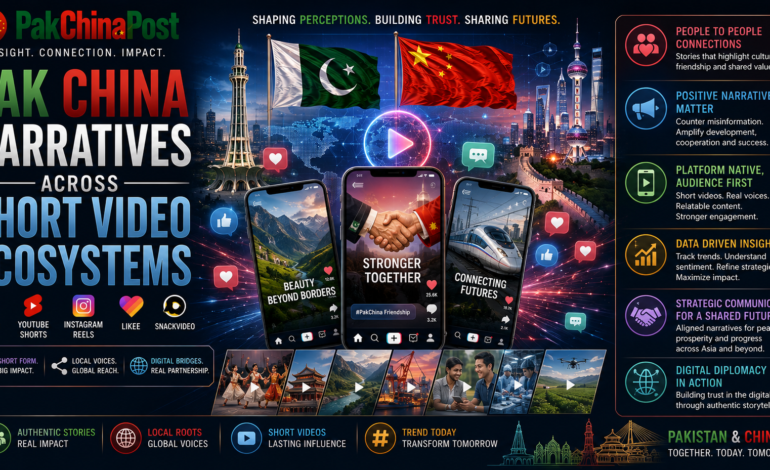
Pak China Narratives Across Short Video Ecosystems


Pak China cooperation is increasingly being interpreted not through diplomatic communiqués, parliamentary debates or conventional newsrooms, but through algorithmically curated streams of short videos consumed by millions of Pakistani citizens every day. Platforms built upon rapid recommendation engines have become influential intermediaries between state policy and public perception, transforming complex strategic relationships into emotionally resonant visual fragments measured by engagement rather than evidentiary value. The consequence is not merely technological disruption of journalism. It represents the emergence of a new arena where geopolitical legitimacy, economic cooperation and strategic trust are continuously negotiated through creators whose institutional affiliations, commercial incentives and informational standards vary considerably. Within this evolving communication architecture, Pakistan and China confront a strategic challenge extending beyond public diplomacy. They must understand how algorithmic visibility increasingly determines which narratives become socially accepted, politically influential and institutionally credible.
Traditional strategic communication assumed that governments, established media organisations and recognised experts functioned as primary custodians of national discourse. That assumption is becoming progressively obsolete. Digital audiences, particularly younger demographics, increasingly encounter information regarding the China Pakistan Economic Corridor, industrial collaboration, educational exchanges, technological partnerships and regional security through influencers explaining infrastructure projects, travel bloggers documenting Chinese cities, entrepreneurs discussing bilateral commerce, university students sharing educational experiences, technology reviewers evaluating Chinese innovation and commentators interpreting diplomatic developments. These creators collectively construct an informal yet powerful ecosystem capable of reinforcing confidence, generating scepticism or amplifying uncertainty with remarkable speed.
The transformation reflects broader structural changes in information consumption. Short video platforms reward immediacy, visual storytelling, emotional engagement and personalised recommendations rather than institutional authority. Algorithms continuously optimise visibility according to behavioural data, enabling relatively unknown creators to influence national conversations previously dominated by newspapers or television broadcasters. Consequently, factual accuracy competes directly against entertainment value, narrative simplicity and emotional intensity. Strategic communication therefore becomes less dependent upon official messaging and increasingly contingent upon algorithmic amplification.
For Pakistan, this transformation possesses significant implications because bilateral cooperation with China encompasses infrastructure investment, industrial modernisation, technological collaboration, defence partnerships, educational exchanges and regional connectivity initiatives requiring sustained public confidence. Long term strategic projects inevitably generate questions regarding implementation, transparency, environmental consequences, financial sustainability and geopolitical implications. Democratic societies naturally accommodate such discussions. The policy challenge lies not in suppressing debate but in ensuring that public deliberation remains grounded in verifiable evidence rather than algorithmically amplified misinformation.
China similarly recognises that international perceptions increasingly emerge from decentralised digital ecosystems rather than formal diplomatic channels. Global public opinion concerning Chinese investment, technological capabilities, governance models and international partnerships is profoundly influenced by digital creators operating independently of governmental communication structures. Consequently, bilateral narrative resilience depends not exclusively upon governmental messaging but upon cultivating broader informational ecosystems capable of sustaining credibility amid intense digital competition.
The algorithmic architecture underpinning short video platforms deserves closer examination because it fundamentally reshapes public cognition. Recommendation systems prioritise content demonstrating higher engagement probabilities, rewarding novelty, emotional reactions, controversy and audience retention. Complex infrastructure financing mechanisms or nuanced policy reforms rarely generate comparable engagement to sensational claims regarding hidden political agendas, exaggerated security threats or dramatic conspiracy theories. Consequently, strategic communication confronts structural disadvantages unrelated to factual quality.
Information asymmetry becomes particularly pronounced during periods of diplomatic tension or regional crises. Misleading videos alleging project failures, fabricated diplomatic disputes or manipulated economic statistics can accumulate millions of views before institutional responses appear. By the time corrections emerge, algorithmic momentum frequently favours original misinformation, allowing inaccurate narratives to establish enduring cognitive impressions despite subsequent factual clarification. This asymmetry challenges conventional government communication practices relying upon delayed press conferences or official statements unsuitable for rapid digital environments.
Influencer ecosystems further complicate strategic communication because creators increasingly occupy hybrid professional identities. A travel vlogger documenting Xinjiang, a technology reviewer assessing Chinese electric vehicles, a business entrepreneur discussing cross border commerce and a university graduate describing academic experiences in Beijing simultaneously function as content producers, commercial personalities and informal diplomatic interpreters. Their audiences frequently perceive these individuals as more authentic than institutional spokespersons precisely because they appear independent. Authenticity therefore becomes a strategic communication asset exceeding formal authority.
Commercial incentives nevertheless introduce vulnerabilities. Platform monetisation rewards audience growth rather than evidentiary standards. Creators may unintentionally oversimplify strategic issues, exaggerate achievements or sensationalise controversies to maximise visibility. Commercial competition occasionally encourages provocative framing, selective presentation of facts or emotionally charged narratives capable of attracting greater algorithmic distribution. These dynamics require institutional awareness without undermining legitimate creative expression.
Educational content represents one of the most promising opportunities within the evolving digital ecosystem. Pakistani students increasingly utilise short video platforms for learning foreign languages, technological concepts, economic developments and international affairs. Educational creators explaining Chinese industrial policy, manufacturing ecosystems, artificial intelligence development, renewable energy innovation or historical cultural connections contribute meaningfully to public understanding when supported by rigorous evidence. Such creators expand informational literacy while reducing dependence upon simplistic geopolitical narratives.
Youth perceptions warrant particular strategic attention because younger generations possess fundamentally different information habits compared with previous policymaking constituencies. Many university students receive initial exposure to international affairs through algorithmically recommended videos rather than academic literature or traditional journalism. Their understanding of bilateral cooperation consequently develops through cumulative exposure to fragmented visual narratives instead of comprehensive policy analysis. Governments ignoring these behavioural transformations risk communicating through increasingly marginal channels while public opinion forms elsewhere.
Digital storytelling also possesses extraordinary capacity to humanise international relationships frequently reduced to abstract strategic terminology. Stories documenting Pakistani engineers collaborating with Chinese counterparts, entrepreneurs exporting agricultural products, medical researchers conducting joint innovation, university exchange programmes, cultural festivals and technological cooperation communicate bilateral relationships through tangible human experiences rather than official rhetoric. Such narratives strengthen societal trust because audiences connect more readily with individual experiences than institutional declarations.
Nevertheless, human centred storytelling should complement rather than replace analytical transparency. Excessively promotional communication risks undermining credibility, particularly among digitally sophisticated audiences capable of identifying orchestrated messaging. Strategic communication therefore requires balanced representation acknowledging implementation challenges, project delays, regulatory reforms and legitimate public concerns alongside documented achievements. Credibility emerges from intellectual honesty rather than perpetual optimism.
The proliferation of synthetic media generated through artificial intelligence introduces another dimension requiring institutional preparedness. Deepfake videos, manipulated speeches, fabricated diplomatic statements and synthetic visual evidence possess increasing capacity to distort public understanding of bilateral relations. During regional crises or politically sensitive developments, adversarial actors may exploit these technologies to manufacture diplomatic misunderstandings, undermine investment confidence or inflame domestic political divisions. Countering such threats demands advanced verification infrastructure rather than reactive censorship.
Institutional capacity for evidence based digital engagement remains uneven across Pakistan’s public sector. Many government departments continue prioritising static websites, lengthy press releases and infrequent media briefings while public discourse increasingly unfolds through dynamic visual platforms demanding continuous interaction. Digital communication teams frequently lack behavioural analytics expertise, multimedia production capabilities, algorithmic literacy or crisis response mechanisms necessary for contemporary information environments. Strategic communication therefore requires organisational modernisation alongside technological investment.
Professional journalism similarly confronts structural adaptation challenges. Resource constrained news organisations struggle to compete against creators producing rapid visual content tailored specifically for platform algorithms. Yet journalism retains comparative advantages in investigative verification, editorial accountability and institutional credibility. Future communication strategies should therefore encourage constructive collaboration between professional journalists, digital creators, academic experts and public institutions rather than treating these communities as mutually exclusive competitors.
Policy legitimacy increasingly depends upon participatory communication rather than one directional dissemination. Citizens expect opportunities to question, critique and discuss major initiatives affecting national development. Short video platforms facilitate interactive engagement through comments, live discussions, collaborative videos and audience feedback mechanisms. Governments capable of participating confidently within these environments demonstrate institutional transparency while strengthening democratic accountability. Conversely, excessive informational distance between policymakers and citizens generates opportunities for speculative narratives filling communication vacuums.
Pakistan’s communication institutions should therefore distinguish clearly between misinformation, disinformation and legitimate criticism. Misinformation often reflects unintentional inaccuracies requiring factual correction. Disinformation involves deliberate manipulation designed to deceive audiences. Legitimate criticism contributes constructively to policy refinement and democratic oversight. Conflating these categories risks diminishing institutional credibility while discouraging informed public participation. Evidence based engagement demands proportionate responses tailored according to informational intent and societal consequences.
China’s extensive experience managing digital platforms provides valuable technological insights, yet Pakistan’s democratic communication environment necessitates context specific adaptation. Institutional learning should emphasise analytical capabilities, multilingual communication, digital verification technologies, audience research and crisis management rather than simplistic regulatory transplantation. Sustainable narrative resilience depends upon public confidence generated through openness and competence rather than administrative restriction.
Strategic communication concerning bilateral cooperation would benefit substantially from integrated research capabilities combining behavioural science, computational social science and communication analytics. Continuous monitoring of narrative evolution, audience segmentation, misinformation pathways and creator ecosystems enables proactive engagement before controversies escalate into broader legitimacy challenges. Such analytical infrastructure should operate according to transparent methodological standards while respecting privacy protections and constitutional freedoms.
Universities possess underutilised potential within this communication architecture. Academic institutions can establish interdisciplinary centres examining digital information ecosystems, algorithmic governance, media literacy and geopolitical communication. Partnerships involving researchers, technology companies, journalists and policymakers would generate evidence supporting adaptive communication strategies responsive to evolving digital realities. Students trained within these programmes would strengthen national expertise in strategic communication and information resilience.
Media literacy constitutes perhaps the most sustainable long term investment. Citizens capable of evaluating sources, recognising algorithmic manipulation, verifying visual evidence and distinguishing opinion from factual reporting become less vulnerable to coordinated misinformation regardless of technological evolution. Educational curricula should therefore integrate digital verification skills alongside conventional civic education. Strengthening public analytical capacity ultimately enhances democratic resilience more effectively than attempting to regulate every emerging communication technology.
Commercial technology companies operating short video platforms similarly bear important responsibilities. Transparency regarding recommendation systems, coordinated inauthentic behaviour, political advertising and synthetic media detection contributes significantly to healthier information environments. Constructive dialogue between governments, platforms, researchers and civil society organisations can establish voluntary standards promoting informational integrity while preserving innovation and legitimate expression.
Regional information competition further elevates strategic significance. South Asia increasingly experiences sophisticated influence operations involving state actors, ideological networks, commercial entities and transnational digital communities pursuing divergent geopolitical objectives. Bilateral cooperation between Pakistan and China inevitably becomes subject to competing narratives seeking either to reinforce or undermine public confidence. Strategic communication consequently intersects directly with broader national resilience, economic security and diplomatic stability.
Future communication strategies should move beyond campaign oriented thinking towards permanent institutional capability. Rather than mobilising temporary responses during controversies, Pakistan requires integrated digital communication frameworks incorporating continuous audience engagement, multilingual content development, creator partnerships, rapid verification systems, behavioural analytics and independent evaluation mechanisms. Institutional maturity derives from consistency rather than episodic mobilisation.
An operational communication model could include a National Digital Narrative Assessment Centre integrating communication specialists, behavioural scientists, cybersecurity analysts, economists and regional experts capable of monitoring emerging informational risks affecting strategic partnerships. Complementing this institution, universities should establish Digital Diplomacy Research Laboratories examining evolving communication technologies while generating policy recommendations grounded in empirical evidence. Provincial information departments could develop specialised multimedia units translating complex policy initiatives into accessible visual formats without compromising analytical accuracy.
Independent fact verification networks deserve systematic strengthening through sustainable funding, professional training and technological infrastructure enabling rapid authentication of viral claims concerning bilateral cooperation. Such institutions should remain operationally independent while maintaining structured communication channels with government departments, academic experts and international verification communities. Public confidence depends upon demonstrable impartiality rather than institutional proximity to political authority.
Creator engagement strategies similarly require institutional sophistication. Governments should avoid attempting to manufacture artificial influencer ecosystems lacking credibility. Instead, transparent partnerships supporting educational content, technological literacy, scientific collaboration and cultural understanding offer more sustainable approaches. Independent creators retain audience trust precisely because they preserve editorial autonomy. Respecting that autonomy strengthens rather than weakens strategic communication outcomes.
Pakistan and China also possess opportunities to expand collaborative digital storytelling through joint documentary initiatives, university media exchanges, innovation competitions, multilingual educational platforms and youth entrepreneurship programmes highlighting practical cooperation across technology, agriculture, healthcare, manufacturing and climate adaptation. These initiatives should emphasise observable outcomes experienced by ordinary citizens rather than abstract geopolitical symbolism, thereby reinforcing authenticity through demonstrable societal benefit.
Ultimately, the strategic contest surrounding Pakistan China cooperation increasingly unfolds within algorithmically mediated attention economies where credibility, transparency and informational agility determine narrative influence more decisively than institutional hierarchy. Governments retaining twentieth century communication assumptions will struggle against decentralised creator ecosystems shaped by behavioural technologies evolving with extraordinary speed. Success will depend neither upon information control nor promotional intensity, but upon cultivating resilient public trust through evidence, transparency, analytical sophistication and continuous engagement. Within this emerging communication landscape, factual discourse itself becomes an element of national strategic capability, ensuring that bilateral cooperation is evaluated through informed public understanding rather than algorithmically magnified distortion.
A Public Service Message


