
Pak China Language Technologies Reshape Strategic Public Diplomacy Architecture

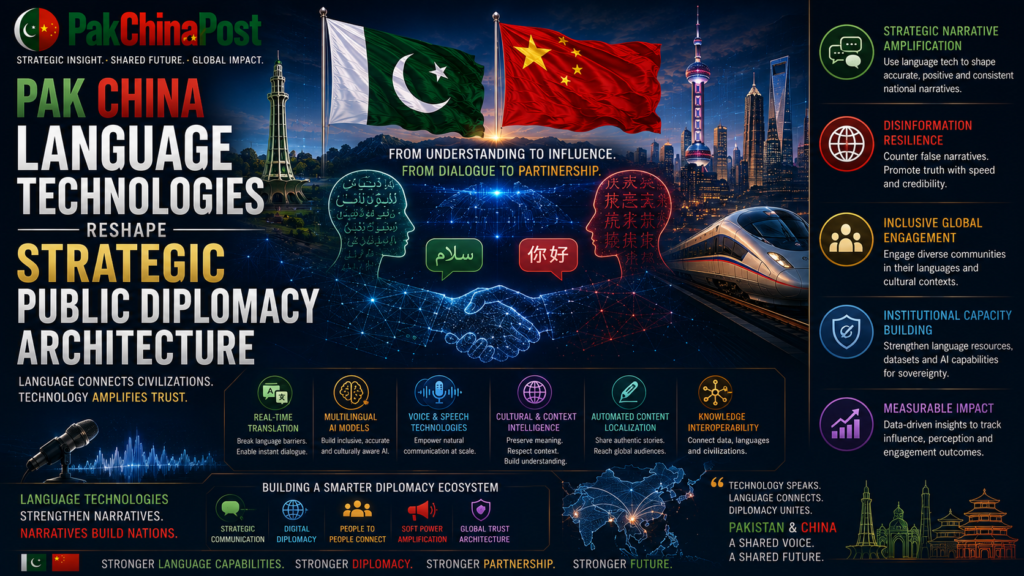
Pak China relations are entering an understated yet potentially transformative phase in which artificial intelligence powered language technologies may prove as strategically consequential as transport corridors, industrial cooperation and financial connectivity. While physical infrastructure has traditionally symbolised bilateral engagement, a quieter digital infrastructure is emerging through neural machine translation, multilingual conversational systems, automated interpretation, speech recognition, educational platforms and knowledge exchange ecosystems capable of reducing one of the longest standing impediments to sustained people-to-people cooperation. Linguistic distance has historically constrained academic collaboration, commercial expansion, scientific partnerships and cultural understanding between Pakistan and China despite decades of diplomatic convergence. Artificial intelligence is progressively narrowing that distance. The strategic implication extends well beyond convenience. Language technology is increasingly becoming an instrument of public diplomacy, national competitiveness and geopolitical influence.
The evolution deserves careful policy attention because communication increasingly constitutes strategic infrastructure rather than merely a supporting administrative function. Every bilateral investment discussion, research partnership, educational exchange, technology transfer agreement and media collaboration ultimately depends upon accurate communication. Artificial intelligence translation systems have significantly accelerated multilingual interaction by enabling real time translation across text, speech, documents and audiovisual content. Such capabilities reduce transaction costs, expand institutional accessibility and create opportunities for citizens, researchers, entrepreneurs and students who previously remained excluded from direct engagement because of linguistic limitations.
For Pakistan, whose strategic partnership with China encompasses infrastructure development, industrial modernisation, digital transformation, higher education and technological cooperation, language technologies represent an underappreciated multiplier capable of improving implementation capacity across multiple sectors simultaneously. The debate should therefore move beyond whether machine translation is sufficiently accurate towards how language technologies should be institutionally integrated into long term national planning. Countries increasingly competing within knowledge economies recognise that translation infrastructure contributes directly to innovation ecosystems by expanding access to scientific literature, commercial documentation, legal agreements and technical standards.
Artificial intelligence translation has evolved substantially beyond conventional dictionary based systems. Contemporary large language models combine contextual reasoning, semantic understanding and domain adaptation to generate translations approaching professional quality across numerous languages. Continuous improvements in speech synthesis, automatic subtitling, multilingual search and conversational interfaces have transformed communication from sequential interpretation into nearly simultaneous multilingual interaction. Educational institutions now increasingly utilise automated translation to facilitate collaborative classrooms involving geographically dispersed participants. Researchers conduct literature reviews across multiple languages with unprecedented efficiency. Businesses negotiate contracts using multilingual digital assistants while cultural institutions distribute locally relevant content across diverse audiences without proportional increases in production costs.
Within Pakistan China cooperation, these developments coincide with expanding educational exchanges, scientific partnerships, digital commerce, vocational training and media engagement. Thousands of Pakistani students pursue education in Chinese universities while Chinese enterprises continue expanding commercial operations throughout Pakistan. Academic institutions increasingly establish collaborative research programmes requiring sustained multilingual communication. Technology companies require engineers capable of exchanging technical documentation across languages. Public institutions negotiate increasingly sophisticated agreements encompassing energy, logistics, cybersecurity, telecommunications and industrial development. Each interaction depends upon precise linguistic interpretation because policy ambiguity frequently originates from translation inaccuracies rather than substantive disagreement.
Public diplomacy likewise enters a fundamentally different operational environment. Traditional diplomacy primarily relied upon official statements, embassy communications and state broadcasters. Digital ecosystems now permit universities, think tanks, entrepreneurs, journalists, cultural organisations and ordinary citizens to participate directly in international communication. Artificial intelligence enables these interactions at scales previously unattainable. Educational webinars simultaneously accommodate participants communicating through multiple languages. Museums provide multilingual virtual exhibitions. Cultural festivals distribute translated digital content globally. Documentary producers automatically subtitle audiovisual material across numerous languages, significantly expanding audience reach while reducing production costs.
The implications extend beyond communication efficiency towards perception management. Public diplomacy increasingly revolves around credibility, accessibility and sustained societal engagement rather than occasional symbolic exchanges. Language technologies permit governments and institutions to communicate directly with foreign populations using culturally adapted messaging rather than relying exclusively upon intermediaries. When executed responsibly, multilingual communication broadens mutual understanding by reducing dependence upon selective interpretation or politically motivated information filtering. This becomes particularly important within increasingly contested international information environments characterised by competing narratives surrounding infrastructure projects, technological cooperation and regional security.
Educational cooperation may experience the most profound transformation. Pakistan continues seeking improved educational quality, technological capability and research productivity while China has significantly expanded higher education internationalisation. Artificial intelligence translation lowers barriers preventing collaborative teaching, joint supervision, virtual laboratories and shared digital libraries. Pakistani students gain expanded access to Chinese scientific publications previously inaccessible because of linguistic constraints. Chinese researchers similarly engage more effectively with Pakistani scholarship addressing regional security, public policy, environmental management and social development. Translation technologies therefore enhance reciprocal knowledge circulation rather than one directional information transfer.
Scientific collaboration increasingly depends upon multilingual knowledge ecosystems because research excellence rarely remains confined within one linguistic community. Artificial intelligence translation accelerates literature synthesis, interdisciplinary cooperation and technical communication among research teams. Joint publications become more feasible when drafting assistance and terminology standardisation reduce linguistic burdens. Collaborative innovation ecosystems particularly benefit within engineering, biotechnology, agricultural sciences, artificial intelligence, renewable energy and healthcare where technical documentation often requires rapid multilingual adaptation. Pakistan’s research institutions consequently possess opportunities to integrate more deeply into regional scientific networks through systematic deployment of advanced translation infrastructure.
Commercial engagement similarly benefits through reduced informational asymmetry. Small and medium enterprises frequently encounter linguistic obstacles preventing international expansion despite possessing competitive products or services. Artificial intelligence translation platforms enable businesses to localise marketing materials, negotiate contracts, understand regulatory documentation and provide multilingual customer support without maintaining extensive translation departments. Pakistani exporters entering Chinese markets and Chinese manufacturers expanding within Pakistan may reduce operational friction through accurate multilingual documentation integrated into commercial workflows.
Nevertheless, strategic optimism requires balanced assessment because language technologies introduce governance challenges requiring institutional preparedness. Translation accuracy remains uneven across specialised disciplines including defence, diplomacy, law, medicine, engineering and finance where terminological precision carries significant legal or operational consequences. Artificial intelligence occasionally generates plausible yet inaccurate translations capable of distorting contractual obligations, regulatory interpretation or diplomatic communications. Such inaccuracies may produce misunderstandings carrying substantial political or economic implications if institutional verification mechanisms remain inadequate.
Algorithmic bias constitutes another emerging concern. Artificial intelligence systems reflect characteristics embedded within their training data, linguistic structures and optimisation objectives. Translation models may inadvertently privilege particular cultural assumptions, political terminology or conceptual frameworks while inadequately representing local linguistic nuances. Certain expressions embedded within Urdu, Mandarin or regional Pakistani languages possess historical, religious or cultural meanings resisting literal translation. Automated systems occasionally simplify complex cultural references into technically correct yet contextually misleading equivalents. Such distortions gradually influence public perception by subtly reshaping how societies interpret each other’s values, institutions and historical experiences.
Information reliability similarly deserves sustained attention. Artificial intelligence increasingly generates translated news, educational material and policy content at extraordinary speed. Although such scalability expands information availability, it simultaneously accelerates dissemination of inaccuracies whenever flawed translations circulate widely before correction. Misinformation therefore acquires multilingual capability. False narratives originating within one linguistic ecosystem rapidly propagate across another through automated translation without deliberate human intervention. Digital diplomacy consequently requires not merely communication capacity but institutional mechanisms verifying translation integrity before strategic information enters public circulation.
Media production illustrates both remarkable opportunity and corresponding vulnerability. Pakistani and Chinese documentary producers, educational broadcasters, digital creators and policy platforms increasingly utilise artificial intelligence for subtitling, voice synthesis and multilingual publishing. These technologies substantially reduce production costs while expanding international audiences. However, automated translation occasionally overlooks cultural sensitivities, idiomatic meanings or contextual references essential for responsible journalism. Editorial oversight therefore becomes increasingly important despite advances in automation. Artificial intelligence should augment professional editorial judgement rather than replace it entirely.
Strategic communication further requires awareness that language itself constitutes an arena of geopolitical competition. Countries investing heavily in multilingual artificial intelligence increasingly shape international knowledge flows by determining which languages receive technological support, which cultural narratives become digitally accessible and which knowledge repositories remain visible within global information ecosystems. Language technology therefore intersects directly with technological sovereignty. Nations relying exclusively upon foreign translation platforms risk external dependence regarding educational resources, policy communication and digital knowledge management.
Pakistan consequently confronts a strategic decision extending beyond procurement of commercial software. National capability requires indigenous expertise capable of developing domain specific multilingual datasets encompassing Urdu, Mandarin, English and regional Pakistani languages. Public institutions require translation systems optimised for governmental terminology, legal documentation, scientific literature and diplomatic communication rather than generic consumer applications. Such specialised capability enhances institutional resilience while preserving contextual accuracy across strategically sensitive sectors.
Joint Pakistan China cooperation offers considerable opportunities within this domain. Collaborative research centres dedicated to multilingual artificial intelligence could develop translation models specifically addressing bilateral communication requirements. Universities may establish computational linguistics laboratories integrating artificial intelligence, language sciences, international relations and public policy. Shared digital corpora containing validated governmental terminology, engineering documentation, legal frameworks and scientific vocabulary would significantly improve translation quality while reducing institutional inconsistency. These initiatives simultaneously strengthen scientific cooperation and strategic autonomy.
Educational diplomacy similarly benefits from coordinated institutional innovation. Rather than treating language acquisition and artificial intelligence as separate policy domains, both governments could integrate intelligent translation systems into scholarship programmes, vocational education and professional training. Hybrid educational models combining human language instruction with artificial intelligence assistance may accelerate proficiency while preserving cultural understanding unavailable through automation alone. Students entering engineering, medicine, economics or international relations programmes could access bilingual digital learning environments supporting technical terminology alongside conversational competence.
Business diplomacy equally requires institutional adaptation. Chambers of commerce, export promotion agencies and investment facilitation authorities should develop multilingual digital service platforms incorporating verified artificial intelligence translation alongside human expert review. Commercial arbitration mechanisms likewise require standardised multilingual terminology ensuring contractual interpretation remains legally consistent across jurisdictions. Digital customs documentation, logistics coordination and financial compliance increasingly depend upon interoperable language infrastructure integrated within broader trade facilitation reforms.
Public diplomacy institutions must similarly modernise communication architecture. Embassies, cultural centres, educational organisations and think tanks require multilingual digital engagement strategies extending beyond occasional translated press releases. Artificial intelligence enables continuous dialogue through multilingual podcasts, educational videos, policy briefings, virtual exhibitions and interactive cultural platforms reaching younger digital audiences. Strategic communication thereby evolves from episodic messaging towards sustained conversational engagement supported by evidence based content adapted across linguistic communities.
Security institutions also possess legitimate interests within language technologies. Cross border law enforcement cooperation, emergency response coordination, cyber incident reporting and humanitarian assistance increasingly require rapid multilingual communication. Artificial intelligence translation may improve operational responsiveness provided systems undergo rigorous validation for specialised terminology. However, security agencies must simultaneously recognise vulnerabilities associated with adversarial manipulation, malicious prompt engineering and translation poisoning whereby compromised datasets intentionally distort sensitive terminology. Cybersecurity therefore becomes inseparable from language infrastructure governance.
Institutional governance should accordingly prioritise transparent evaluation standards. Translation systems deployed across government require certification frameworks measuring accuracy within specialised domains including diplomacy, defence, healthcare, engineering and finance. Independent auditing mechanisms should continuously evaluate performance across linguistic variations rather than relying solely upon vendor claims. Universities, standards organisations and technology regulators could jointly establish national benchmarks guiding procurement and operational deployment.
Data governance requires equal attention. Artificial intelligence translation systems frequently process confidential governmental documents, commercial contracts and personal communications. Privacy protections, encryption standards, data localisation requirements and secure cloud infrastructure therefore become essential components of language technology policy. Strategic sectors handling classified information require sovereign deployment models preventing unauthorised external access while preserving interoperability where appropriate. Digital trust ultimately determines whether institutions confidently integrate artificial intelligence into sensitive communication environments.
Another priority concerns linguistic inclusivity. Pakistan’s linguistic diversity extends beyond Urdu and English, encompassing Punjabi, Sindhi, Pashto, Balochi, Saraiki and numerous additional languages. Artificial intelligence development should avoid reinforcing digital inequalities by concentrating exclusively upon dominant languages. Inclusive multilingual datasets broaden educational accessibility while preserving cultural heritage. Similar considerations apply within China where multiple linguistic communities coexist alongside Mandarin. Bilateral cooperation should therefore encourage computational preservation of linguistic diversity rather than technological homogenisation.
Professional capacity building remains indispensable because technological sophistication alone cannot compensate for institutional skill deficits. Diplomats, journalists, educators, researchers, lawyers and civil servants require specialised training enabling critical evaluation of machine generated translations. Artificial intelligence literacy should encompass understanding of algorithmic limitations, contextual ambiguity, verification methodologies and ethical responsibilities. Human expertise consequently evolves rather than diminishes within increasingly automated communication ecosystems.
The broader geopolitical significance deserves careful recognition. International influence increasingly depends upon narrative accessibility. States capable of communicating effectively across linguistic boundaries acquire disproportionate capacity to explain policies, attract investment, disseminate scientific achievements and cultivate long term societal relationships. Artificial intelligence translation therefore contributes directly to soft power by expanding communicative reach without proportionate resource expansion. Pakistan and China possess opportunities to strengthen bilateral understanding while projecting collaborative initiatives more effectively across wider regional audiences through sophisticated multilingual engagement.
Yet sustainable success ultimately depends upon preserving authenticity alongside automation. Public diplomacy cannot rely exclusively upon algorithmic efficiency because trust emerges through cultural sensitivity, intellectual credibility and reciprocal engagement. Artificial intelligence facilitates communication but cannot independently generate mutual respect or strategic confidence. Institutions must therefore integrate technological capability with human expertise, academic exchange, cultural immersion and transparent dialogue. The objective should remain deeper understanding rather than merely faster translation.
Pak China cooperation has repeatedly demonstrated that infrastructure acquires enduring value only when institutional ecosystems mature alongside physical investment. Language technology represents the next logical extension of that principle. Roads connect territories, energy networks connect economies, digital platforms connect institutions, but language ultimately connects societies. Artificial intelligence now offers unprecedented capability to strengthen those connections provided governance frameworks anticipate associated risks with equal sophistication. Policymakers should therefore regard multilingual artificial intelligence not as a peripheral educational technology but as strategic national infrastructure underpinning diplomacy, commerce, research, security and public engagement. Establishing joint computational linguistics research centres, sovereign multilingual translation platforms, certified governmental terminology repositories, secure data governance protocols, bilingual scientific publishing initiatives, artificial intelligence assisted educational exchanges, multilingual digital diplomacy units and continuous algorithmic auditing mechanisms would substantially enhance bilateral resilience. The countries that master trusted multilingual communication will increasingly shape international partnerships through knowledge rather than rhetoric, credibility rather than volume and institutional coherence rather than technological novelty. For Pakistan and China, investing collectively in trusted language intelligence today may ultimately prove as strategically consequential as any physical corridor constructed during the past generation.
A Public Service Message