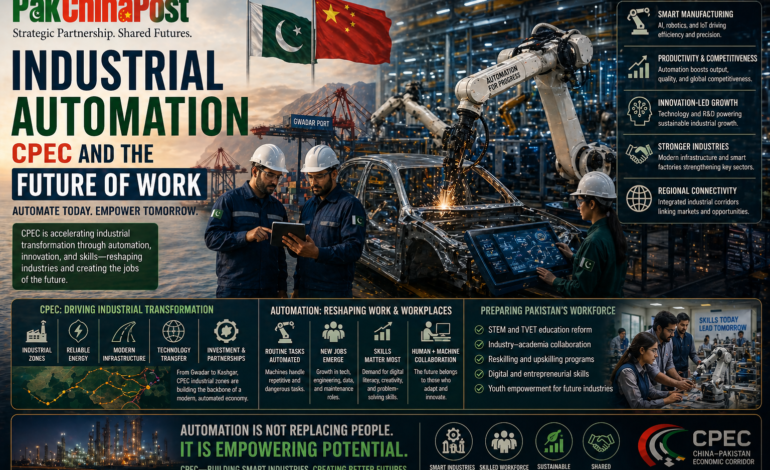
Industrial Automation CPEC and the Future of Work

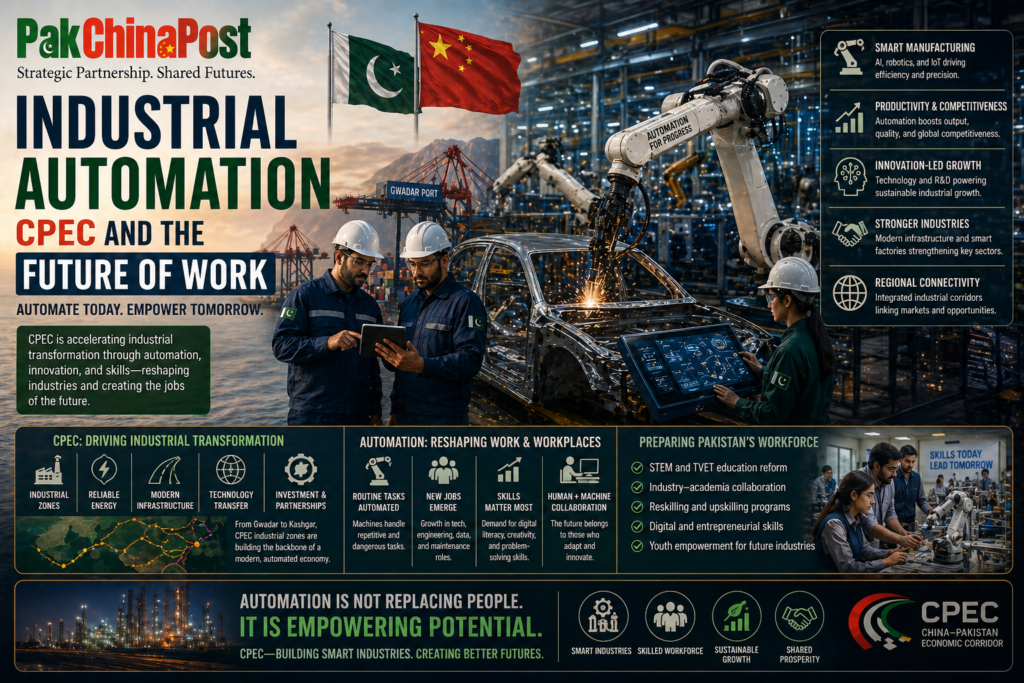
Industrial automation under CPEC 2.0 is quietly redefining the economic imagination of Pakistan. What was once framed as a corridor of roads, railways, and energy plants is increasingly being reoriented toward a more complex ambition, the restructuring of industrial production itself through robotics, artificial intelligence, smart factories, and digitally coordinated manufacturing systems. This transition is not occurring through dramatic rupture but through incremental embedding of Chinese industrial technologies into Pakistan’s production landscape. The consequences are likely to be far reaching, not only for output and efficiency, but for employment, skills, and the very structure of economic opportunity.
At the center of this transformation is a shift in the logic of industrial development. Traditional models of industrialization in late developing economies relied heavily on labor intensive manufacturing, where comparative advantage was derived from abundant low cost labor. This model underpinned East Asian growth in earlier decades and shaped Pakistan’s own industrial aspirations. However, the emerging Chinese industrial model being exported through CPEC 2.0 is increasingly capital intensive, digitally coordinated, and automation driven. It reflects China’s own internal transition toward high productivity manufacturing and technological upgrading.
This creates a structural tension. On one hand, Pakistan seeks industrial expansion, export growth, and integration into global value chains. On the other hand, the technological model being introduced is not labor absorbing in the traditional sense. Smart factories, automated logistics systems, and AI driven production lines reduce the need for large pools of semi skilled labor. Instead, they demand a smaller workforce with higher technical competencies, data literacy, and systems management capabilities.
The promise of industrial automation is often framed in terms of productivity gains. Machines do not tire, digital systems reduce errors, and AI driven optimization can significantly enhance output efficiency. In sectors such as textiles, cement, agriculture processing, and light manufacturing, automation can theoretically improve competitiveness in global markets where margins are increasingly tight. For Pakistan, which faces chronic productivity constraints, this appears attractive.
Yet productivity is only one side of the equation. The distribution of productivity gains is equally important. If automation increases output while reducing employment, the net effect on social welfare depends on whether new forms of employment are generated elsewhere in the economy. This is where the uncertainty lies. Historical evidence from industrial transitions suggests that automation does create new jobs, but not always at the same scale, location, or skill level as those displaced.
The introduction of Chinese industrial technologies into Pakistan under CPEC 2.0 is occurring through multiple channels. These include the establishment of special economic zones equipped with modern production facilities, joint ventures in manufacturing sectors, technology transfer agreements, and the deployment of industrial Internet of Things systems that connect machines, sensors, and management platforms in real time. Each of these channels contributes to a broader ecosystem of smart manufacturing.
In theory, this ecosystem could enable Pakistan to leapfrog stages of industrial development. Rather than replicating labor intensive industrialization pathways, Pakistan could integrate directly into advanced manufacturing networks. This is the classic argument of technological leapfrogging. However, leapfrogging is rarely automatic. It requires deep institutional capacity, technical education systems, research infrastructure, and a domestic innovation base capable of absorbing and adapting imported technologies.
Without these conditions, automation risks producing what can be described as a dual economy structure. In such a structure, enclaves of high tech, highly productive industrial zones coexist with a broader economy characterized by low productivity and informal employment. The gap between these two segments can widen over time, creating new forms of inequality within the labor market.
One of the most immediate concerns associated with industrial automation is labor displacement. In sectors such as textiles and garment manufacturing, which constitute a significant share of Pakistan’s exports and employment, automation technologies are increasingly capable of performing tasks that were traditionally labor intensive. Cutting, stitching, quality control, and packaging processes can now be partially or fully automated. While this increases efficiency, it reduces the demand for unskilled labor.
The social implications of this shift are significant. Manufacturing has historically been one of the few sectors capable of absorbing large numbers of semi skilled workers, particularly in developing economies. If this absorptive capacity declines, pressure increases on other sectors such as services or informal labor markets, which may not have the capacity to absorb displaced workers at comparable wage levels.
There is also a spatial dimension to consider. Industrial automation tends to concentrate production in fewer, larger, and more technologically advanced facilities. This can lead to regional disparities, where industrial hubs become more productive but less labor intensive, while peripheral regions experience reduced employment opportunities. The geography of industrialization thus becomes more uneven.
From a governance perspective, the challenge is not simply to adopt automation technologies, but to manage their transition effects. This includes designing labor reskilling programs, investing in technical education, and developing industrial policies that balance efficiency with employment considerations. The effectiveness of such policies will determine whether automation becomes a tool of inclusive growth or concentrated productivity.
Chinese involvement in this process introduces additional layers of complexity. China’s industrial ecosystem is among the most advanced in the world in terms of automation and smart manufacturing. Its firms possess extensive experience in integrating robotics, AI driven logistics, and large scale production optimization. Through CPEC related industrial cooperation, Pakistan gains access to this expertise. However, the transfer of technology does not automatically translate into transfer of capability.
Technology transfer is often asymmetric. While machinery and systems can be imported, the underlying knowledge required to design, maintain, and innovate upon these systems is harder to internalize. Without strong domestic engineering and research capacity, countries risk becoming dependent on external technical support for high end industrial operations. This can limit long term autonomy in industrial strategy.
Another important dimension is the changing nature of skills demand. Industrial automation shifts the labor market away from manual and repetitive tasks toward technical, analytical, and supervisory roles. This includes fields such as robotics maintenance, data analytics, systems engineering, and digital production management. For Pakistan, this implies a significant transformation in education and vocational training systems.
Current educational structures are not fully aligned with these emerging demands. Without rapid adaptation, there is a risk of skills mismatch, where labor supply does not meet the requirements of automated industrial systems. This could paradoxically coexist with unemployment in low skill segments and labor shortages in high skill technical roles.
At the macroeconomic level, automation also influences trade competitiveness. Countries that successfully integrate advanced manufacturing technologies can reduce production costs, improve quality, and increase export competitiveness. For Pakistan, which has struggled with persistent trade deficits, this offers a potential pathway to strengthening export capacity. However, competitiveness based on automation also intensifies global competition, as many countries pursue similar strategies.
There is also a geopolitical dimension embedded within industrial automation under CPEC 2.0. As Chinese industrial systems become more deeply integrated into Pakistan’s manufacturing base, industrial standards, technical protocols, and production systems may increasingly align with Chinese models. This creates a form of industrial convergence that extends beyond economics into technological governance.
Yet it would be simplistic to view this transformation solely through the lens of dependency or displacement. Industrial automation also opens possibilities for upgrading Pakistan’s industrial base. If managed effectively, it can enable higher productivity, improved product quality, and integration into more sophisticated segments of global value chains. The key variable is not technology itself, but institutional response.
The critical question is whether Pakistan can develop a coherent industrial strategy that leverages automation while mitigating its disruptive effects. This requires coordination between industrial policy, education reform, labor regulation, and technological governance. Without such coordination, automation may proceed in a fragmented manner, producing uneven outcomes.
In the broader context of global economic transformation, Pakistan is not unique in facing these challenges. Countries across Asia, Africa, and Latin America are grappling with similar tensions between automation and employment. The difference lies in institutional preparedness and policy coherence.
Industrial automation under CPEC 2.0 therefore represents both an opportunity and a stress test. It tests Pakistan’s ability to absorb advanced technologies, to manage structural labor transitions, and to redefine its place within global manufacturing networks. The outcome will not be determined solely by the scale of Chinese investment or the sophistication of imported machinery. It will be determined by how effectively Pakistan translates technological integration into sustainable economic and social development.
In the end, automation is not simply about machines replacing labor. It is about the reorganization of economic systems, the redistribution of opportunity, and the redefinition of work itself. Under CPEC 2.0, Pakistan is entering this transformation at speed. Whether it becomes a story of industrial upgrading or technological displacement will depend on choices that are still being made, in factories, classrooms, policy offices, and boardrooms across the country.
A Public Service Message