CPECTransition, StateCapacity, EconomicReform, InstitutionalDevelopment, SustainableGrowth


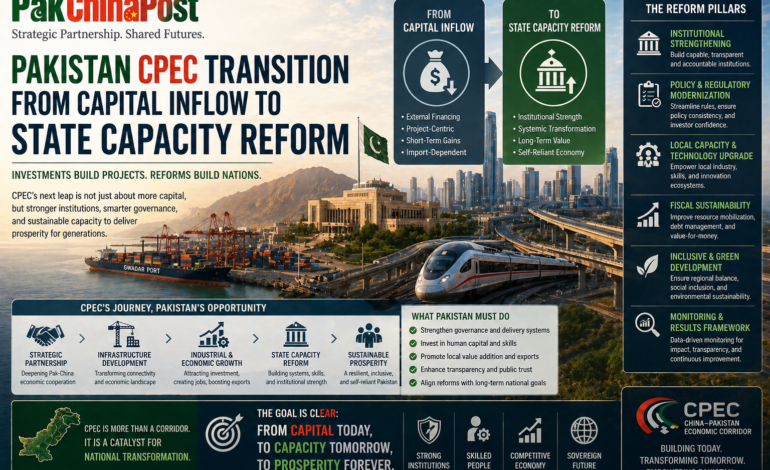
Pakistan’s development trajectory under the China Pakistan Economic Corridor has reached a structural inflection point where the central constraint is no longer the availability of external capital but the internal coherence of institutions responsible for absorbing, distributing, and transforming that capital into sustained national growth. The earlier narrative of scarcity, which dominated Pakistan’s economic discourse for decades, has gradually been displaced by a more complex reality in which capital inflows exist at scale, yet productive outcomes remain uneven, fragmented, and frequently disconnected from long term development objectives. In this sense, the challenge is not volumetric but systemic. It is not how much finance enters the economy, but how effectively the state converts external commitments into domestic capability, technological upgrading, and industrial deepening.
The evolution of CPEC from a predominantly infrastructure driven initiative to a more ambitious framework of industrial cooperation and technological partnership has amplified this institutional contradiction. Roads, ports, and energy projects have demonstrated that Pakistan can execute large scale physical infrastructure with Chinese cooperation, yet the transition toward second phase objectives such as industrial relocation, export diversification, digital integration, and agricultural modernization exposes significant limitations in governance capacity. These limitations are not marginal inefficiencies. They are structural frictions embedded in bureaucratic fragmentation, policy discontinuity, and weak coordination between federal and provincial economic planning units.
At the heart of the issue lies a persistent mismatch between external engagement and internal reform. Pakistan’s economic diplomacy with China has been highly active, often driven by strategic urgency and geopolitical alignment, yet domestic institutional reforms have lagged behind the scale and complexity of incoming commitments. This creates a paradoxical condition in which the country is simultaneously over engaged externally and under prepared internally. Agreements are signed at the highest political level, but implementation is filtered through weak administrative ecosystems that lack the technical capacity, regulatory coherence, and data driven planning systems required to translate policy intent into measurable outcomes.
The result is a corridor that functions efficiently as a diplomatic symbol and partially as an infrastructure network, but less effectively as a transformative economic system. Energy projects have alleviated short term shortages, transport infrastructure has improved connectivity, and ports have expanded logistical capacity, yet the anticipated spillovers into industrial productivity, export competitiveness, and employment generation remain limited. This gap is not a failure of intent on either side, but a reflection of asymmetric institutional readiness. Chinese state capacity in long term planning and execution is met by Pakistani administrative systems that remain reactive, fragmented, and often constrained by short political cycles.
One of the most critical dimensions of this asymmetry is the absence of a unified national framework for capital absorption. Investment flows under CPEC enter multiple channels, including federal ministries, provincial governments, state owned enterprises, and special purpose vehicles, yet there is no single integrated architecture that aligns these flows with macroeconomic priorities such as export growth, fiscal sustainability, and industrial diversification. In effect, capital is deployed in segments rather than systems, producing localized efficiencies without systemic transformation. This fragmentation weakens multiplier effects and reduces the overall developmental impact of large scale investment.
The issue becomes even more pronounced when considering the transition toward industrial cooperation. Industrial relocation from China to Pakistan, which is a central pillar of CPEC phase two, requires a fundamentally different institutional environment than infrastructure development. It demands predictable regulatory regimes, reliable dispute resolution mechanisms, skilled labor pools, and integrated supply chain ecosystems. These conditions cannot be created through bilateral agreements alone. They require deep domestic reforms in education, taxation, land management, trade facilitation, and industrial policy coordination. Without such reforms, industrial relocation risks remaining aspirational rather than operational.
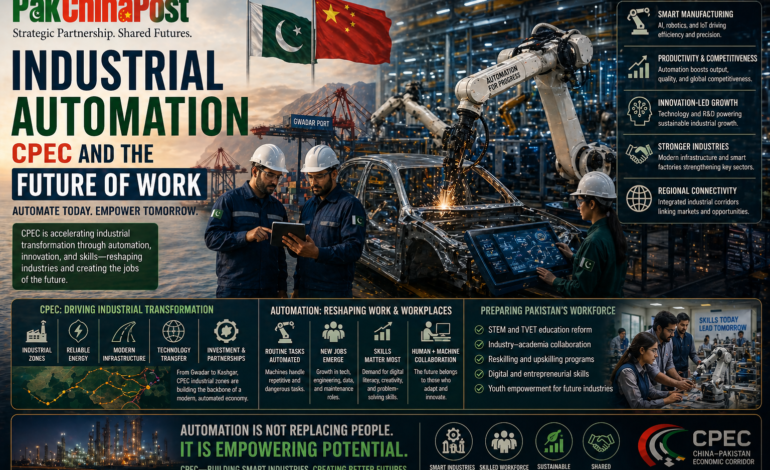
Similarly, the ambition to integrate Pakistan into Chinese centered regional value chains depends on the country’s ability to upgrade its technological and human capital base. Yet labor skilling remains uneven, vocational training is weakly linked to industry demand, and higher education systems are insufficiently aligned with emerging sectors such as automation, renewable energy, logistics management, and digital services. This creates a structural bottleneck in which capital and technology arrive faster than the workforce can absorb them, resulting in underutilization of investment and limited productivity gains.
Another dimension of institutional incoherence lies in the relationship between federal and provincial authorities. Economic governance under CPEC remains heavily centralized, yet implementation burdens are increasingly decentralized. Provinces are expected to host industrial zones, manage labor markets, and facilitate land acquisition, but they often lack fiscal autonomy, technical capacity, and negotiation authority. This disconnect produces delays, inefficiencies, and in some cases, political contestation over resource allocation. A more balanced model of provincial inclusion is therefore not merely a political necessity but an economic requirement for effective localization of gains.
The problem is further compounded by the absence of a long term strategic planning horizon in Pakistan’s China policy. Engagement tends to be reactive, shaped by immediate financing needs, geopolitical developments, or project specific negotiations, rather than guided by a coherent ten to fifteen year national strategy. This short term orientation limits Pakistan’s ability to negotiate from a position of institutional clarity. In contrast, China’s economic engagement is embedded in long term planning cycles, allowing for continuity, scalability, and systemic integration across multiple sectors and regions.
What emerges is a structural imbalance between strategic depth and tactical improvisation. China operates through long horizon state planning mechanisms that integrate infrastructure, industry, technology, and finance into a coherent system, while Pakistan often responds through fragmented administrative channels that lack cross sectoral integration. This divergence does not necessarily reflect policy failure but institutional asymmetry, where one side operates through systemic coordination and the other through episodic negotiation.
The implications of this imbalance are significant. Without institutional reform, Pakistan risks remaining locked in a pattern of dependency in which external capital compensates for internal weaknesses without resolving them. This creates a cycle of perpetual adjustment rather than transformation. Infrastructure expands, but productivity stagnates. Financing increases, but fiscal vulnerabilities persist. Connectivity improves, but competitiveness remains constrained. The core issue is therefore not the presence of investment but the absence of institutional convergence between investment and national development planning.
Addressing this challenge requires a shift from a memorandum driven model of engagement to a performance driven governance framework. Agreements must be embedded within measurable indicators that link project execution to national development outcomes. These indicators should include employment generation, export contribution, technology transfer, local content utilization, and fiscal sustainability. Without such metrics, investment remains politically visible but economically diffuse.
Equally important is the need to establish a centralized institutional mechanism for strategic capital management. Such a mechanism would coordinate between federal ministries, provincial governments, and foreign partners to ensure that investment flows are aligned with national priorities. It would also provide a unified platform for data collection, performance monitoring, and policy adjustment. In the absence of such an institution, fragmentation will continue to dilute the developmental impact of external capital.
The governance of strategic sectors such as energy, telecommunications, digital infrastructure, and transport also requires a more coherent regulatory framework. These sectors are not only economically significant but strategically sensitive. As Chinese investment deepens in these areas, questions of data sovereignty, technological dependence, and regulatory oversight become increasingly important. A structured framework for managing strategic capital is therefore essential to balance openness with sovereignty.
At the same time, Pakistan must avoid the temptation to interpret regulatory strengthening as protectionism. The objective is not to restrict foreign investment but to enhance its developmental quality. Strategic governance should facilitate capital inflows while ensuring that such inflows contribute to domestic capability building rather than enclave development. This requires careful calibration between investor confidence and national development priorities.
Ultimately, the transformation of CPEC into a genuinely developmental corridor depends on Pakistan’s ability to evolve from a reactive negotiation state into a strategic economic state. This transition is not merely administrative but structural. It requires rethinking the relationship between the state and capital, between external partnerships and internal capability, and between short term financing and long term transformation.
If Pakistan is able to undertake this shift, CPEC could become more than a network of infrastructure projects. It could function as a platform for industrial modernization, technological upgrading, and regional economic integration. If not, it risks remaining a corridor of connectivity without commensurate transformation in productivity or institutional capacity.
The central policy imperative is therefore clear. Pakistan must move from capital attraction to capital absorption, from project execution to system building, and from reactive engagement to strategic governance. Only then can external investment be transformed into sustained national growth, and only then can the promise of CPEC be fully realized as an instrument of structural economic change rather than a collection of isolated development initiatives.
A Public Service Message