
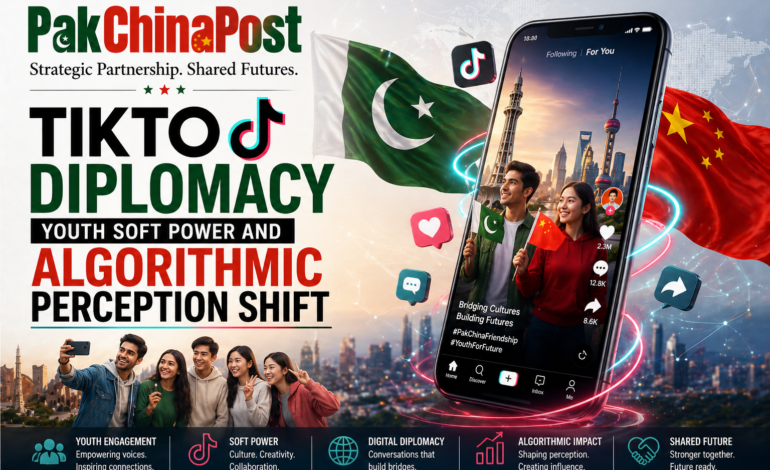
TikTok Diplomacy Youth Soft Power and Algorithmic Perception Shift

The rise of TikTok in Pakistan has quietly reshaped the country’s informational and geopolitical imagination in ways that traditional diplomatic theory struggles to fully explain. What was once understood as soft power exercised through embassies, cultural institutes, and state broadcasting has now migrated into an algorithmically governed attention economy where visibility itself becomes a form of influence. Within this emerging digital ecosystem, China’s image among Pakistan’s youth is increasingly not constructed through formal diplomacy but through short-form videos, viral aesthetics, and platform-driven narratives of development, modernity, and aspiration.
This transformation is not simply technological. It represents a deeper epistemic shift in how geopolitical meaning is produced. In earlier media eras, perception was shaped by editorial gatekeeping, institutional journalism, and state broadcasting hierarchies. Today, perception is increasingly shaped by recommendation systems that prioritize engagement, emotional intensity, and visual immediacy. In such an environment, diplomacy is no longer confined to speeches and policy statements; it is embedded in the architecture of attention itself.
On TikTok in Pakistan, China appears in highly stylised fragments of infrastructural modernity. High speed trains, luminous urban skylines, industrial automation, agricultural transformation, and technological innovation circulate as short visual units of progress. These clips are often detached from formal geopolitical context, yet they cumulatively construct an image of China as a technologically advanced, orderly, and future oriented civilisation. The repetition of such visual motifs produces what can be described as algorithmic soft power, where influence emerges not from deliberate persuasion but from continuous exposure.
The Pakistani youth demographic is central to this shift. With a median age well below global averages and rapidly expanding smartphone penetration, Pakistan represents one of the most active TikTok user bases in South Asia. For this generation, political perception is increasingly inseparable from platform experience. China is not encountered as a foreign policy actor in abstract terms but as a digital presence embedded in everyday scrolling habits. This creates a form of proximity without physical contact, where geopolitical understanding is mediated through entertainment logic.
The implications of this shift are profound. Traditional soft power theory assumes a relatively stable distinction between information producer and information consumer. TikTok disrupts this distinction entirely. Every user becomes a potential content producer, every viewer a potential amplifier, and every video a node in a decentralized influence network. In this environment, Chinese soft power does not operate solely through state directed campaigns but through a hybrid ecosystem where state affiliated content, commercial creators, and independent influencers converge unintentionally around similar visual narratives of development and modernity.
At the same time, the platform’s algorithmic structure intensifies certain types of content over others. Videos that evoke admiration, surprise, or aspiration tend to perform better than complex policy explanations or critical geopolitical analysis. As a result, representations of China that emphasize spectacle, efficiency, and technological advancement are more likely to circulate widely than those that engage with structural critique or political nuance. This does not necessarily indicate manipulation, but it does reflect a structural bias in how attention is distributed.
Chinese digital diplomacy has adapted rapidly to this environment. While traditional state media continues to play a role, there is increasing emphasis on platform native content strategies that align with TikTok’s visual grammar. This includes influencer collaborations, short documentary style clips, and localized storytelling formats that highlight Pakistan China friendship through human interest narratives. Engineers, students, traders, and workers are often featured in micro stories that emphasize collaboration and shared progress rather than abstract geopolitical alignment.
However, the perception shift among Pakistani youth is not entirely unidirectional. TikTok is also a site of fragmentation, contradiction, and counter narrative circulation. Alongside positive representations of China, there exist critical videos addressing labor conditions, regional inequalities, and local grievances associated with large infrastructure projects. In some cases, these narratives gain traction during moments of political tension or security related incidents. The platform thus functions simultaneously as a site of soft power projection and narrative contestation.
What makes TikTok particularly significant in the Pakistan China context is its ability to compress geopolitical complexity into emotionally legible visual sequences. Development becomes visible not as a policy outcome but as a sequence of before and after transformations. Infrastructure becomes aesthetic. Technology becomes aspirational identity. Diplomacy becomes lifestyle content. In this sense, TikTok does not simply communicate information; it reorganizes perception itself.
The concept of algorithmic diplomacy is useful here. Unlike classical diplomacy, which is intentional and state led, algorithmic diplomacy emerges through distributed interactions between users, platforms, and content systems. It is indirect, ambient, and continuous. China’s visibility on TikTok in Pakistan is therefore not solely the result of coordinated state messaging but also of platform dynamics that reward certain types of visual storytelling aligned with modernity, infrastructure, and technological advancement.
This creates a feedback loop. As content portraying Chinese development performs well, more creators produce similar content, which in turn increases visibility, which further reinforces perception. Over time, this loop generates a stable representational bias in which China is disproportionately associated with progress narratives in the digital imagination of young users. The geopolitical meaning of this association is subtle but significant, as it shapes how future generations intuitively interpret China’s role in regional and global affairs.
Yet this digital affinity is not without ambiguity. The same platform that circulates aspirational imagery also exposes users to competing geopolitical narratives, including those originating from Indian digital ecosystems, Western media fragments, and domestic political commentary. Pakistan China relations thus become part of a broader contested informational environment where multiple actors compete for visibility within the same attention economy. The result is not consensus but coexistence of contradictory perceptions.
Importantly, TikTok’s influence is not limited to political perception alone. It also shapes cultural imagination. Chinese music trends, fashion aesthetics, lifestyle content, and educational narratives circulate alongside infrastructural imagery, contributing to a broader sense of China as a multidimensional cultural reference point. This is particularly significant for younger users who may have limited direct exposure to China but develop strong mediated familiarity through repeated platform engagement.
The emergence of TikTok as a diplomatic space also raises questions about agency and control. Unlike traditional media, where content production is more centralized, TikTok’s ecosystem is decentralized and opaque. The extent to which any state, including China, can fully control narrative outcomes is therefore limited. Influence is probabilistic rather than deterministic. It operates through shaping conditions of visibility rather than dictating specific interpretations.
In Pakistan, this creates a layered media reality. Official narratives of Pakistan China friendship continue to operate through television, newspapers, and government communication channels. At the same time, TikTok generates parallel narrative streams that may reinforce, complicate, or occasionally contradict these official framings. The interaction between these layers produces a hybrid perception environment in which geopolitical understanding is fragmented, dynamic, and continuously negotiated.
One of the most important consequences of this shift is the changing nature of youth political consciousness. For many young users, China is not a distant geopolitical abstraction but a familiar digital presence associated with technological progress and economic possibility. This does not necessarily translate into formal political alignment, but it does shape emotional orientation and intuitive trust. In international relations terms, this represents a shift from cognitive diplomacy to affective diplomacy.
At the same time, there is a risk of oversimplifying this transformation as purely positive or uniformly influential. Digital perception is inherently unstable. Trends on TikTok are ephemeral, driven by algorithmic recalibration and shifting user interests. A narrative that dominates today may disappear tomorrow. This volatility means that while TikTok can amplify soft power in the short term, its long term impact is less predictable and more contingent than traditional media systems.
Moreover, the platform’s commercial logic introduces additional complexity. Engagement driven algorithms prioritize emotional intensity over informational accuracy. This can lead to the amplification of exaggerated, selective, or decontextualized representations of geopolitical realities. As a result, the image of China circulating on TikTok may be both highly influential and structurally incomplete.
Despite these limitations, the platform’s role in reshaping Pakistan China perception among youth is undeniable. It has introduced a new modality of diplomatic influence that operates through entertainment, participation, and algorithmic circulation rather than formal persuasion. In doing so, it has fundamentally altered the informational terrain on which geopolitical meaning is constructed.
In conclusion, TikTok diplomacy represents a significant evolution in the Pakistan China informational relationship. It reflects a broader global shift in which platforms have become central actors in shaping political perception. For Pakistan, this means that China is increasingly encountered not only as a strategic partner but as a digital presence embedded in everyday cultural consumption. For China, it represents both an opportunity and a challenge, as influence is now mediated through systems that are simultaneously expansive and uncontrollable.
The future of this dynamic will depend on how effectively both states understand and adapt to the logic of algorithmic visibility. In a world where perception is increasingly shaped by platforms rather than institutions, diplomacy is no longer only about negotiation between states but also about navigation within attention economies that are fluid, fragmented, and continuously evolving.
A Public Service Message


