
Positioning Pakistan Within Semiconductor Value Networks

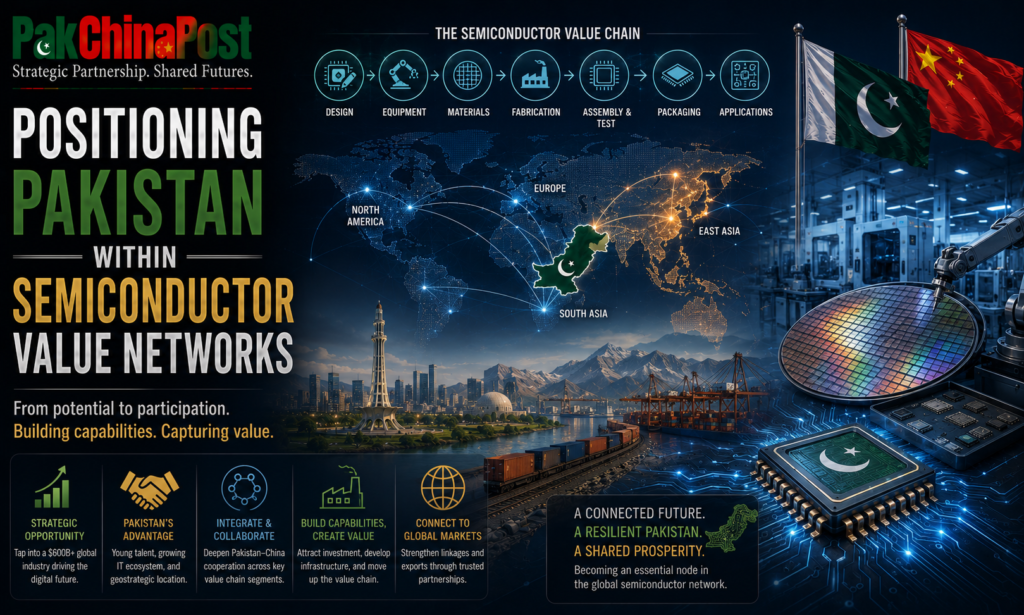
The global semiconductor industry has evolved into the most consequential industrial architecture of the twenty first century, defining the parameters of economic competitiveness, military modernization, and digital sovereignty. Unlike previous waves of industrial transformation driven by energy, textiles, or heavy manufacturing, the semiconductor domain is characterized by extreme specialization, geographically dispersed value chains, and high barriers to entry reinforced by capital intensity, intellectual property consolidation, and precision manufacturing requirements. Within this environment, Pakistan’s position remains peripheral, shaped more by consumption of imported electronic systems than participation in the design, fabrication, assembly, or testing stages that constitute the semiconductor value chain.
China’s trajectory within this ecosystem presents a differentiated model. While still dependent on external inputs for advanced lithography and certain categories of high end fabrication equipment, China has systematically expanded its capabilities across design, packaging, testing, materials engineering, and mature node fabrication. This expansion is not merely industrial but institutional, supported by long term state financing, university industry integration, and strategic alignment between municipal innovation zones and national technology objectives. The resulting architecture is not fully self sufficient, yet sufficiently diversified to exert structural influence over global supply dynamics. For Pakistan, the central question is not whether it can replicate this trajectory, but whether it can identify viable entry points into segmented portions of this value chain without overextending its institutional and technological capacity.
The prevailing policy discourse in Pakistan often treats semiconductors as an aspirational frontier rather than an actionable industrial domain. This perception is partly shaped by the extreme sophistication of leading edge fabrication processes, where nanometer scale precision, controlled environments, and multibillion dollar facilities dominate the narrative. However, the semiconductor ecosystem is not monolithic. It is composed of multiple layers including electronic design automation, chip design architecture, wafer fabrication at varying node levels, outsourced assembly and testing, substrate manufacturing, chemical supply chains, packaging technologies, and downstream integration into electronic systems. Each layer has distinct entry thresholds, capital requirements, and skill dependencies. Pakistan’s strategic opportunity lies not in attempting full spectrum participation, but in selective specialization within intermediate segments that align with its existing industrial base and human capital constraints.
The most immediate entry point lies in assembly, testing, marking, and packaging operations, commonly referred to as outsourced semiconductor assembly and testing. This segment is less capital intensive than advanced fabrication and relies more on process engineering, quality control systems, and logistics integration. Countries that have successfully entered this layer have often done so through export processing zones, foreign direct investment partnerships, and integration into multinational supply chains. Pakistan’s existing special economic zones, though underutilized in many respects, could be recalibrated to host such operations if supported by targeted infrastructure upgrades, regulatory clarity, and reliable energy provisioning. The role of Chinese firms in this segment is particularly relevant, given their expansion in mid tier semiconductor services and their search for geographically diversified production bases.
A second potential entry point is in semiconductor design services. While fabrication requires enormous capital expenditure, chip design relies more heavily on skilled human capital, software proficiency, and access to electronic design automation tools. Pakistan’s information technology sector, though uneven in scale, possesses pockets of engineering talent capable of contributing to design outsourcing ecosystems. Collaboration with Chinese design houses could facilitate structured entry into this domain through joint design centers, internship pipelines, and co development of application specific integrated circuits tailored to industrial and agricultural use cases. However, this would require a significant overhaul of technical education curricula, particularly in electrical engineering and computer architecture disciplines, where theoretical instruction often remains disconnected from industrial practice.
The upstream segment of materials engineering represents another underexplored domain. Semiconductor manufacturing depends on a complex array of inputs including silicon wafers, photochemical compounds, specialty gases, and precision materials. While Pakistan is not positioned to engage in high purity material production at scale in the immediate term, it could develop niche capabilities in supporting chemical supply chains, industrial gas management, and logistics for materials handling. Such participation would require stringent regulatory frameworks to ensure quality consistency, environmental safety, and compliance with international standards, but it would offer a relatively accessible entry point into the broader ecosystem.
The challenge of human capital remains central to any discussion of semiconductor participation. The industry demands a workforce trained not only in electrical engineering but also in materials science, quantum physics fundamentals, nanofabrication processes, and advanced computational modeling. Pakistan’s current educational infrastructure does not systematically produce graduates with exposure to these interdisciplinary domains at the required depth. Reforming this trajectory would require the establishment of specialized semiconductor engineering programs, potentially in collaboration with Chinese technical universities and research institutes that already operate within mature semiconductor ecosystems. Such programs would need to emphasize laboratory based training, industry embedded internships, and co supervised research projects aligned with industrial requirements rather than purely academic output.
China’s semiconductor ecosystem offers a pragmatic model of incremental capability accumulation. Rather than attempting immediate parity with leading global firms, Chinese institutions have focused on expanding competence in mature nodes, packaging technologies, and application specific chip development. This approach has enabled gradual substitution of imported components in domestic industries while simultaneously building capacity for more advanced experimentation. For Pakistan, selective adaptation of this model could provide a realistic pathway for entry. However, adaptation must account for structural differences in scale, industrial depth, and capital availability.
Institutional coordination represents a critical bottleneck in Pakistan’s current industrial policy environment. Semiconductor development cannot be achieved through isolated initiatives dispersed across ministries, universities, and private firms. It requires a centralized coordination mechanism capable of aligning educational reform, industrial policy, foreign investment strategy, and research funding. Without such coherence, efforts risk fragmentation and inefficiency. A dedicated semiconductor development authority, operating with cross ministerial authority and industry participation, could serve as the central node for policy implementation and international coordination.
Energy infrastructure is another decisive constraint. Semiconductor related activities, even in downstream segments, require stable, high quality, uninterrupted power supply. Frequent fluctuations in energy availability not only disrupt production processes but also compromise quality assurance standards essential for global supply chain integration. Addressing this challenge would require integration of industrial zones with dedicated energy provisioning systems, potentially including renewable energy clusters supplemented by grid stability enhancements. Collaboration with Chinese energy engineering firms could facilitate the design of such integrated systems, particularly in industrial parks designated for electronics manufacturing.
Regulatory modernization is equally essential. Semiconductor related industries operate within tightly regulated global compliance frameworks, including export controls, intellectual property protections, and environmental safety standards. Pakistan’s current regulatory environment is not fully aligned with these requirements, creating friction for potential investors and partners. Harmonization with international standards, particularly those observed in East Asian semiconductor hubs, would be necessary to ensure credibility and operational viability. This includes strengthening intellectual property enforcement mechanisms, streamlining customs procedures for high value electronic components, and establishing certification bodies for quality assurance.
Financial structuring poses another significant challenge. Semiconductor investments are characterized by long gestation periods and high initial capital requirements. Traditional banking systems in Pakistan are not structurally designed to support such investment profiles. Innovative financing mechanisms, potentially involving sovereign backed innovation funds, joint venture capital pools with Chinese institutions, and multilateral development financing, would be required to bridge this gap. The emphasis should be on de risked investment structures that encourage private sector participation while maintaining strategic oversight.
The geopolitical dimension of semiconductor supply chains cannot be ignored. Global competition over semiconductor technologies has intensified, with major economies seeking to secure supply chain resilience and reduce external dependencies. Within this environment, Pakistan’s participation must be carefully calibrated to avoid overexposure to geopolitical volatility while still securing meaningful integration into global production networks. Collaboration with China provides an entry point, but it must be structured in a way that allows Pakistan to maintain flexibility in its external economic relations.
Downstream integration represents a further area of opportunity. Semiconductors ultimately derive their economic value from incorporation into finished systems such as telecommunications equipment, automotive electronics, industrial automation tools, and consumer devices. Pakistan’s industrial base could potentially expand into assembly and integration of such systems, particularly in telecommunications infrastructure and agricultural technology applications. This would create domestic demand for semiconductor components while simultaneously embedding local firms within broader value chains.
The long term sustainability of semiconductor participation depends on the creation of innovation ecosystems rather than isolated industrial projects. Innovation ecosystems require continuous interaction between universities, firms, regulatory bodies, and international partners. They also require cultural shifts in research orientation, moving away from purely theoretical output toward applied problem solving and iterative experimentation. Without such shifts, infrastructure investments risk underutilization.
A bilateral Pakistan China semiconductor collaboration framework would therefore need to extend beyond trade and investment agreements into institutional co design. Joint research laboratories, shared fabrication facilities at mature node levels, and co governed training institutes could form the backbone of such a framework. However, governance structures must ensure equitable participation and avoid asymmetrical dependency.
Policy makers must also recognize that semiconductor capability development is a generational process rather than a short-term industrial intervention. Expectations of rapid transformation are unrealistic and potentially counterproductive. Instead, incremental milestones should be established, focusing first on assembly and testing capabilities, then gradually expanding into design services, materials support, and eventually limited fabrication participation in mature nodes.
In conclusion, Pakistan’s potential integration into semiconductor value networks is neither unattainable nor immediate. It requires disciplined prioritization, institutional restructuring, and sustained international collaboration. China offers a practical partner in this process, not as a source of transfer alone, but as a co architect in selective ecosystem development. The decisive factor will be Pakistan’s ability to align its educational systems, industrial policies, and regulatory frameworks into a coherent long-term strategy that recognizes the segmented nature of semiconductor value creation. The opportunity exists within defined constraints, but its realization depends on the capacity to transform aspiration into structured capability building over time.
A Public Service Message