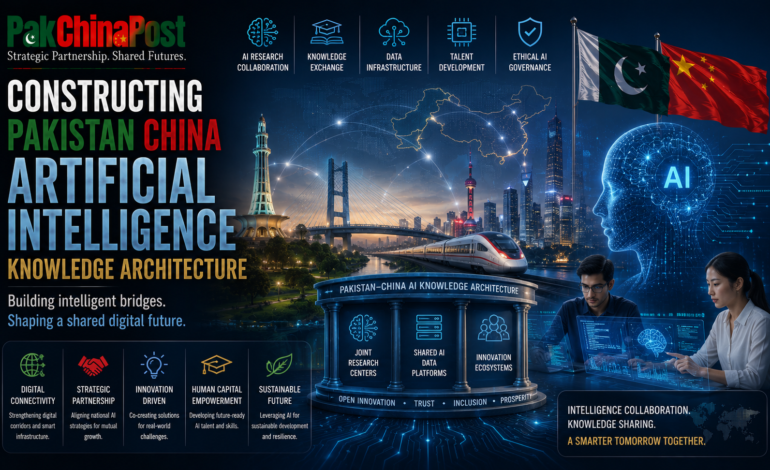
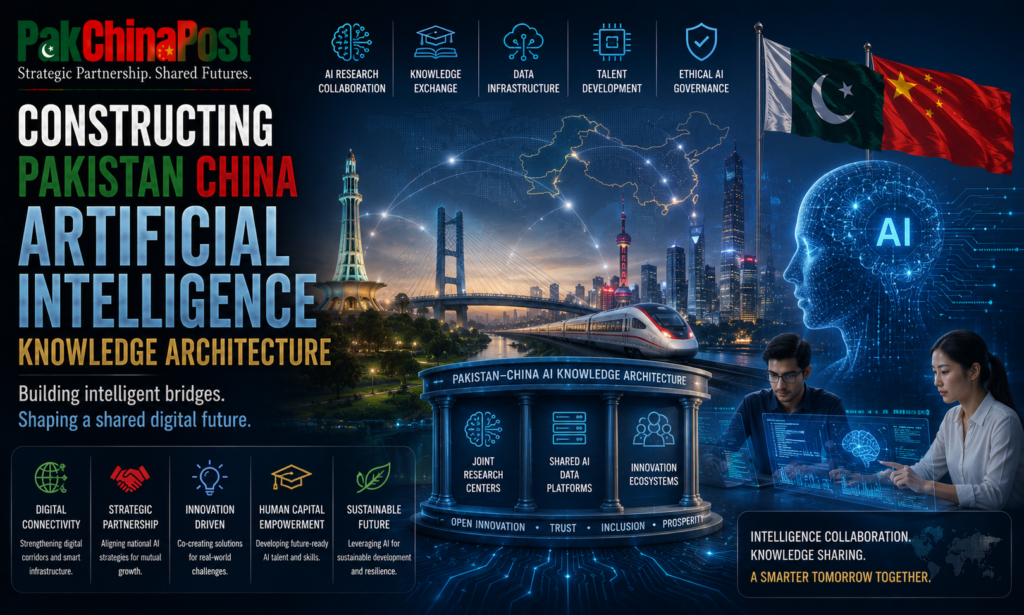
Constructing Pakistan China Artificial Intelligence Knowledge Architecture

The contemporary evolution of artificial intelligence has ceased to be a mere technological progression and has instead assumed the characteristics of a structural force reshaping epistemic authority, industrial competitiveness, and state capacity. Within this emergent configuration, Pakistan’s position remains largely defined by consumption patterns of imported digital systems, fragmented computational capacity, and episodic research output that seldom transcends academic insulation into scalable industrial application. China, by contrast, has developed an integrated innovation machine where state directives, private capital, university laboratories, and municipal experimentation zones operate in calibrated alignment, producing a dense ecosystem of algorithmic development, data governance experimentation, and infrastructure scaling. The asymmetry between these two trajectories defines both an opportunity and a constraint for bilateral technological cooperation that is no longer optional but increasingly systemic.
The prevailing narrative within policy circles often reduces collaboration to technology transfer or joint academic ventures. Such framing is analytically insufficient. Artificial intelligence ecosystems are not transferred; they are cultivated through layered institutional convergence, sustained computational investment, and continuous feedback loops between applied deployment and theoretical refinement. The absence of such loops in Pakistan’s current research environment creates a structural dependency that limits the absorption of advanced models and inhibits indigenous innovation capacity. The challenge, therefore, is not access to Chinese expertise but the construction of a domestic architecture capable of metabolizing that expertise into locally relevant innovation.
China’s AI ecosystem demonstrates a distinct pattern of state-enabled acceleration. Its success is not derived solely from capital allocation but from institutional orchestration. Universities are embedded within industrial partnerships, municipal authorities serve as experimental regulators for algorithmic deployment, and data is treated as a national resource governed under strategic parameters. The resulting environment produces rapid iteration cycles in machine learning systems, autonomous platforms, and applied computational linguistics. For Pakistan, the absence of such integrative mechanisms means that isolated pockets of competence remain disconnected from industrial demand and policy application. Research outputs often remain confined to conference proceedings without transition into deployable systems.
A bilateral AI research architecture would therefore require Pakistan to reconceptualize its institutional design rather than merely expand funding envelopes. The first axis of reform lies in the restructuring of higher education governance in technical disciplines. Universities must evolve from credential-producing institutions into problem-solving laboratories embedded within national priority sectors such as agriculture optimization, urban infrastructure management, energy distribution modeling, and public health analytics. This transformation cannot occur without redefining incentive structures for faculty, where publication metrics alone are insufficient and must be supplemented by applied deployment benchmarks and industry-linked innovation outputs.
The second axis concerns computational infrastructure, which remains the most decisive determinant of AI competitiveness. High-performance computing clusters, cloud-based training environments, and secure data repositories form the substrate upon which machine learning systems are trained. Without sovereign or semi-sovereign access to such infrastructure, Pakistan risks perpetuating a dependency on external platforms that limits both data autonomy and algorithmic sovereignty. Collaboration with Chinese institutions could facilitate access to scalable computing resources, but such access must be structured through joint governance frameworks rather than unilateral dependence. Shared compute architectures, co-managed data centers, and bilateral cloud protocols would constitute a more sustainable model of engagement.
A third dimension involves data architecture and governance. Artificial intelligence systems derive their predictive and analytical strength from the volume, diversity, and integrity of datasets. Pakistan’s data environment remains fragmented across administrative silos, with limited interoperability between federal, provincial, and sectoral databases. A foundational prerequisite for any AI ecosystem is therefore the consolidation of data infrastructures into interoperable frameworks governed by standardized protocols. China’s experience in constructing large-scale data governance systems, particularly in urban management and industrial monitoring, offers a potential reference point, though direct replication would be neither feasible nor desirable due to differing regulatory and socio-political contexts. Instead, selective adaptation of data harmonization principles could enable Pakistan to construct a hybrid model of controlled openness and institutional oversight.
Industrial participation represents the fourth structural pillar. In most advanced AI ecosystems, private sector firms serve as the primary engines of applied innovation, translating academic research into commercial products and scalable solutions. Pakistan’s private technology sector remains relatively small, risk-averse, and structurally disconnected from research institutions. A recalibration is required wherein joint ventures with Chinese technology firms are not limited to infrastructure projects but extended into algorithmic development, localized AI applications, and sector-specific automation tools. This would necessitate regulatory adjustments to facilitate intellectual property sharing frameworks that protect innovation while encouraging cross-border collaboration.
The question of talent development is equally central. Artificial intelligence ecosystems are fundamentally human capital systems before they become technological systems. Pakistan’s current talent pipeline produces graduates with theoretical exposure but limited practical engagement with advanced machine learning frameworks, large language models, or distributed computing systems. A structured exchange mechanism with Chinese universities and research institutes could address this gap, but such exchanges must be institutionalized rather than episodic. Dual-degree programs, joint doctoral supervision, and embedded research residencies would provide more durable pathways for knowledge transfer. However, the deeper challenge lies in retaining talent within domestic systems, as global labor markets continue to exert gravitational pull on skilled engineers and data scientists.
Policy architecture must also address the regulatory ambiguity surrounding artificial intelligence deployment. In the absence of clear ethical frameworks, deployment risks becoming inconsistent and fragmented, particularly in sensitive sectors such as surveillance, financial modeling, and predictive governance. A bilateral policy dialogue with Chinese regulatory authorities could assist in developing governance templates that balance innovation with oversight. However, Pakistan must avoid importing regulatory models wholesale, instead adapting them to its constitutional, legal, and institutional context.
The emerging global environment of AI development is increasingly characterized by consolidation around a limited number of computational hubs and data ecosystems. Within this configuration, smaller states face the risk of becoming peripheral consumers of externally generated intelligence systems. Pakistan’s strategic objective, therefore, should not be defined in terms of competition with major technological powers but in terms of selective integration into high-value segments of the AI value chain. These segments may include natural language processing for regional languages, agricultural optimization algorithms tailored to arid climates, logistics modeling for corridor-based trade systems, and public sector automation tools designed for high-population governance environments.
China’s interest in expanding collaborative technological ecosystems aligns with its broader objective of diversifying innovation partnerships and embedding its technological standards across multiple regions. However, such alignment must be approached through a calibrated framework that preserves Pakistan’s institutional autonomy while enabling deep technological integration. Dependency-driven models would undermine long-term sustainability, whereas co-creation models would generate mutual resilience. The distinction between these two approaches is not semantic but structural.
Financing mechanisms constitute another critical dimension of ecosystem development. AI research and deployment require sustained capital flows that are often incompatible with short-term budgetary cycles. Establishing joint innovation funds, backed by both public and private stakeholders from Pakistan and China, could provide the financial stability necessary for long-term research programs. Such funds should prioritize high-risk, high-reward projects rather than incremental technological upgrades, thereby encouraging experimentation in frontier domains such as neural architecture optimization, edge computing applications, and multilingual generative systems.
The integration of artificial intelligence into public governance systems presents both opportunities and risks. On one hand, predictive analytics can enhance service delivery, optimize resource allocation, and improve administrative efficiency. On the other hand, algorithmic governance without transparency mechanisms may exacerbate institutional opacity and reduce public trust. A carefully designed framework for explainable AI, auditability of algorithms, and citizen-facing transparency protocols would therefore be essential components of any large-scale deployment strategy.
At the geopolitical level, the evolution of AI ecosystems is increasingly influencing economic hierarchies and diplomatic alignments. States with advanced computational capabilities are able to shape standards, influence regulatory regimes, and define interoperability protocols. For Pakistan, participation in such standard-setting processes through collaboration with Chinese institutions offers a pathway to partial inclusion in global technological governance structures. However, participation must be strategic rather than symbolic, grounded in demonstrable domestic capability.
The cultural dimension of technological development is often overlooked but remains significant. Artificial intelligence systems are not culturally neutral; they embed linguistic patterns, behavioral assumptions, and normative frameworks derived from their training environments. Developing AI systems that are sensitive to local linguistic diversity, socio-cultural norms, and governance structures is therefore essential for ensuring relevance and usability. Collaboration with Chinese institutions in this domain could focus on multilingual model development, particularly for South Asian languages, dialectal variations, and hybrid linguistic forms.
The sustainability of any AI ecosystem ultimately depends on institutional continuity. Policy discontinuities, administrative turnover, and fragmented governance structures have historically undermined long-term technological initiatives in Pakistan. A bilateral framework with China could mitigate some of these risks by embedding projects within intergovernmental agreements that extend beyond electoral cycles. However, external stabilization cannot substitute for internal institutional coherence.
The transition from a consumer-oriented digital economy to a producer-oriented AI ecosystem is neither linear nor rapid. It requires sequential layering of reforms across education, infrastructure, regulation, industry, and finance. The Pakistan-China technological relationship, if properly structured, could serve as an accelerant for this transition, but only if it is grounded in co-development principles rather than asymmetrical transfer models.
In policy terms, the most urgent requirement is the establishment of a national artificial intelligence coordination authority tasked with integrating research agendas, industrial partnerships, and international collaborations into a unified strategic framework. Such an institution would function not as a bureaucratic layer but as an orchestration hub, ensuring coherence across disparate initiatives and preventing fragmentation of effort.
Ultimately, the construction of a Pakistan-China artificial intelligence knowledge architecture is less a technological project than a state capacity project. It demands reconfiguration of institutional logics, recalibration of educational priorities, and redesign of innovation incentives. The opportunity exists, but it is constrained by time, institutional inertia, and global acceleration in computational capability. The decisive variable will not be access to technology but the ability to institutionalize learning at scale and sustain it across administrative cycles.
A Public Service Message