Strategic Convergence: Pakistan, China, and the Recalibration of Global Power

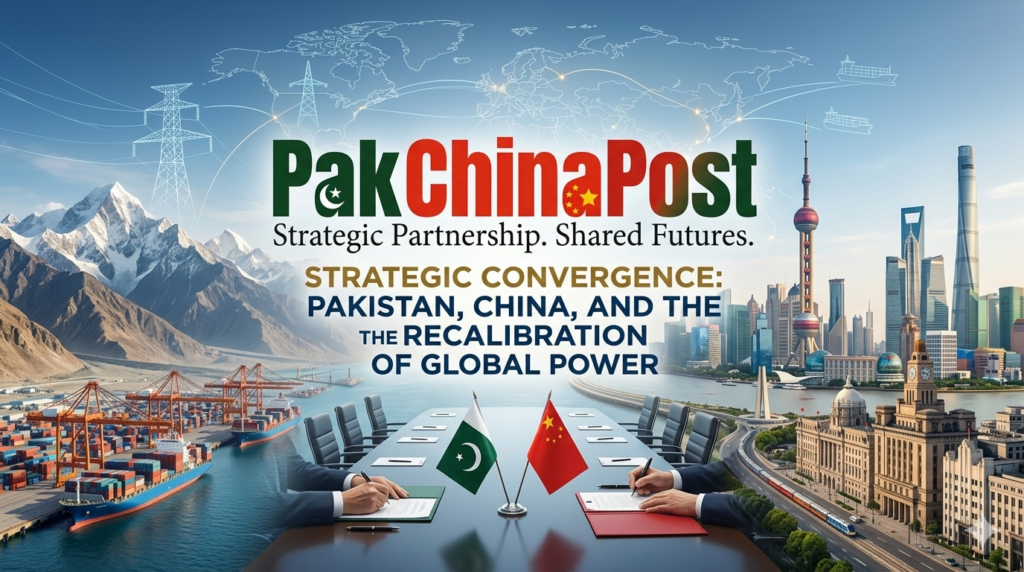
Pakistan stands at a profoundly intricate geopolitical crossroads where converging alignments among global powers generate both constraint and possibility. The evolving strategic convergence between the United States, India, and Israel, increasingly reinforced by partners such as the European Union, Japan, Canada, and Australia, reflects not merely a set of bilateral or regional partnerships but a broader attempt to consolidate influence across economic, technological, and security domains. Within this shifting architecture, Pakistan confronts a dual reality: on one hand, it faces mounting external pressure in a system that privileges established powers, and on the other, it encounters emerging opportunities within an increasingly multipolar order. It is in this context that China assumes a central role, not as a conventional ally bound by transactional engagement, but as a structural counterweight capable of reshaping the strategic calculus of the region. However, the sustainability of Pakistan’s engagement with China rests not upon subordination or passive alignment, but upon the cultivation of a dynamic and mutually reinforcing symbiosis.
To appreciate the depth of this convergence, it is essential to situate China’s rise within a broader historical and institutional framework. China’s transformation over the past four decades represents one of the most significant shifts in the global distribution of power. Unlike many postcolonial states that navigated development through reactive and externally influenced policy frameworks, China pursued a model anchored in long-term strategic planning, institutional coherence, and an unwavering commitment to technological self-reliance. The Chinese state has demonstrated an exceptional capacity to align political authority with economic ambition, thereby enabling sustained industrialization, rapid poverty reduction, and the creation of globally competitive technological ecosystems. This synthesis of governance and development is underpinned by a civilizational consciousness that situates modernization within a continuum of historical identity, rather than as a rupture imposed from outside.
For Pakistan, engagement with this model offers insights that extend far beyond the immediate gains of infrastructure investment or financial assistance. It opens a pathway toward reimagining state capacity itself, emphasizing the importance of coordinated policymaking, institutional discipline, and the prioritization of long-term national objectives over short-term political expediency. The challenge, however, lies in translating these lessons into a domestic context characterized by structural constraints, governance deficits, and competing political interests. Strategic convergence with China, therefore, must be understood as a process of selective adaptation rather than wholesale imitation.
Historically, Pakistan’s relationship with China has evolved through phases that reflect both continuity and transformation. From early diplomatic recognition to deepening defense cooperation, the partnership has consistently functioned as a stabilizing axis within a volatile regional environment. China’s diplomatic support at forums such as the United Nations Security Council has provided Pakistan with critical leverage, particularly in moments of heightened tension. Similarly, joint defense initiatives, exemplified by platforms such as the JF-17 Thunder, have enabled Pakistan to transition from a position of reliance on external suppliers to one of collaborative production. These developments signify not merely tactical cooperation but the gradual construction of strategic trust.
In the contemporary era, however, the axis of convergence is increasingly defined by economic and technological interdependence. The China-Pakistan Economic Corridor stands as the most visible embodiment of this shift, representing a comprehensive framework for connectivity, infrastructure development, and industrial integration. Yet its true significance lies in its potential to transform Pakistan’s economic structure. If effectively implemented, it can facilitate the transition from a consumption-driven economy to one oriented toward production and export competitiveness. This transformation, however, is contingent upon complementary domestic reforms, including the development of human capital, the strengthening of regulatory institutions, and the creation of an enabling environment for private sector participation.
The economic dimension of Pakistan–China convergence must also be situated within the broader context of global financial architecture. For decades, Pakistan’s engagement with international financial institutions has been characterized by cycles of borrowing and conditionality, which have constrained policy autonomy and limited the scope for independent decision-making. In contrast, China’s efforts to construct alternative financial frameworks, including institutions such as the Asian Infrastructure Investment Bank and initiatives like the Belt and Road Initiative, offer new avenues for engagement. These platforms are not devoid of strategic considerations, yet they provide an opportunity to diversify financial partnerships and reduce overreliance on traditional sources of funding.
At the same time, the pursuit of financial diversification must be accompanied by a renewed emphasis on domestic fiscal responsibility. External partnerships, regardless of their origin, cannot substitute for the fundamental requirement of building a robust and sustainable economic base. This necessitates comprehensive tax reforms, the reduction of inefficiencies in public expenditure, and the creation of mechanisms to ensure transparency and accountability. Without such measures, the benefits of external engagement risk being diluted by internal structural weaknesses.
The technological dimension of convergence represents perhaps the most critical frontier in the evolving relationship between Pakistan and China. In an era defined by the centrality of data, artificial intelligence, and digital infrastructure, technological capability has become synonymous with strategic power. China’s advancements in these domains position it as a leading actor in shaping the future of global innovation. For Pakistan, collaboration with Chinese technology firms such as Huawei offers an opportunity to accelerate digital transformation and enhance connectivity. However, the long-term value of such collaboration depends on the extent to which it facilitates knowledge transfer, capacity building, and the development of indigenous technological ecosystems.
Equally important is the question of governance within the digital domain. The integration of advanced technologies into state and society raises complex issues related to data sovereignty, cybersecurity, and regulatory oversight. Pakistan must therefore approach technological convergence with a clear strategic vision that balances the benefits of innovation with the imperatives of national security and individual rights. This requires the development of comprehensive policy frameworks that are informed by global best practices while remaining responsive to local realities.
Beyond economics and technology, the convergence between Pakistan and China also encompasses a broader geopolitical and normative dimension. China’s emphasis on principles such as non-interference and mutual respect resonates strongly within the Global South, where historical experiences of colonialism and external intervention continue to shape political consciousness. For Pakistan, alignment with this normative framework provides an opportunity to assert a more independent voice within the international system. At the same time, it underscores the importance of maintaining a balanced approach to diplomacy, one that avoids the pitfalls of exclusivity while maximizing the benefits of strategic partnerships.
The cultural and civilizational aspects of this relationship further enrich its complexity. China’s identity as a civilizational state, characterized by a deep sense of historical continuity and cultural cohesion, offers a distinctive perspective on development and governance. For Pakistan, engagement at this level opens avenues for educational exchange, cultural dialogue, and the cultivation of mutual understanding. Such interactions have the potential to strengthen the social foundations of the bilateral relationship, ensuring that it is not confined to the realm of elite policymaking but extends to broader societal engagement.
Nevertheless, a comprehensive analysis must also address the inherent risks associated with deepening convergence. Overreliance on a single partner, regardless of its strengths, can create vulnerabilities that undermine long-term stability. Trade imbalances, for instance, represent a persistent challenge in Pakistan–China economic relations, while the concentration of large-scale projects in specific sectors may limit diversification. Furthermore, the perception of asymmetry within the relationship can generate domestic concerns that, if left unaddressed, may erode public support.
To mitigate these risks, Pakistan must adopt a strategy of calibrated integration. This entails leveraging Chinese investment and expertise in a manner that strengthens domestic capabilities and promotes inclusive growth. It also requires a commitment to transparency in project implementation, ensuring that the benefits of cooperation are widely distributed across society. In this context, the role of governance becomes paramount, as effective institutions are essential for translating external opportunities into tangible outcomes.
Looking ahead, the recalibration of global power is likely to intensify, driven by technological competition, shifting economic dynamics, and evolving geopolitical alignments. In this environment, Pakistan’s ability to navigate complexity will depend on its capacity to align external partnerships with internal priorities. The relationship with China provides a critical foundation for this process, offering both strategic support and developmental opportunities. However, its success ultimately hinges on Pakistan’s willingness to undertake the necessary reforms and to articulate a coherent vision for its future.
In conclusion, the convergence between Pakistan and China represents a significant development within the broader transformation of the international system. It reflects the emergence of new centers of power and the reconfiguration of global relationships in ways that challenge established hierarchies. For Pakistan, this convergence offers a pathway toward greater resilience and autonomy, provided it is approached with strategic clarity and a commitment to internal strengthening. The task, therefore, is not merely to align with China, but to engage with it in a manner that enhances Pakistan’s own capabilities and secures a stable and prosperous future for its citizens.
A Public Service Message