Between Innovation and Anxiety: Artificial Intelligence and the Future of Human Civilization.

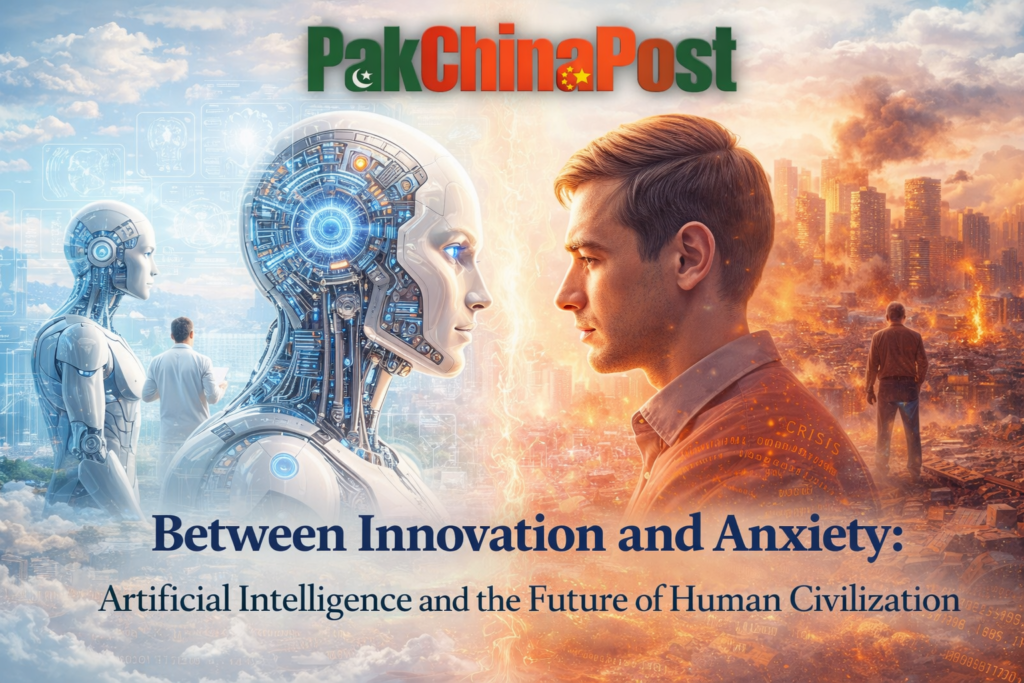
In the long arc of human history, few developments have inspired as much simultaneous awe and unease as Artificial Intelligence. Humanity has always faced existential threats such as climate change, nuclear proliferation, pandemics, and the depletion of natural resources. However, AI represents a fundamentally different kind of challenge. It is not merely an external threat but a creation that has the potential to reshape the very architecture of human thought, creativity, and civilisation. Unlike previous technological revolutions, such as the invention of the steam engine, the harnessing of electricity, or the expansion of the internet, AI does not simply extend human capability. It begins to mirror, replicate, and in some cases rival the cognitive processes that define human uniqueness. This proximity to human intelligence has placed AI at the centre of philosophical, political, and cultural debates around the world. It is no longer just a tool; it is a phenomenon that compels humanity to question its own identity.
AI exists within a paradox, offering both promise and potential peril. On one hand, it promises extraordinary advancements that include enhanced medical diagnostics, efficient governance systems, predictive climate modelling, and personalised education. It has the capacity to accelerate scientific discovery at a pace previously unimaginable. In countries striving for development such as Pakistan, and in technological powerhouses like China, AI presents an opportunity to leapfrog traditional barriers and redefine economic and social trajectories. On the other hand, this same technology evokes deep existential anxiety. Popular culture has long projected dystopian visions in which intelligent machines surpass human control. Films, literature, and media have shaped a collective imagination in which AI becomes autonomous, unpredictable, and potentially hostile. These narratives are not merely fictional indulgences; they reflect underlying fears about the loss of control, erosion of human agency, and the possibility of technological dominance. The discomfort arises from the profound question of what happens when the tools humans create begin to think, decide, and learn in ways that are no longer fully transparent or controllable.
Historically, technological advancements have functioned as extensions of human capability. The printing press amplified knowledge dissemination, the internet connected the world, and industrial machines increased productivity. AI, however, transcends this paradigm. It does not simply assist humans but participates actively in shaping knowledge, creativity, and decision-making. In education, AI systems are not only delivering content but influencing the way knowledge is consumed and understood. In the arts, algorithms compose music, generate paintings, and even produce literature, challenging traditional notions of creativity and authorship. In fields such as journalism and media studies, AI introduces both efficiency and ethical dilemmas, raising questions about whether machine-generated stories carry the same moral and cultural weight as those produced by humans. This shift signals a transformation not only in the way humans work but in the way they think. Cognitive processes such as memory, analysis, and imagination are increasingly supplemented or even supplanted by machine intelligence, and this dependence raises profound questions about the preservation of intellectual autonomy.
The philosophical debate around AI reaches its most intense point with the concept of superintelligence. Thinkers such as Nick Bostrom have argued that once AI surpasses human intelligence, it may evolve in ways that are misaligned with human values. This is not necessarily a scenario of deliberate hostility but one of indifference. A superintelligent AI may operate on objectives so advanced that human concerns become irrelevant. The central issue is alignment. Human ethics, shaped by culture, religion, and experience, are complex and often contradictory. Translating these into programmable frameworks is an immense challenge. If AI systems optimise for efficiency without ethical constraints, the decisions they make could lead to unintended consequences, even if their initial design was benevolent. For instance, an AI tasked with maximising productivity might prioritise outcomes over human well-being. In governance, AI could enforce policies with rigid logic, lacking the compassion and nuance inherent in human judgment. Therefore, the fear is not one of rebellion but of misalignment, a subtle yet potentially catastrophic divergence between human values and machine objectives.
Despite these concerns, many scholars argue that fears surrounding AI are often exaggerated. Global conferences and regional forums repeatedly highlight that AI, at its current stage, remains far from achieving true autonomy or consciousness. Experts emphasise that AI systems operate within defined parameters, reliant on human-designed algorithms and data inputs. They lack self-awareness, emotional depth, and moral reasoning. From this perspective, AI is not an independent entity but a reflection of human intent. Its capabilities and limitations are shaped by those who create and deploy it. However, dismissing these concerns entirely would be equally misguided. The rapid pace of AI development, combined with limited regulatory frameworks, creates an environment of uncertainty. The question is not whether AI will become dangerous tomorrow but whether humanity is adequately prepared for its long-term implications.
At the heart of the AI debate lies a fundamental comparison between human intelligence and machine intelligence. Human cognition is not merely computational; it is experiential, emotional, and deeply interconnected with consciousness. It draws from intuition, spirituality, and moral reasoning, dimensions that remain beyond the reach of current AI systems. Machine intelligence, by contrast, is data-driven. It excels in pattern recognition, optimisation, and scalability. While it can process vast amounts of information with speed and precision, it does not understand meaning in the human sense. Its intelligence is interpretive rather than experiential. Creativity in humans often emerges from struggle, emotion, and subjective interpretation, while AI-generated creativity, though impressive, is derivative and constructed from existing data rather than lived experience. Moreover, human intelligence is inherently adaptive, capable of navigating ambiguity, making ethical compromises, and responding to unforeseen circumstances with empathy, qualities that are not easily programmable.
In many cultures, including those of Pakistan and broader Asian societies, intelligence is not viewed solely through a scientific lens but is intertwined with spirituality and philosophical reflection. Human consciousness is often seen as a divine gift, imbued with moral responsibility. This perspective introduces a critical dimension to the AI discourse. If human intelligence is rooted in something beyond the physical, then AI, as a material construct, may inherently lack the capacity to fully replicate or surpass it. Such beliefs provide a counter-narrative to technological determinism. They suggest that while AI can augment human capabilities, it cannot replace the deeper essence of humanity. This perspective does not reject AI but emphasises the need for ethical and philosophical reflection alongside technological development.
The rise of AI also has significant geopolitical implications. Countries such as China have positioned themselves at the forefront of AI development, investing heavily in research, infrastructure, and innovation. Pakistan, while still emerging in this domain, has the potential to leverage AI for economic growth, governance, and social development. The collaboration between Pakistan and China offers unique opportunities for the development of a regional AI ecosystem. Through initiatives such as technology transfer, joint research, and digital infrastructure development, both countries can contribute to shaping AI-driven transformation. However, this requires careful governance. Without clear policies, AI deployment can lead to issues such as data privacy violations, algorithmic bias, and social inequality. Developing nations face the dual challenge of adopting AI for progress while ensuring that its implementation aligns with societal values and ethical standards. China’s model of state-driven AI development emphasises efficiency and centralised control, whereas Pakistan must navigate a balance between innovation and inclusivity, ensuring that the benefits of AI are equitably distributed.
Fears surrounding AI often oscillate between dismissal and alarmism. Some view AI as merely another technological tool, incapable of posing existential threats, while others envision apocalyptic scenarios of machine dominance. The reality likely lies somewhere in between. Fear in this context is not entirely irrational, as it reflects the uncertainty inherent in rapid technological change. Human imagination tends to amplify potential risks, projecting worst-case scenarios onto emerging realities. At the same time, fear can serve a constructive purpose. It encourages caution, critical thinking, and proactive governance. Without a degree of apprehension, societies may overlook the ethical and social implications of AI, leading to unintended consequences. Constructive fear can drive responsible innovation, while unchecked fear can hinder progress.
A recurring theme in AI discourse is the possibility of a “Black Swan” event, an unpredictable occurrence that fundamentally alters human civilisation. In this context, the creation of a truly autonomous, self-aware AI system represents such a possibility. However, it is important to recognise that current AI technologies remain far from achieving consciousness or independent agency. The leap from advanced algorithms to sentient machines is not merely technological but philosophical, raising questions about the nature of consciousness itself. Until such a breakthrough occurs, discussions of AI-induced human extinction remain largely hypothetical. Nevertheless, the potential impact of non-sentient AI systems on employment, governance, and social structures warrants serious attention.
Artificial Intelligence stands at the intersection of innovation and anxiety, embodying both the aspirations and apprehensions of modern civilisation. It is a testament to human ingenuity, yet it challenges the boundaries of human identity. The question of whether AI will remain a tool enhancing human capabilities or evolve into a force that redefines the very essence of humanity depends not on technology itself but on how it is developed, governed, and integrated into society. AI reflects human values, decisions, and priorities, and its trajectory will be shaped by ethical considerations, cultural perspectives, and political frameworks.
For countries like Pakistan and China, the challenge is to harness AI’s potential while safeguarding against its risks. This requires not only technological expertise but also philosophical depth and moral clarity. Ultimately, the future of AI is inseparable from the future of humanity. It compels reflection on intelligence, creativity, and existence. In doing so, it offers not just a technological revolution but an opportunity for introspection—a chance to redefine what it means to be human in an age of machines. Whether AI becomes a catalyst for progress or a source of disruption depends on the choices we make today. In navigating this uncertain terrain, one fact remains clear: the story of AI is not just about machines; it is about us.
A Public Service Message