
Civilizational Harmony and Cultural Diplomacy in the Pakistan-China Partnership

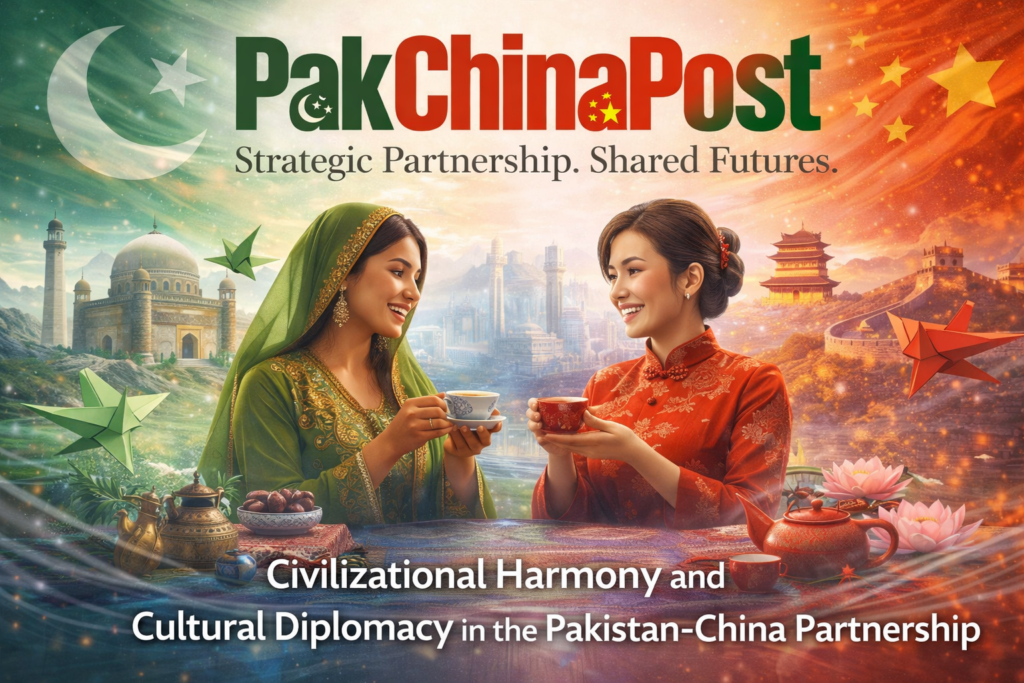
In the contemporary international system, where influence extends beyond material power into symbolic and intellectual domains, the notion of a civilizational state has gained renewed salience. China presents itself not merely as a rising economic and military actor but as a society whose political philosophy, development trajectory, and social organization are deeply rooted in historical continuity. This self-identification distinguishes China from Western frameworks, which traditionally link modernization with liberal political prescriptions, thereby offering a developmental model that resonates with segments of the Muslim world. For Pakistan, engagement with China in this framework offers a strategic opportunity to recalibrate external relations while simultaneously enriching domestic policies on governance, culture, and national identity.
China’s model exemplifies the synthesis of tradition and modernization. Unlike approaches that perceive development as a break from the past, China harmonizes historical identity with technological and economic advancement. Governance systems, industrial strategies, and cultural initiatives reflect this interplay, demonstrating that modernization can coexist with enduring civilizational ethos. Pakistan, with its layered history, faith-based identity, and postcolonial experience, finds in this approach a framework for constructing a developmental pathway that balances continuity and forward-looking transformation.
Educational collaboration represents a pivotal dimension of this partnership. Academic exchanges, research initiatives, and joint scholarly projects facilitate the transfer of technical expertise while cultivating mutual understanding. Pakistani institutions benefit from exposure to Chinese innovation in science, technology, and applied research, strengthening domestic capacity. Simultaneously, Pakistani scholars gain insights into China’s pedagogical philosophies and cultural traditions, fostering intellectual versatility. Such programs cultivate a generation equipped to engage with global technological, economic, and cultural currents while retaining national identity.
Media cooperation constitutes another critical pillar of strategic alignment. In an era dominated by rapid information flows, shaping narratives and countering disinformation are essential for safeguarding national interests. Joint media initiatives between Pakistan and China can amplify perspectives that otherwise face marginalization in global discourse. Collaborative content production, cross-platform broadcasting, and digital partnerships provide avenues to articulate shared priorities, reinforce bilateral trust, and present a counterbalance to adversarial narratives that may distort regional realities.
Cultural diplomacy further enhances bilateral engagement by emphasizing historical linkages and people-to-people interaction. The legacy of the Silk Road, which facilitated the movement of goods, ideas, and cultural practices, serves as a powerful symbol of interconnectedness between the two regions. Reviving this shared heritage allows both countries to construct a narrative of continuity that transcends contemporary political arrangements. Cultural exchanges encompassing art exhibitions, literary collaborations, festivals, and heritage preservation initiatives create platforms for showcasing creativity, reinforcing trust, and deepening societal connections.
China’s philosophy of international engagement prioritizes development cooperation over ideological imposition, enhancing its attractiveness as a partner for states seeking pragmatic solutions. This approach holds particular significance for Pakistan, where past external interventions have often been accompanied by prescriptive frameworks inconsistent with local conditions. China’s adherence to principles of respect for sovereignty and non-interference allows for flexible partnerships tailored to Pakistan’s strategic objectives and domestic priorities. While Chinese interests are evident, the cooperative model relies on alignment of objectives rather than unilateral imposition, thereby fostering sustainable and mutually beneficial collaboration.
The resonance of China’s model within the broader Muslim world reflects shared concerns regarding modernization, cultural preservation, and development. Many societies seek pathways to economic growth that respect religious and cultural norms, and China’s experience demonstrates that rapid transformation need not entail the abandonment of civilizational identity. For Pakistan, adopting aspects of this approach informs domestic policies and enhances its capacity to offer constructive examples within the Muslim geopolitical sphere.
While these forms of alignment provide substantial advantages, careful management is required to maintain authenticity and strategic balance. Engagement must avoid eroding Pakistan’s distinctive cultural, historical, and institutional identity. Bilateral initiatives should emphasize dialogue, adaptation, and mutual enrichment, ensuring that cooperation strengthens rather than homogenizes societal characteristics. Pakistan’s diverse heritage requires that cultural interaction remain reciprocal, with both countries contributing to and benefiting from shared projects.
Language and communication are critical tools in reinforcing this partnership. Proficiency in Chinese enables Pakistani professionals, students, and policymakers to engage effectively across academic, technological, and diplomatic fields. Similarly, promoting Urdu and other regional languages in China fosters understanding, empathy, and cultural literacy. These initiatives deepen trust, facilitate collaboration, and contribute to a sustainable long-term relationship that extends beyond transactional exchanges.
Integrating cultural, educational, and media efforts with economic and technological cooperation enhances the multidimensional character of the partnership. Joint research projects that combine technical expertise with historical and social knowledge can address challenges such as urbanization, resource management, and public health. Media initiatives that utilize digital innovation extend outreach and amplify constructive narratives. By linking these sectors, Pakistan and China create a cohesive framework in which strategic, economic, and cultural interests are mutually reinforcing.
The strategic implications of civilizational alignment extend into global diplomacy. In a world increasingly shaped by competing development models, articulating a coherent vision grounded in historical continuity and practical effectiveness becomes a form of influence. By emphasizing shared developmental and cultural priorities with China, Pakistan positions itself as a proactive actor capable of shaping alternative narratives that challenge dominant assumptions regarding modernization and governance. This enhances its diplomatic leverage and strengthens its role in regional and international forums.
Domestic conditions play a crucial role in maximizing the benefits of cultural and civilizational collaboration. Institutional capacity, policy coherence, and sustained investment are prerequisites for effective engagement. Strengthening educational institutions, cultural bodies, and media organizations ensures that exchanges translate into meaningful outcomes. Strategic frameworks guiding interactions with China enable Pakistan to harness opportunities systematically, fostering long-term development and diplomatic resilience.
Civil society participation further strengthens the foundation for sustainable engagement. Universities, think tanks, cultural organizations, and community institutions contribute to a dynamic ecosystem that supports exchange, innovation, and dialogue. Inclusive participation ensures that partnerships reflect diverse perspectives and resonate with the broader public, thereby reinforcing legitimacy and enhancing societal impact.
In summary, civilizational and cultural alignment with China represents a significant strategic dimension of Pakistan’s international engagement. By engaging with China as a civilization state, Pakistan gains access to a development model that harmonizes historical identity with modernization. Educational programs, media cooperation, and cultural diplomacy deepen understanding, foster trust, and create societal linkages that extend beyond formal political structures. At the same time, preserving Pakistan’s own identity, promoting dialogue, and ensuring reciprocal benefit remain essential to sustaining this partnership. In an era of complex global dynamics, this approach offers a pathway for Pakistan to strengthen its regional influence, secure long-term development, and articulate a distinctive voice within the evolving world order.
A Public Service Message