Technological Convergence and the Reconstitution of Power in the Digital Age

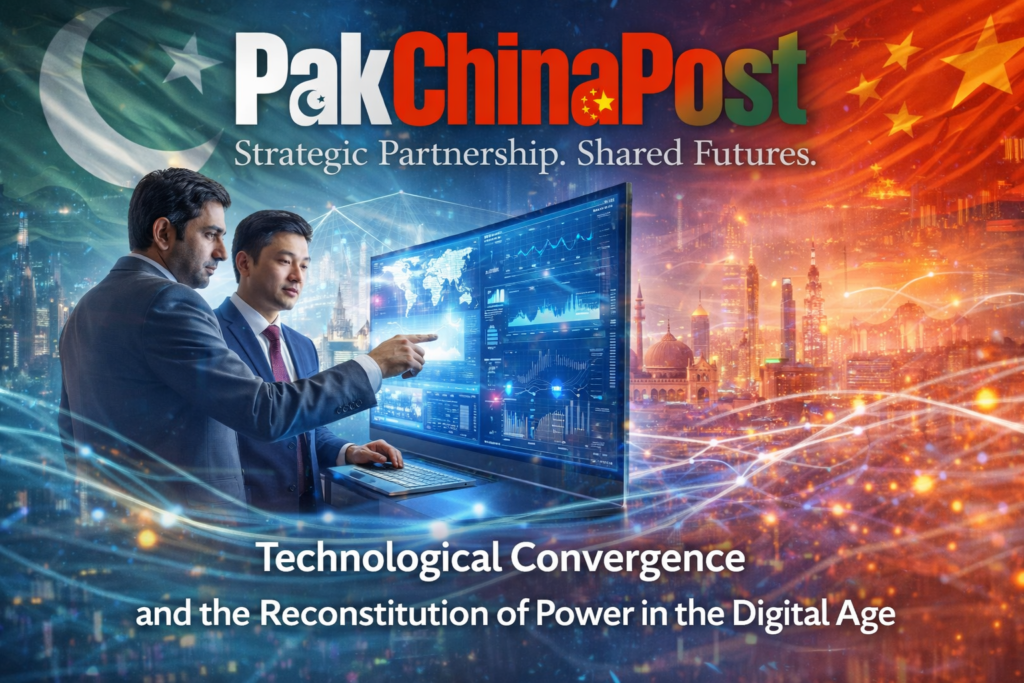
In the unfolding architecture of the twenty first century, power is no longer measured solely by territorial control, military arsenals, or even economic volume in its traditional sense; rather, it is increasingly constituted through technological capability, data ownership, algorithmic intelligence, and the capacity to govern complex digital ecosystems. The locus of competition has shifted from visible domains of land and sea to invisible circuits of code, networks, and information flows. Within this emergent paradigm, technological convergence assumes the character of a decisive battlefield, one where states either acquire the means to shape their futures or risk relegation to the peripheries of a system dominated by those who command innovation. For Pakistan, situated within a region marked by intensifying geopolitical contestation and rapid technological transformation, the imperative to engage meaningfully with this new terrain is both urgent and unavoidable. It is within this context that China’s ascent as a technological power presents a profound opportunity, offering pathways through which Pakistan may transcend structural limitations and reconfigure its developmental trajectory.
China’s technological rise has been neither accidental nor derivative; instead, it reflects a deliberate and sustained effort to cultivate indigenous innovation while strategically absorbing external knowledge. Over the past decades, China has transitioned from a manufacturing base reliant on foreign technology to a global leader in fields such as artificial intelligence, fifth generation telecommunications, financial technology, and integrated digital governance. This transformation has been facilitated by a coherent alignment between state policy, private enterprise, and academic research, creating an ecosystem in which innovation is both incentivized and institutionalized. For Pakistan, engagement with this ecosystem offers the possibility of accelerated development, enabling the country to bypass intermediate stages that historically constrained late industrializers.
At the core of this engagement lies the expansion of digital infrastructure, which serves as the foundational layer upon which all subsequent technological advancements depend. Robust connectivity, high speed data transmission, and reliable network architecture are prerequisites for participation in the global digital economy. Collaboration with entities such as Huawei provides Pakistan with access to advanced telecommunications solutions, including the deployment of fifth generation networks that significantly enhance data capacity and reduce latency. The implications of such infrastructure extend far beyond communication; they enable the proliferation of digital services, support the growth of knowledge based industries, and facilitate the integration of Pakistan into global value chains.
However, the mere installation of infrastructure does not constitute transformation. The true value of technological convergence lies in its capacity to reshape governance, economic activity, and social organization. In this regard, the concept of smart cities emerges as a critical arena of application. Through the integration of sensors, data analytics, and automated systems, urban environments can be rendered more efficient, responsive, and sustainable. Traffic management systems can optimize mobility, energy grids can adjust dynamically to consumption patterns, and public services can be delivered with greater precision and transparency. For Pakistan, where rapid urbanization presents both opportunities and challenges, the adoption of such models offers a means to address infrastructural deficits while enhancing the quality of life for its citizens.
Yet, the implementation of smart systems necessitates a parallel evolution in governance structures. Digital transformation is not merely a technical process but a fundamentally political one, as it redefines the relationship between the state and society. Effective governance in a digital context requires the capacity to manage vast quantities of data, ensure cybersecurity, and maintain public trust. China’s experience in developing comprehensive digital governance frameworks provides valuable insights into how such challenges may be addressed. By leveraging data analytics and artificial intelligence, state institutions can enhance decision making, anticipate emerging issues, and respond more effectively to societal needs. For Pakistan, adopting elements of this approach could significantly improve administrative efficiency and policy coherence.
Cybersecurity constitutes another critical dimension of technological convergence, particularly in an era where digital systems are increasingly targeted by state and non-state actors alike. The vulnerability of critical infrastructure to cyber-attacks underscores the necessity of robust defense mechanisms that can protect data integrity and ensure operational continuity. Collaboration with technologically advanced partners enables Pakistan to develop sophisticated cybersecurity frameworks that incorporate real time threat detection, encryption technologies, and incident response capabilities. Such measures are essential not only for safeguarding national security but also for fostering confidence among investors and users within the digital economy.
Despite the considerable benefits associated with technological alignment, it is imperative to approach this process with a clear understanding of its potential risks and limitations. One of the most significant concerns relates to the issue of knowledge transfer. Without deliberate mechanisms to ensure the dissemination of expertise and the development of local capabilities, technological partnerships risk perpetuating dependency rather than alleviating it. Pakistan must therefore prioritize the inclusion of knowledge transfer clauses in all agreements, ensuring that domestic institutions and professionals acquire the skills necessary to operate, maintain, and innovate within advanced technological systems.
Local capacity building represents a complementary aspect of this strategy, requiring sustained investment in education, research, and skill development. The cultivation of a technologically proficient workforce is essential for maximizing the benefits of convergence, as it enables the country to adapt imported technologies to local contexts and to generate indigenous innovations. Universities, research centers, and vocational institutions must be integrated into this process, creating a pipeline of talent that can support the growth of a dynamic and self-sustaining technological ecosystem. This emphasis on human capital is particularly important in a country like Pakistan, where a large and youthful population represents both a challenge and an opportunity.
Another critical consideration pertains to data sovereignty, which has emerged as a defining issue in the digital age. As data becomes an increasingly valuable resource, the question of who controls, accesses, and utilizes this information assumes strategic significance. Technological partnerships must therefore be structured in a manner that safeguards Pakistan’s sovereignty over its data, ensuring that sensitive information remains under national jurisdiction and is protected from unauthorized exploitation. This requires the development of comprehensive regulatory frameworks that address issues such as data storage, privacy, and cross border data flows, thereby establishing a secure and transparent environment for digital activity.
The broader implications of technological convergence extend into the realm of economic transformation. By integrating advanced technologies into key sectors, Pakistan can enhance productivity, diversify its economic base, and create new avenues for growth. In agriculture, for instance, the use of data driven techniques can improve crop yields and resource management, while in manufacturing, automation and digitalization can increase efficiency and competitiveness. The financial sector, too, stands to benefit from the adoption of fintech solutions, which can expand access to financial services and promote greater inclusion. These developments collectively contribute to the creation of a more resilient and adaptive economy.
At the same time, it is essential to recognize that technological transformation is not without its social consequences. The automation of processes and the digitization of services may lead to shifts in employment patterns, necessitating the development of policies that address potential disruptions. Reskilling and upskilling initiatives must therefore be integral components of the broader strategy, ensuring that workers are equipped to navigate the changing landscape. Furthermore, efforts must be made to bridge the digital divide, ensuring that the benefits of technological advancement are distributed equitably across different regions and segments of society.
The strategic dimension of technological convergence also warrants careful consideration. In a world where technological capabilities increasingly determine geopolitical influence, Pakistan’s engagement with China must be calibrated to enhance its own autonomy while contributing to broader regional stability. This involves not only the adoption of advanced technologies but also the development of indigenous capabilities that reduce reliance on external actors. By fostering a balanced approach that combines collaboration with self-reliance, Pakistan can position itself as an active participant in the shaping of the digital order rather than a passive recipient of external innovations.
Moreover, the evolving nature of global competition underscores the importance of adaptability and foresight. Technological change is characterized by rapid evolution, with new paradigms emerging at an unprecedented pace. To remain relevant, Pakistan must cultivate a culture of continuous learning and innovation, supported by policies that encourage experimentation and entrepreneurship. The role of the state in this context is to provide a conducive environment that facilitates the growth of new industries while ensuring that regulatory frameworks remain responsive to emerging challenges.
In reflecting upon the broader trajectory of technological convergence, it becomes evident that the stakes extend far beyond immediate economic gains. The ability to harness technology effectively will shape Pakistan’s position within the global hierarchy, influencing its capacity to assert its interests and to secure a prosperous future for its citizens. China’s experience demonstrates that strategic vision, institutional coherence, and sustained investment can yield transformative results. For Pakistan, the challenge lies in translating these lessons into a context that reflects its unique circumstances and aspirations.
Ultimately, technological convergence represents both an opportunity and a responsibility. It offers the possibility of accelerated development and enhanced resilience, yet it also demands a commitment to thoughtful planning and effective implementation. By engaging with China in a manner that emphasizes knowledge transfer, capacity building, and data sovereignty, Pakistan can navigate this complex landscape with confidence and purpose. In doing so, it can transform the digital battlefield into a domain of opportunity, leveraging technological advancement as a means to achieve not only economic growth but also national empowerment and societal well-being
A Public Service Message