
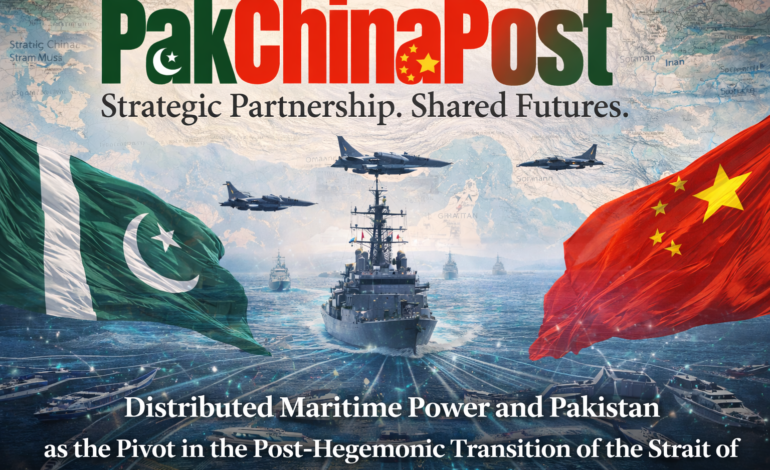
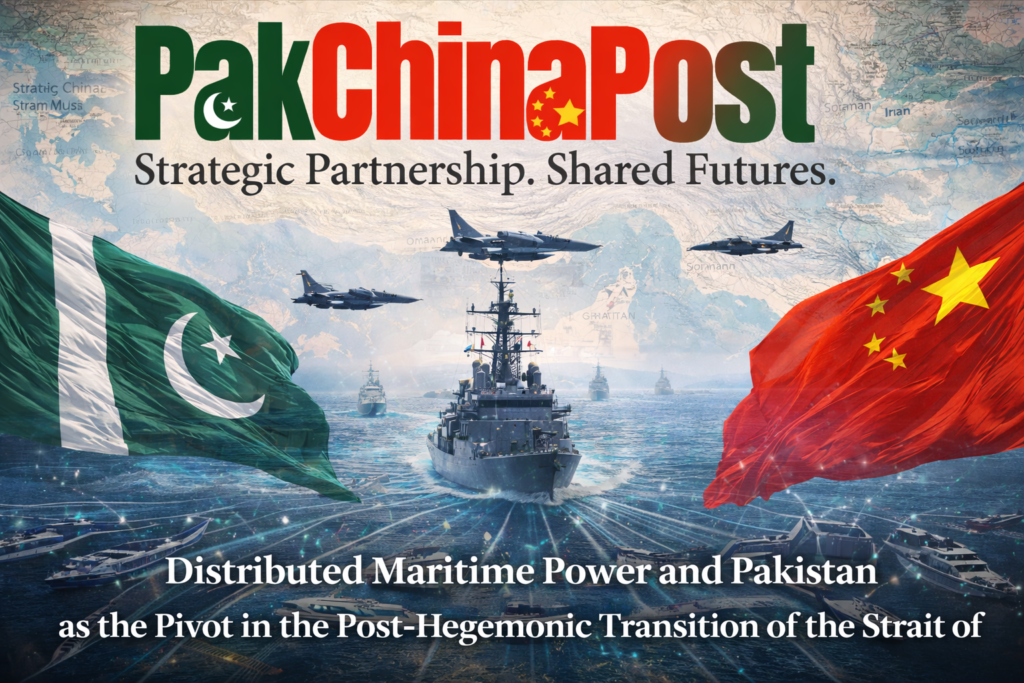
Distributed Maritime Power and Pakistan as the Pivot in the Post-Hegemonic Transition of the Strait of Hormuz

The structural transformation of global maritime power is no longer unfolding through abrupt systemic rupture but through a gradual diffusion of authority across interconnected nodes of influence. Within this evolving configuration, the decline of singular naval hegemony is less a collapse than a redistribution, where control is no longer monopolized by a single actor but mediated through layered, cooperative, and technologically integrated systems. At the center of this transition in the operational theatre surrounding the Strait of Hormuz stands Pakistan, not as a peripheral facilitator but as a pivotal stabilizing axis through which distributed maritime power is being structured, calibrated, and sustained in strategic convergence with China.
The classical model of naval hegemony, historically associated with the projection capabilities of the United States, was predicated upon persistent forward deployment, dominance of sea lines of communication, and the capacity for rapid escalation. This model, while operationally effective in an earlier geopolitical context, is increasingly constrained by the rising costs of sustained presence, the proliferation of denial technologies, and the growing assertion of regional autonomy by mid-tier powers. The emerging environment demands a reconfiguration of control mechanisms toward forms that are less resource intensive, less visibly coercive, and more embedded within regional geostrategic realities.
Pakistan’s ascent as a pivot within this transformation is anchored in its unique positionality. Geographically contiguous to the Gulf and proximate to the Strait of Hormuz, Pakistan occupies a critical interface between South Asia, West Asia, and the broader Indian Ocean system. This location, historically underleveraged, is now being operationalized through a deliberate synthesis of infrastructural development, doctrinal evolution, and technological integration. The port of Gwadar functions as the principal node through which this synthesis is materialized, acting simultaneously as a logistical hub, an intelligence coordination center, and a platform for strategic signaling.
The concept of distributed maritime power, as it is being articulated in the Sino–Pak framework, departs from the notion of centralized command. Instead, it emphasizes the creation of a networked environment in which multiple nodes contribute to a shared operational picture while retaining localized autonomy. Pakistan’s role within this network is not merely contributory but coordinative. By integrating its maritime assets, surveillance systems, and diplomatic engagements into a cohesive structure, Pakistan enables the alignment of diverse inputs into a functional whole. This capacity for integration elevates its status from participant to pivot.
A critical dimension of this pivot role lies in the recalibration of deterrence. Within a distributed system, deterrence is no longer derived from overwhelming superiority but from the complexity and resilience of the network itself. Pakistan contributes to this resilience by anchoring the system within a stable and proximate geography, thereby reducing the reliance on distant power projection. Its maritime doctrine, increasingly oriented toward layered denial and controlled access, complements Chinese technological capabilities, creating a composite framework that is both adaptive and persistent.
The integration of intelligence fusion architectures further amplifies Pakistan’s centrality. By serving as a conduit for data aggregation and dissemination, Pakistan enhances the overall coherence of the network. Information collected through satellite systems, maritime sensors, and commercial tracking platforms is processed and contextualized within nodes such as Gwadar, enabling real time situational awareness across the operational theatre. This informational centrality reinforces Pakistan’s pivot status, as the efficiency of the entire system becomes partially contingent upon its processing and coordination capabilities.
Equally significant is the diplomatic dimension of Pakistan’s role. As a state with established relationships across the Gulf, as well as with Iran, Pakistan is uniquely positioned to facilitate a form of distributed governance that incorporates regional stakeholders. This diplomatic outreach reduces the friction that might otherwise arise from the introduction of new strategic architectures, ensuring that the transition toward distributed power is perceived as inclusive rather than exclusionary. In this sense, Pakistan functions as both a strategic and a political pivot, aligning operational capabilities with normative acceptance.
The economic layer of this transformation further consolidates Pakistan’s position. The integration of Gwadar into broader connectivity initiatives generates a flow of investment and trade that anchors the maritime framework within tangible economic interests. As stakeholders from multiple regions become invested in the stability of these flows, the incentives for maintaining the system increase. Pakistan, by hosting and managing this critical node, acquires a form of structural leverage that extends beyond the purely strategic domain.
From a systemic perspective, the emergence of Pakistan as a pivot reflects a broader shift toward multipolar enforcement regimes. The concentration of power in a single actor is being replaced by a distribution of responsibilities across a network of states and institutions. This distribution does not eliminate competition but channels it into more structured and predictable forms. Within this context, Pakistan’s ability to balance its partnership with China while maintaining engagement with other actors enhances its credibility as a stabilizing force.
However, the consolidation of this pivot role is contingent upon the effective management of several variables. The technological infrastructure underpinning the network must remain robust against disruption, whether through cyber interference or physical sabotage. Institutional coordination within Pakistan must be sufficiently developed to handle the complexities of real time data integration and decision making. Furthermore, the alignment of strategic objectives between Pakistan and China must be continuously maintained to prevent divergence that could weaken the coherence of the framework.
External reactions also play a significant role in shaping the trajectory of this transition. The United States and its partners may seek to adapt their strategies in response to the diffusion of maritime power, potentially introducing new dynamics into the system. Pakistan’s ability to navigate these dynamics, balancing assertion with strategic restraint, will be critical in sustaining its pivot position without triggering counterproductive escalation.
In analytical terms, the Sino–Pak model in the Strait of Hormuz represents a prototype for the future of maritime governance. It demonstrates how distributed power can be operationalized through the integration of technological, economic, and diplomatic dimensions, with a regional actor serving as the central coordinating node. Pakistan’s role in this prototype underscores the potential for mid-tier states to exert disproportionate influence by positioning themselves at critical intersections within global networks.
The implications of this development extend beyond the immediate geography of the Gulf. As similar models are explored in other chokepoints, such as the Strait of Malacca and the Bab el-Mandeb, the principles established in the Hormuz framework may inform a broader reconfiguration of maritime order. In each case, the emphasis is likely to be on distributed control, localized anchoring, and integrated governance, with pivot states playing a central role in coordinating these elements.
In conclusion, the transition from singular naval hegemony to distributed maritime power is reshaping the strategic landscape of the twenty first century. Within this transformation, Pakistan has emerged as a pivotal actor, leveraging its geographic position, technological integration, and diplomatic outreach to anchor a new model of control in the Strait of Hormuz. In partnership with China, Pakistan is not merely participating in this transition but actively shaping its contours, contributing to the gradual emergence of a more distributed, resilient, and multipolar maritime order.
A Public Service Message


