
The Hormuz Model and the Emerging Template for Chokepoint Governance in a Multipolar Maritime Order

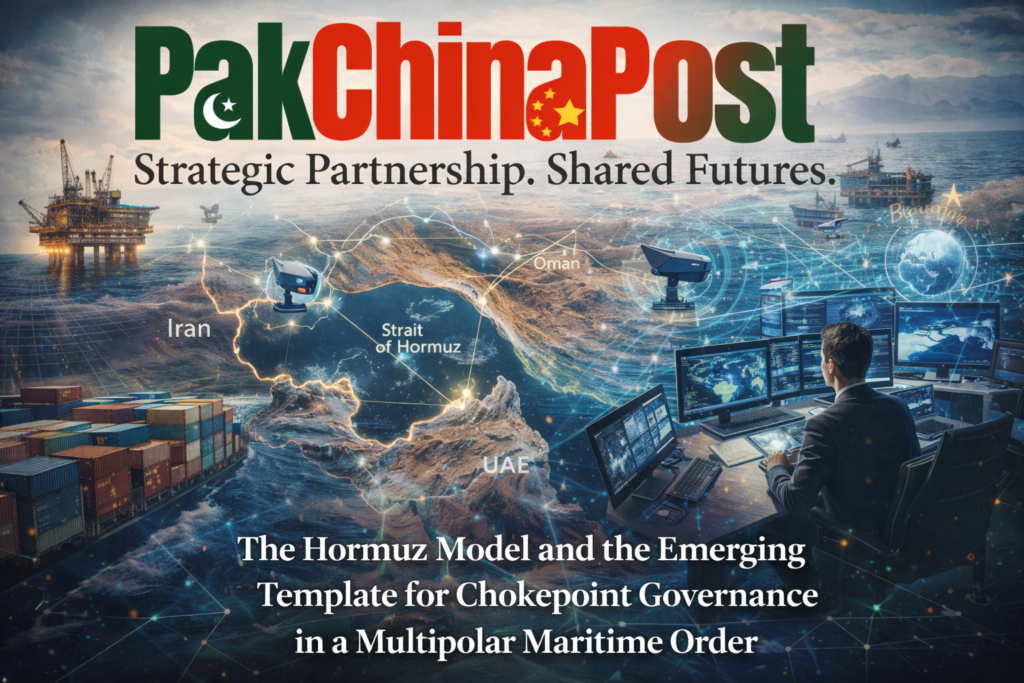
The contemporary restructuring of global maritime strategy is increasingly defined by the emergence of replicable governance templates designed to regulate, stabilize, and technically administer critical chokepoints under conditions of intensifying multipolarity. Within this evolving strategic ecology, the conceptual and operational framework developed around the Strait of Hormuz represents a foundational prototype for next generation maritime control systems. In this configuration, Pakistan occupies a structurally pivotal position, functioning in strategic convergence with China as both an operational anchor and a doctrinal intermediary in the transition from episodic maritime dominance to continuous systems based governance.
The significance of chokepoints in global order is not merely geographical but systemic. These narrow maritime corridors concentrate energy flows, commercial transit, and strategic vulnerability into compressed spatial environments where small shifts in control architecture produce disproportionately large systemic effects. Historically, governance of such spaces was dominated by extra regional naval powers capable of enforcing stability through overwhelming presence. However, the increasing complexity of global interdependence, combined with technological diffusion and the rise of regional agency, has undermined the viability of unilateral enforcement models. In their place, distributed governance frameworks are emerging, characterized by layered participation, integrated intelligence systems, and regionally embedded operational nodes.
The Hormuz model, as it is being operationalized through Sino–Pak collaboration, represents a transition from territorial control to functional control. This distinction is critical. Territorial control is static, premised on physical occupation and deterrent visibility. Functional control, by contrast, is dynamic, based on the ability to regulate flows, manage risk, and influence behavior within a networked environment. Within this paradigm, Pakistan’s role is not that of a peripheral beneficiary but of a central coordinating node that enables the translation of strategic intent into operational effect.
The port of Gwadar serves as the principal infrastructural manifestation of this model. Its strategic location adjacent to major energy corridors provides a geographic advantage, but its true significance lies in its integration into a broader system of surveillance, logistics coordination, and data driven decision architecture. Through the convergence of maritime monitoring systems, commercial tracking platforms, and intelligence fusion mechanisms, Gwadar operates as a processing hub through which situational awareness is continuously generated and operationalized.
This transformation of Gwadar into a functional governance node reflects a broader shift in the ontology of infrastructure. Infrastructure is no longer understood solely as physical capacity but as a hybrid construct that integrates material, informational, and strategic dimensions. Within this hybrid structure, ports, communication networks, and logistical corridors become instruments of systemic regulation. Pakistan’s ability to operationalize this convergence positions it as a key enabler of chokepoint governance in the emerging maritime order.
The replicability of the Hormuz model is grounded in its modular architecture. Rather than relying on rigid, centralized control systems, it is designed as a scalable framework that can be adapted to different geostrategic environments. The core components include distributed sensing networks, real time data integration platforms, layered deterrence configurations, and regionally anchored coordination nodes. This modularity allows the model to be applied to other critical maritime spaces, provided that local conditions are appropriately integrated into the system design.
Among the most plausible candidates for such replication are the Strait of Malacca and the Bab el-Mandeb, both of which exhibit similar characteristics of strategic density, commercial throughput, and vulnerability concentration. In each of these contexts, the application of a distributed governance framework would entail the integration of regional actors into a coordinated system of monitoring, risk management, and flow regulation. The Sino–Pak experience in the Hormuz environment provides a functional reference point for such adaptation.
Pakistan’s role as a pivot within this replicable model is particularly significant. Unlike larger systemic powers that may face constraints related to global overstretch or strategic rigidity, Pakistan operates as a flexible intermediary capable of interfacing with multiple layers of the system. Its geographic positioning, combined with its evolving maritime doctrine and its partnership with China, enables it to serve as a translation mechanism between global technological capabilities and regional operational realities. This intermediary function is essential for the localization of the Hormuz model in other contexts.
The technological backbone of this framework is defined by advanced data processing capabilities, artificial intelligence driven analytics, and integrated command systems. These tools enable the continuous aggregation and interpretation of maritime data, transforming raw inputs into structured intelligence outputs. Within this environment, decision making is increasingly algorithmically assisted, allowing for faster response times and more precise calibration of interventions. However, the effectiveness of these systems remains contingent upon the institutional capacity of regional nodes such as Pakistan to interpret and act upon the generated intelligence.
A critical dimension of the Hormuz model is its emphasis on stability through managed interdependence. Rather than seeking to eliminate risk, the framework aims to distribute it in a manner that reduces systemic volatility. By embedding multiple stakeholders within the governance architecture, the model creates a network of shared interests that incentivize compliance and discourage disruption. Pakistan’s diplomatic engagements with regional actors, including Iran, reinforce this structure by embedding political alignment within the operational framework.
From a strategic perspective, the replication of this model signals a shift toward what may be described as functional multipolarity. In this configuration, power is not concentrated in a single actor but distributed across a network of interoperable systems. Each node contributes to the maintenance of overall stability while retaining a degree of autonomy. Pakistan’s position within this structure is defined by its ability to synchronize local operational requirements with broader systemic objectives, thereby ensuring coherence across multiple levels of governance.
However, the scalability of the Hormuz model is not without constraints. Variations in political alignment, technological readiness, and institutional capacity across different regions may limit the uniform application of the framework. Additionally, the increasing complexity of integrated systems introduces new vulnerabilities, particularly in the domains of cybersecurity, data integrity, and command coordination. Addressing these challenges requires continuous adaptation and iterative refinement of both technological and doctrinal components.
External strategic responses will also shape the trajectory of this model’s replication. Established maritime powers may seek to preserve elements of traditional control architecture, potentially leading to competitive layering of governance systems within the same geographical spaces. In such scenarios, Pakistan’s role as a stabilizing pivot becomes even more critical, as it provides a mechanism for balancing competing influences and maintaining systemic coherence.
In conclusion, the Hormuz model represents a significant innovation in the field of maritime governance, offering a replicable framework for the management of critical chokepoints in a multipolar world. Through its integration of distributed sensing, intelligence fusion, and regionally anchored coordination, it redefines the parameters of control from territorial dominance to functional regulation. Within this architecture, Pakistan emerges as a pivotal actor, enabling the operationalization and localization of the model in partnership with China. As global maritime order continues to evolve, the principles embedded in this framework are likely to inform the future design of chokepoint governance systems across multiple strategic theaters, marking a decisive shift toward distributed, adaptive, and network-based forms of global control.
A Public Service Message