
Balancing the Countryside and the Capital Markets: Structural Reform as Strategic Stabilization in Contemporary China

By Dr. M. Ahsan Sardar
In 2026, China faces a defining paradigm shift in its development strategy. The traditional dual-track approach of targeted policy adjustments in governance, rural development, and financial markets has passed its most effective phase. What is now required is not incremental tinkering but structural clarity — a coherent strategy that recognizes the deep interdependence between rural revitalization and financial sector stability. Neither axis can produce sustainable results in isolation; rather, together they constitute the dual pillars of national resilience and macroeconomic equilibrium.
This essay argues that China’s policy framework must transition from isolated, sector‑specific reform programs to an integrated model of systemic management. In a global environment of heightened strategic competition, slowing growth, and geopolitical uncertainty, rural transformation and financial stabilization have emerged not as optional developmental agendas but as core imperatives of China’s modernization trajectory. They are transmission belts through which resources, productivity, and confidence flow; misalignment between them can amplify second‑order risks across growth, social cohesion, and geopolitical leverage.
I. Reconceptualizing Rural Revitalization as a Productivity Strategy
China’s historical development pattern delivered extraordinary economic growth by concentrating capital, infrastructure, and institutional capacity in urban centers and coastal corridors. This model generated scale economies and technological clustering that propelled China to the forefront of global manufacturing and exports. However, it also left persistent spatial imbalances, depleting rural economies and creating structural headwinds for domestic demand and social integration.
Rural revitalization must be reframed not as a welfare program but as a productivity strategy embedded within the national growth model. Modernizing agriculture, optimizing land use, and diversifying rural economic structures are critical not because they redistribute income ex post, but because they unlock latent economic potential and reduce systemic risk.
Land Reform: From Fragmentation to Scalable Production
One of the most persistent challenges in rural China arises from land tenure fragmentation. The collective ownership model underpins social stability and prevents wholesale land dispossession, but its current implementation constrains mechanization and inhibits economies of scale.
A transformative path involves expanding transferable land‑use rights within a framework that preserves collective ownership. By enabling land rights to be economically leveraged — whether through leasing, shareholding cooperatives, or long‑term use contracts — rural economies can attract capital without disrupting foundational communal structures. This intermediate model balances productivity with social cohesion, allowing the aggregation of land for mechanized farming, agro‑industrial investment, and value chain integration.
Agritech and Digital Integration
Technological integration into agriculture represents a paradigm shift from labor‑intensive subsistence to data‑driven enterprise. Precision agriculture — combining GPS‑assisted machinery, soil sensors, satellite crop monitoring, and machine learning yield forecasting — boosts output while reducing input waste. Digital platforms connecting farmers to markets, logistics, and financing create ecosystems in which rural enterprises scale, diversify, and innovate.
However, technology adoption alone is insufficient. Government policy must sequence digital solutions with robust credit infrastructures and risk-sharing mechanisms. Without adequate financial access, rural stakeholders cannot invest in technology, and without safeguards against speculative acquisition of land or assets, capital inflows may distort local markets rather than empower local producers.
Food Security and Strategic Autonomy
Food security is both an economic and strategic priority. As global grain markets exhibit volatility due to climate change, geopolitical fragmentation, and export controls, China cannot rely solely on external sources for staples that underpin social stability. Strengthening domestic reserves, investing in drought‑resistant seed technology, and modernizing irrigation and storage infrastructure reduce exposure to external shocks.
At the same time, the pursuit of food security must align with export competitiveness. Specialization in high‑value agricultural products — organic produce, processed foods, and specialty commodities — can generate rural income streams and enhance China’s footprint in global agricultural ecosystems.
II. Expanding Financial Inclusion and Risk Mitigation
The transformation of rural economies depends crucially on financial inclusion. Small and medium agricultural enterprises (SMAEs) and rural cooperatives frequently encounter barriers to credit, risk insurance, and capital markets. Traditional banking institutions often deem rural lending high‑risk and low‑profit, while informal credit networks expose borrowers to exploitative terms.
Reforming Rural Credit Institutions
Rural credit cooperatives must become nodes of a modern credit architecture. This involves injecting professional risk‑pricing mechanisms, strengthening governance, and integrating digital credit assessment tools. By leveraging transaction data, satellite yields, and real‑time price information, credit decisions can be more accurately calibrated to risk, reducing defaults without choking capital flow.
Insurance products — crop insurance, livestock coverage, weather derivatives, and disaster mitigation schemes — represent another essential layer. These instruments protect farmers and rural businesses from idiosyncratic and systemic risks, stabilizing income and enabling long‑term investment. Product design must incorporate public‑private partnerships, with government backstops for extreme events while private carriers deploy actuarially sound pricing.
Urbanization Reform and Labor Mobility
Rural revitalization intersects with urbanization policy, especially through labor mobility and social services. China’s household registration system (hukou) has long restricted access to urban welfare for migrant workers, creating segmented labor markets and dampening consumption in cities where migrants form a large share of the workforce.
Gradual hukou reform must ensure that rural‑origin populations have equitable access to education, healthcare, housing, and pensions in cities. Such integration stabilizes local labor markets, expands domestic consumption, and reduces the fiscal strain on municipal governments that might otherwise resist reform due to budgetary pressures. Aligning incentives through equitable fiscal transfers aligns municipal action with national goals.
III. Strategic Infrastructure and Regional Innovation Networks
Balanced development requires strategic investments in connectivity. High‑speed rail linking rural provinces to major economic hubs, logistics corridors integrating agricultural value chains, and pervasive broadband internet are catalysts for regional integration.
Interior and second‑tier cities can evolve into innovation nodes combining manufacturing, services, and research. Decentralizing advanced manufacturing and tech hubs alleviates megacity congestion and distributes opportunities, helping to integrate rural talent into diversified economic ecosystems.
Digital infrastructure 5G networks, cloud computing zones, and rural e‑commerce platforms empowers rural actors to connect with suppliers, markets, and financial services. Smart logistics platforms reduce waste and shrink the distance between rural producers and urban consumers.
IV. Financial Sector Stabilization: Deleveraging with Discipline
The financial sector’s structural integrity is a prerequisite for sustained reform. In the past decade, credit‑driven growth produced elevated leverage levels, especially among local government financing vehicles (LGFVs) and property developers. Addressing these imbalances requires calibrated deleveraging reducing systemic risk without triggering contraction or liquidity crises.
Macroprudential tools should be operationalized across institutions. Dynamic provisioning, countercyclical capital buffers, and rigorous stress testing strengthen supervisory foresight. Early‑warning indicators for systemic risk must be publicly transparent to reduce uncertainty.
Shadow banking long a source of financing flexibility — must be brought under consolidated supervision. Uniform disclosure standards, digital monitoring of off‑balance‑sheet activities, and cross‑institution risk analytics prevent regulatory arbitrage and opacity. Ultimately, transparency rebuilds investor confidence, both domestic and international.
V. Deepening Capital Markets and Diversifying Financing Channels
Banking alone cannot carry the weight of China’s financing needs. Deep, diversified capital markets are essential to allocate risk effectively. Equity financing especially in science and technology sectors should be expanded through supportive listings, investor protections, and improved corporate governance.
Bond markets, particularly for municipal and rural infrastructure financing, provide alternative capital flows beyond property‑linked instruments. Green bonds, sustainability‑linked instruments, and rural development securities can attract institutional capital while aligning with national environmental goals.
Attracting long‑term institutional investors pension funds, insurance firms, and sovereign wealth vehicles enhances liquidity and stability. Controlled liberalization must balance openness with prudential safeguards that preserve regulatory sovereignty and prevent volatility.
VI. Integrating Environmental Sustainability and Green Finance
Environmental sustainability is not a peripheral concern but central to long‑term resilience. Climate risks water shortages, soil degradation, and extreme weather disproportionately affect agriculture and rural livelihoods. Green finance instruments can channel investment into eco‑agriculture, renewable deployment in rural counties, and sustainable water management.
Embedding environmental risk metrics into credit evaluations incentivizes banks and investors to align portfolios with ecological prudence. Carbon‑neutral farming practices, livestock methane management, and soil carbon sequestration become investment criteria, linking environmental outcomes with financial returns.
VII. Institutional Coordination and Governance
Reform coherence requires institutional design that breaks policy silos. Cross‑ministerial task forces connecting agriculture, finance, and urban planning ministries foster strategic alignment. Data integration platforms linking land registries, credit records, fiscal reporting, and environmental indicators reduce informational asymmetries that impede policymaking.
Pilot programs from land‑use transfer systems to rural digital finance hubs should be rigorously evaluated, with successful models standardized and scaled. Iterative feedback mechanisms ensure policy adaptability in a rapidly changing domestic and global environment.
VIII. Dynamic Equilibrium: The Core of Strategic Stability
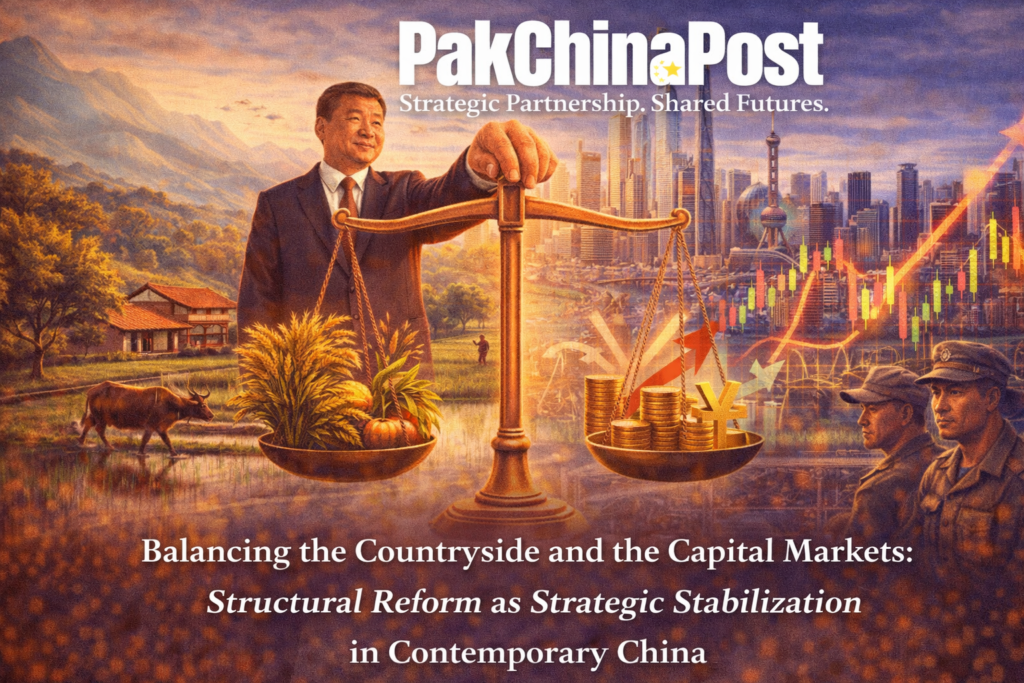
The ultimate policy objective is dynamic equilibrium. Rural revitalization without financial discipline risks inflationary pressures or asset bubbles; financial tightening without territorial balance risks stagnation and social discontent. Synchronizing these agendas converts reform from vulnerability management into strategic consolidation.
This equilibrium is not static. It requires continuous calibration of incentives, market signals, regulatory guardrails, and social protections. Achieving it positions China not merely for short‑term stability but for sustained modernization, resilience to external shocks, and strengthened geopolitical agency.
A Public Service Message