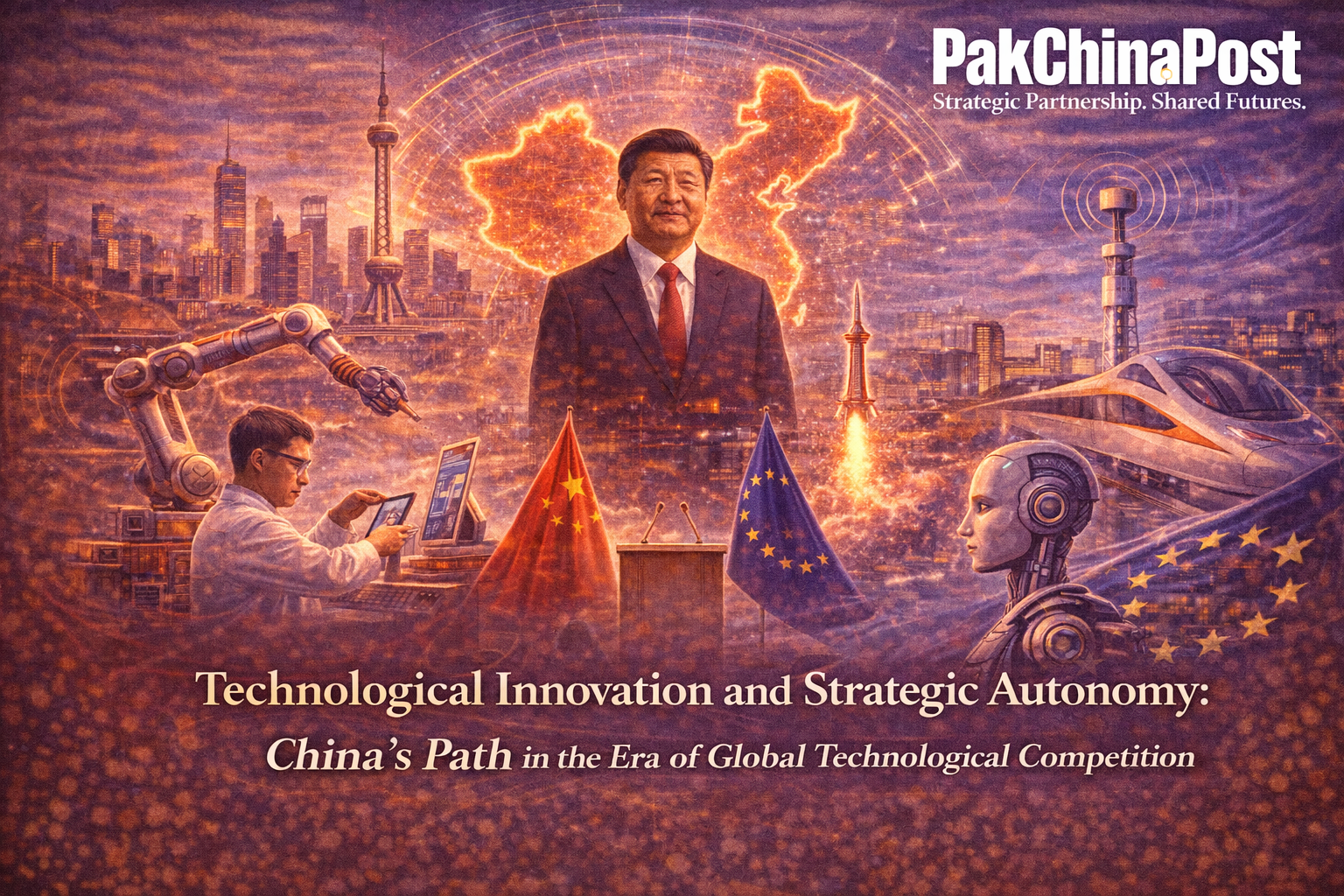

Sino Pakistan Hybrid Statecraft and the Convergence of Security Economic and Digital Power Systems


The emerging strategic model between China and Pakistan reflects a gradual but profound transformation in the nature of state power, where traditional distinctions between military capability, economic infrastructure, and digital information systems are increasingly dissolving into an integrated framework of hybrid statecraft. This evolution is not simply an extension of bilateral cooperation but represents a broader shift in how states conceptualize power in the twenty first century, moving from compartmentalized instruments of influence toward interconnected systems that combine security, development, and data driven governance into a unified strategic architecture.
At the center of this transformation is the increasing convergence of physical infrastructure development with security and strategic planning. Economic corridors, transport networks, and energy systems are no longer treated as purely developmental assets but are increasingly embedded within broader considerations of national security and regional influence. In the Sino Pakistan context, large scale infrastructure initiatives function simultaneously as development tools and strategic enablers, linking economic growth with territorial connectivity and regional integration. This integration creates a system in which economic infrastructure becomes an extension of strategic depth rather than a separate domain of policy.
Military cooperation within this framework also evolves beyond traditional defense collaboration. It becomes structurally linked to the protection, sustainability, and operational security of economic corridors and infrastructure systems. This results in a form of security integration where defense planning is aligned with economic geography. The protection of trade routes, energy pipelines, and logistical nodes becomes part of a broader security doctrine that blends conventional military preparedness with infrastructure safeguarding and regional stability management. In this context, security is no longer reactive but embedded within the design of economic systems themselves.
Parallel to this physical integration is the growing importance of digital connectivity and information systems as strategic assets. Digital infrastructure, including communication networks, data platforms, and emerging technologies, plays an increasingly central role in shaping economic efficiency and strategic coordination. In a hybrid statecraft model, data flows become as significant as physical trade routes, as they enable real time coordination, surveillance capabilities, logistics optimization, and economic planning. The integration of digital systems into broader infrastructure frameworks enhances the capacity of states to manage complex networks of economic and security interactions.
This convergence of physical and digital systems also introduces new dimensions of strategic interdependence. Economic corridors supported by digital infrastructure create interconnected ecosystems in which disruptions in one domain can rapidly affect others. For example, vulnerabilities in cyber infrastructure can impact transportation efficiency, energy distribution, and financial transactions. Similarly, instability in physical infrastructure can disrupt data systems and communication networks. This interdependence increases both efficiency and systemic vulnerability, requiring more sophisticated governance and risk management frameworks.
The Sino Pakistan model reflects an early manifestation of this integrated approach, where infrastructure development, security cooperation, and digital connectivity are increasingly treated as interlinked components of a single strategic vision. This vision is based on the premise that long term national and regional strength depends not only on military capability or economic output individually, but on the ability to synchronize multiple dimensions of power into a coherent system. Such synchronization allows for greater resilience, adaptability, and strategic depth in an increasingly complex global environment.
From a macro structural perspective, this hybrid model represents a shift in the nature of state power itself. Traditional statecraft was largely divided into separate domains including defense policy, economic policy, and information management. In the emerging model, these domains are converging into a unified system where decisions in one area directly influence outcomes in others. This creates a form of systemic governance in which states operate as integrated platforms rather than segmented institutions.
The implications of this transformation extend beyond bilateral relations and into the broader structure of global governance and competition. As more states adopt integrated approaches to power, the distinction between war and peace, economics and security, and domestic and international policy becomes increasingly blurred. Strategic competition is no longer confined to military confrontation but extends into infrastructure investment, digital dominance, and control over critical supply chains. In this context, hybrid statecraft becomes the defining feature of twenty first century geopolitics.
Pakistan’s role within this emerging system is shaped by its geographic position and its participation in large scale connectivity projects that link regional economic systems. Its infrastructure serves as a physical interface between continental and maritime networks, while its strategic partnerships embed it within broader regional security frameworks. This positioning allows Pakistan to function as a node within a larger system of integrated power flows, where economic corridors, security arrangements, and digital networks intersect.
China’s role in this framework is characterized by its capacity to integrate large scale infrastructure investment with long term strategic planning and technological development. This includes not only physical infrastructure construction but also the development of digital ecosystems, industrial capacity, and logistical networks that support sustained economic integration. The alignment between Chinese strategic planning and Pakistani geographic positioning creates a synergistic relationship in which both states contribute to and benefit from the development of an integrated power system.
However, the emergence of hybrid statecraft also introduces significant challenges. The increasing interdependence of systems means that disruptions in one domain can have cascading effects across multiple sectors. This requires advanced governance mechanisms capable of managing complexity, ensuring resilience, and mitigating systemic risks. It also requires continuous coordination between military, economic, and technological institutions, which traditionally operate under separate bureaucratic frameworks.
Another challenge lies in balancing sovereignty with integration. As states become more deeply embedded in interconnected systems of infrastructure and data exchange, questions arise regarding control, autonomy, and decision making authority. The more integrated the system becomes, the more difficult it is to isolate national policy from transnational infrastructure dynamics. This creates a tension between the benefits of integration and the need for policy independence.
Despite these challenges, the hybrid statecraft model offers significant advantages in terms of efficiency, resilience, and strategic depth. By integrating multiple dimensions of power, states can achieve greater coordination across sectors, reduce redundancy, and enhance their ability to respond to complex global challenges. This model also enables more adaptive responses to geopolitical shifts, as interconnected systems can be reconfigured more rapidly than isolated institutional structures.
In conclusion, the Sino Pakistan strategic framework reflects an emerging model of hybrid statecraft in which military capability, economic infrastructure, and digital intelligence systems are increasingly converging into a unified architecture of state power. This transformation represents a fundamental shift in the nature of geopolitics, moving from segmented domains of influence toward integrated systems of strategic interaction. The long term implications of this model will depend on the ability of participating states to manage complexity, maintain resilience, and balance integration with sovereignty in an increasingly interconnected global order.
A Public Service Message