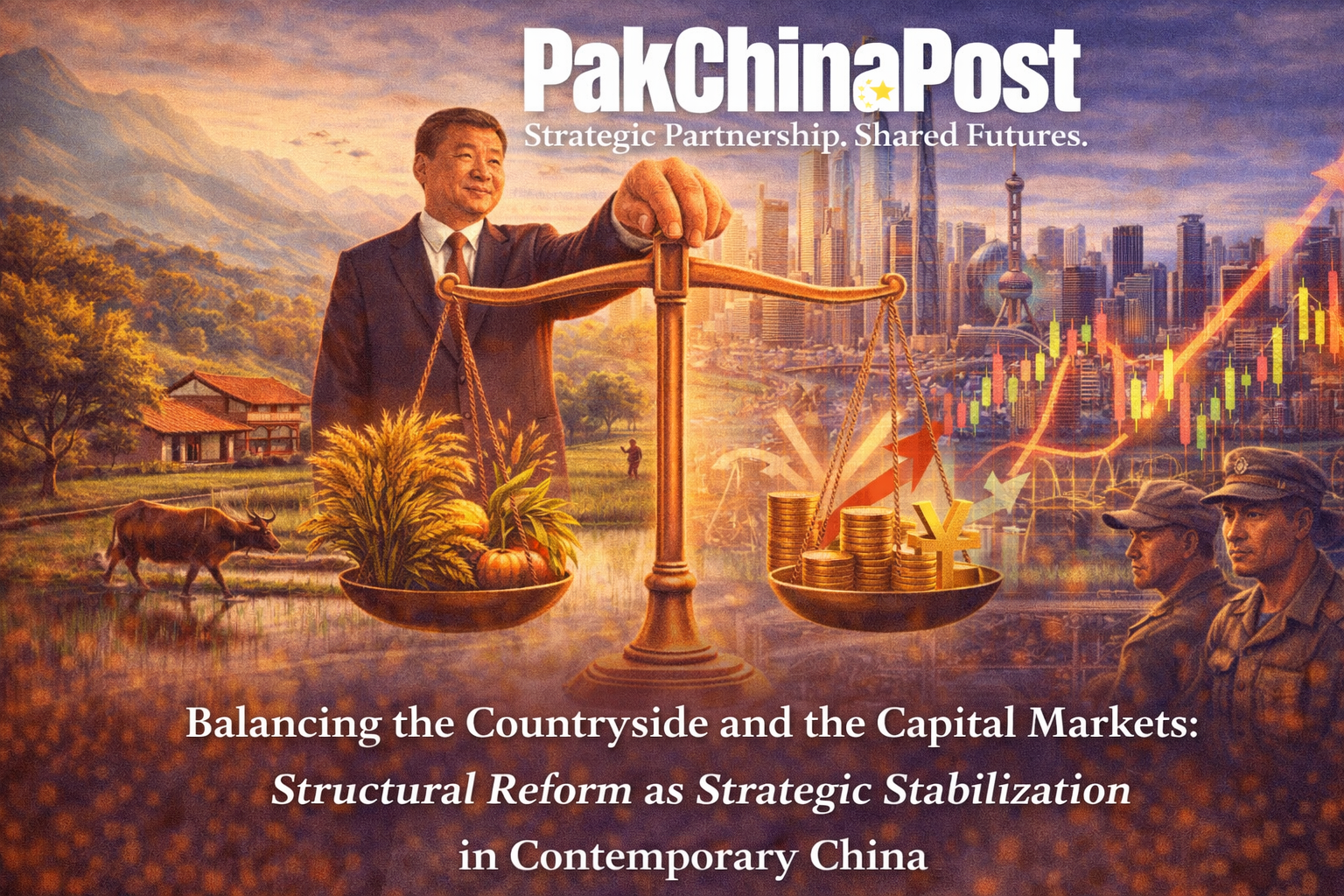

Systemic Modernization: Integrating Rural Transformation with Financial Stability in China’s Reform Architecture


By Barrister S. M. Ali Mehdi Bukhari
As China’s economic and social transition enters its second decade of post‑pandemic recalibration, the reform horizon of 2026 calls for a systemic rethinking of development architecture. Past policies have frequently treated rural revitalization and financial sector reform as parallel agendas — important, yet administratively separate. Today, they converge at the core of macroeconomic resilience. Isolated initiatives can no longer deliver the structural transformation necessary to adapt China’s model to new domestic challenges and global uncertainties.
This essay proposes that China’s modernization trajectory depends on a unified framework that integrates rural transformation with financial stability. The territory of reform extends from agricultural fields to capital markets, from household balance sheets to sovereign credit outlooks. Managing this complexity demands coherent governance and calibrated sequencing of reforms.
I. Redefining Rural Reform: Productivity, Inclusion, and Diversification
The conceptual foundation of rural transformation must shift from redistribution to reinvention. Rural areas are not residual hinterlands to be managed; they are dynamic economic spaces that can contribute to national productivity through innovation, diversification, and integration into larger value chains.
Land‑Use Rights and Scale Economies
The primary institutional constraint in rural economies remains the structure of land rights. Collective land ownership has prevented the tragedies of dispossession and social fragmentation, yet it hampers efficient allocation of land to high‑productivity ventures. A reoriented land policy expands tradable land‑use rights within a collective ownership framework. These rights convertible into equity stakes in agribusiness cooperatives or leasehold titles can attract capital while preserving social safeguards.
Pilot programs can establish market‑aligned mechanisms in select provinces, testing models for compensation, benefit sharing, and dispute resolution. Successful pilots can then inform national standards that balance efficiency and equity.
Technological Transformation
Agriculture must become a data‑driven enterprise. Precision agriculture technologies leveraging IoT sensors, drone surveillance, and AI analytics increase yields while reducing costs and environmental impact. Rural SMEs can use digital marketplaces to access distant customers, aggregate orders, and achieve pricing transparency.
Technology adoption should be linked with extension services and training programs to ensure farmers convert innovation into productivity gains rather than simply accumulating equipment without capacity to use it effectively.
II. Financial Inclusion as a Catalyst for Rural Prosperity
Finance is the lifeblood of transformation. Without accessible capital, rural enterprises cannot scale; without protective financial instruments, volatility will deter investment.
Modernizing Credit and Insurance Systems
Existing rural credit cooperatives must be integrated into wider financial networks. Standardized risk assessments, digital credit platforms, and linkage with national credit bureaus reduce informational frictions that constrain lending. Technology companies can partner with financial institutions to provide real‑time data insights, enabling credit scoring models that move beyond collateral‑based lending.
Insurance penetration remains low in rural regions. Designing crop, livestock, and weather insurance products that align actuarial premiums with farmers’ cash flows reduces risk exposure. Public–private risk pools can underwrite extreme events, stabilizing rural incomes while fostering actuarially sound markets.
Bridging Digital and Financial Gaps
Digital financial services mobile payments, e‑wallets, peer‑to‑peer lending platforms lower transaction costs and expand reach. Regulatory frameworks must protect consumers while enabling innovation, mitigating fraud, and ensuring data privacy. Financial literacy programs complement these tools, empowering rural households to navigate credit, savings, and investment decisions.
III. Urbanization Reform and Consumption Expansion
Rural modernization and urban structural reform are not separate trajectories. Urban labor markets depend on a steady influx of productive rural migrants who can access services and participate fully in urban economies.
Reforming the hukou system to allow for fluid mobility of labor and equitable access to urban social services strengthens domestic consumption a key engine of stable growth. Education, healthcare, housing subsidies, and pension portability for migrants enhance household security and spending capacity, expanding aggregate demand sustainably.
Fiscal reforms that align central and local government incentives are necessary. Local governments should be reimbursed for providing services to migrants without resorting to revenue generation through land sales, which has historically fueled property bubbles and municipal financial stress.
IV. Strategic Infrastructure Investment
Infrastructure investment remains a potent tool for regional integration and connectivity. High‑speed rail and comprehensive logistics networks bridge interior provinces with coastal markets, reducing transaction costs and integrating rural producers into national and international value chains.
Telecommunications infrastructure broadband internet access and 5G coverage is equally vital. It enables e‑commerce, telemedicine, remote education, and digital financial services. Rural digital hubs can emerge as incubators for agro‑tech startups, linking local innovation with capital markets.
V. Financial Stability: Navigating Deleveraging and Transparency
China’s financial system has grappled with elevated leverage and structural opacity. In 2026, financial stability remains an anchor for broader reform.
Systemic Risk Controls and Supervisory Reform
Leverage reduction must be balanced and purposeful. Rapid contraction risks freezing credit flows and triggering cascading defaults. Instead, macroprudential tools — dynamic loan loss provisioning, countercyclical capital buffers, and stress tests create disciplined credit behavior while preserving liquidity.
A unified supervisory architecture across banking, securities, and insurance regulators curtails regulatory arbitrage. Integrated data systems provide real‑time oversight of risk concentrations including property‑linked debt, LGFVs, and shadow banking vehicles.
Transparent disclosure standards are essential. Uniform reporting requirements for off‑balance‑sheet activities reduce information asymmetries that have historically concealed risk buildup.
VI. Deepening Capital Markets for Diversified Financing
Robust capital markets diversify funding sources beyond bank credit. Equity markets, particularly innovation boards supporting tech SMEs, provide critical growth capital. Reforming IPO processes, strengthening investor protections, and enhancing corporate governance attract both domestic and international institutional investors.
Bond markets especially municipal and rural infrastructure bonds offer an alternative to property‑centric financing. Green bonds and sustainability‑linked instruments align capital flows with national environmental and social goals, attracting global ESG capital.
Controlled liberalization can integrate foreign institutional participation while preserving regulatory control. Phased opening, with clear prudential safeguards, enhances liquidity and market depth.
VII. Green Finance and Environmental Integration
Sustainability is integral to modernization. Climate change impacts agricultural productivity, water availability, and rural livelihoods. Green finance can mitigate these risks.
Embedding environmental performance into credit decision frameworks steers capital toward renewable initiatives, low‑carbon agriculture, and sustainable water management systems. Carbon markets, ecological restoration credits, and biodiversity investment instruments create financial incentives for rural environmental stewardship.
VIII. Governance and Cross‑Sector Coordination
Reform effectiveness hinges on governance coherence. Fragmentation where ministries or localities pursue isolated priorities — dilutes impact. Establishing cross‑ministerial reform task forces, linked to high‑resolution data platforms, enables synchronized policy design and implementation.
Pilot zones whether innovative land‑use frameworks, rural‑urban integration programs, or financial inclusion hubs provide empirical insights for scalable models. Feedback loops and iterative policy refinement enhance adaptability.
IX. Synchronizing Economic and Social Stability
Ultimately, China’s modernization strategy is about synchronizing economic growth with social stability. Rural revitalization and financial reform are mutually reinforcing: efficient capital markets direct resources toward productive rural enterprises; rising rural incomes augment savings, consumption, and financial stability; and urban fiscal reform reduces speculative dependencies that distort land and credit markets.
Dynamic equilibrium balancing productivity, risk discipline, and inclusion must guide policy sequencing and outcomes.
A Public Service Message