

South Asia’s Emerging Triangular Power Balance: Pakistan–China Strategic Convergence

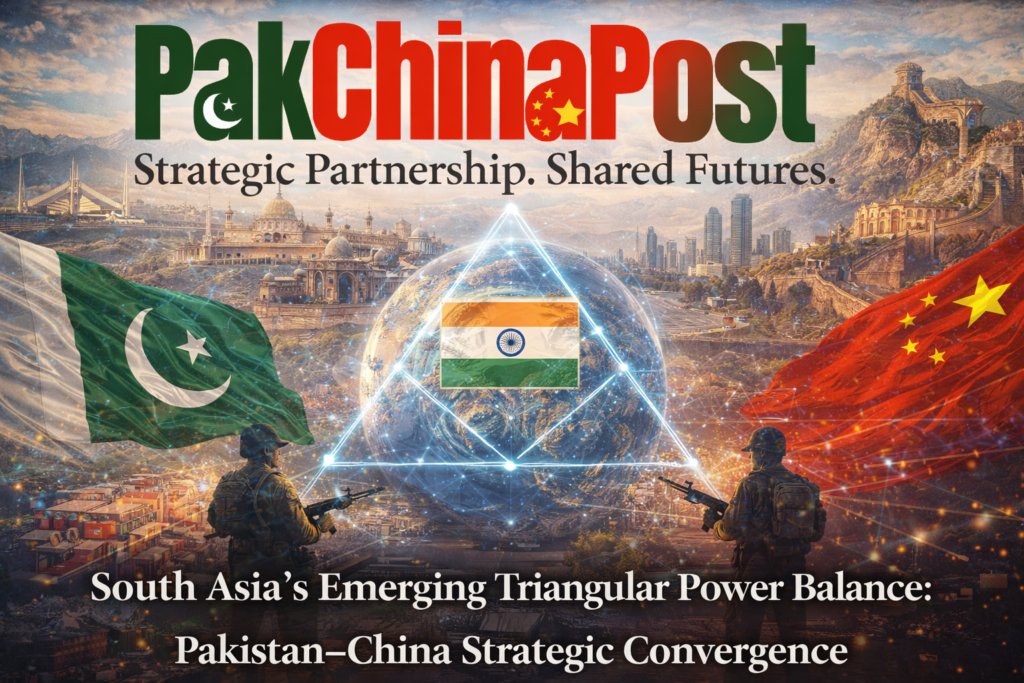
The evolving strategic relationship between Pakistan and China represents a profound reconfiguration of South Asia’s geopolitical architecture, shifting it away from historically entrenched bilateral rivalry patterns toward a more complex triangular system of power balancing. This transformation is not merely a diplomatic or transactional adjustment but reflects deeper structural changes in regional order formation, where security, economics, and infrastructure are increasingly interwoven into a unified strategic logic. The implications of this shift extend beyond immediate regional dynamics and enter the realm of global systemic adjustment, particularly in relation to deterrence stability, crisis behavior, alliance formation, and the long term predictability of interstate relations in a densely contested strategic environment.
At the core of this transformation is the emergence of a strategic convergence between Pakistan and China that operates across multiple layers of state interaction. These include defense cooperation, infrastructure development, energy connectivity, financial coordination, and diplomatic alignment in multilateral forums. The cumulative effect of these interactions is the gradual formation of a structured partnership that influences not only bilateral relations but also the behavior of third party actors in the region. In classical international relations theory, South Asia has often been described through a dyadic lens dominated by the Pakistan India rivalry. However, the increasing presence of China as a deeply embedded strategic actor introduces a third structural pillar that alters equilibrium calculations and expands the geometry of regional power distribution.
This triangular configuration modifies the traditional logic of deterrence in South Asia. In a purely bilateral rivalry system, deterrence stability is largely dependent on symmetrical escalation thresholds, direct signaling, and predictable retaliation frameworks. However, the inclusion of a third major actor introduces asymmetry in capabilities, strategic depth, and crisis management pathways. China’s role as a high capacity partner to Pakistan effectively expands Pakistan’s strategic deterrence horizon, while simultaneously introducing calibrated restraint mechanisms designed to avoid uncontrolled escalation that could threaten broader regional economic and strategic interests. This dual dynamic creates a more complex deterrence environment where signaling is no longer linear but multidirectional, involving layered communication between multiple centers of strategic authority.
The impact of this shift on crisis stability is equally significant. In traditional South Asian crisis episodes, escalation pathways have been relatively direct, often unfolding rapidly between Pakistan and India with limited external mediation in the initial phases. In the emerging triangular system, crisis behavior is increasingly influenced by anticipatory calculations involving Chinese strategic interests as well as broader global economic considerations. This introduces additional layers of caution into escalation ladders, as the potential for external involvement and economic spillover effects increases the cost of military confrontation. At the same time, it also creates new challenges for crisis management, as decision making becomes distributed across multiple strategic nodes with varying priorities and thresholds for intervention.
The evolution of alliance behavior in the region further reflects this structural transformation. Pakistan China strategic coordination represents a form of deep partnership that extends beyond traditional alliance frameworks. It is characterized by long term infrastructural commitments, sustained defense cooperation, and integrated economic planning. This model differs from conventional alliances that are often reactive and security centric. Instead, it reflects a proactive and development oriented strategic alignment where economic connectivity and security considerations are treated as mutually reinforcing components of a single strategic architecture. This has implications for how regional states interpret alignment choices, as the cost benefit calculus of partnership is increasingly shaped by economic infrastructure access in addition to security guarantees.
India’s strategic positioning in response to this evolving structure introduces another layer of complexity. As China deepens its engagement with Pakistan, India faces a strategic environment in which its traditional bilateral competition is embedded within a broader triangular configuration involving a global major power. This alters the parameters of deterrence and compels diversification of strategic partnerships, including increased engagement with external powers and regional coalitions. The resulting environment is not one of rigid bloc formation but of fluid alignment networks where states continuously recalibrate their positions based on shifting power asymmetries and economic incentives.
From the perspective of external actors such as the United States, the European Union, and Russia, the triangular system in South Asia introduces both constraints and opportunities. On one hand, it complicates traditional influence strategies that rely on bilateral engagement and predictable alliance structures. On the other hand, it opens avenues for indirect engagement through economic, technological, and institutional channels that intersect with the China Pakistan strategic framework. The result is a more fragmented but also more interconnected geopolitical landscape in which influence is distributed across multiple domains rather than concentrated in singular alliance structures.
The economic dimension of this transformation is inseparable from its strategic implications. Infrastructure development, energy corridors, and trade connectivity projects associated with China Pakistan cooperation function not only as development instruments but also as strategic stabilizers that reshape regional interdependence. By embedding economic flows into physical infrastructure networks, the partnership reduces the likelihood of sudden decoupling and increases the cost of conflict for all involved parties. This economic interdependence acts as a moderating force on strategic behavior, introducing a form of structural deterrence based on shared developmental stakes rather than purely military calculations.
However, this interdependence also generates asymmetric dependencies that must be carefully managed. The scale and financing structures of large infrastructure projects can create long term fiscal obligations that influence sovereign decision making. This introduces a new dimension to strategic autonomy, where economic dependencies intersect with security alignments to produce hybrid forms of influence. The sustainability of this model depends on the ability of participating states to balance immediate development gains with long term fiscal and strategic flexibility.
The triangular system also has implications for regional institutional resilience. Existing regional organizations have historically struggled to manage deep security rivalries and overlapping economic interests. The emergence of a more complex strategic architecture challenges these institutions to adapt or risk marginalization. In this context, the effectiveness of regional governance mechanisms will depend on their ability to incorporate multi vector diplomacy, integrate economic and security considerations, and accommodate asymmetric power relationships without collapsing into paralysis.
Another important dimension of this transformation is the changing nature of conflict itself. In a triangular system, conflict is less likely to manifest as direct large scale warfare and more likely to take the form of calibrated pressure, proxy competition, cyber engagement, and economic signaling. The presence of a major external partner with vested interests in regional stability reduces the probability of uncontrolled escalation but does not eliminate competition. Instead, it channels competition into more complex and diffuse forms that require new analytical frameworks for understanding escalation dynamics and strategic intent.
The long term trajectory of this system will depend on several interrelated factors. These include the sustainability of economic growth within participating states, the stability of domestic political systems, the evolution of global power distribution, and the resilience of infrastructure based connectivity under stress conditions. If managed effectively, the triangular configuration could contribute to a more stable regional equilibrium characterized by reduced probability of direct conflict and increased economic integration. If mismanaged, however, it could produce overlapping spheres of influence that increase strategic ambiguity and raise the risk of miscalculation.
From a systemic perspective, the most significant implication of the Pakistan China strategic convergence is the transition from a zero sum regional logic to a more complex equilibrium structure where cooperation and competition coexist in layered forms. This does not eliminate rivalry but embeds it within broader frameworks of economic interdependence and strategic coordination. The result is a hybrid system in which stability is produced not through elimination of conflict but through its regulation across multiple domains and actors.
In conclusion, the transformation of South Asia’s geopolitical structure through the deepening Pakistan China strategic partnership represents a fundamental shift in the architecture of regional order. It introduces a triangular system of power balancing that alters deterrence logic, redefines alliance behavior, and reshapes crisis stability mechanisms. While this system offers potential pathways toward greater structural stability through economic interdependence and strategic coordination, it also introduces new complexities related to asymmetry, dependency, and multi actor decision making. The ultimate trajectory of this evolving order will depend on the ability of regional and global stakeholders to manage these tensions within a framework that balances strategic competition with the imperatives of economic development and regional stability.
A Public Service Message


