
The Taiwan Question: The Most Sensitive Flashpoint in U.S.–China Relations

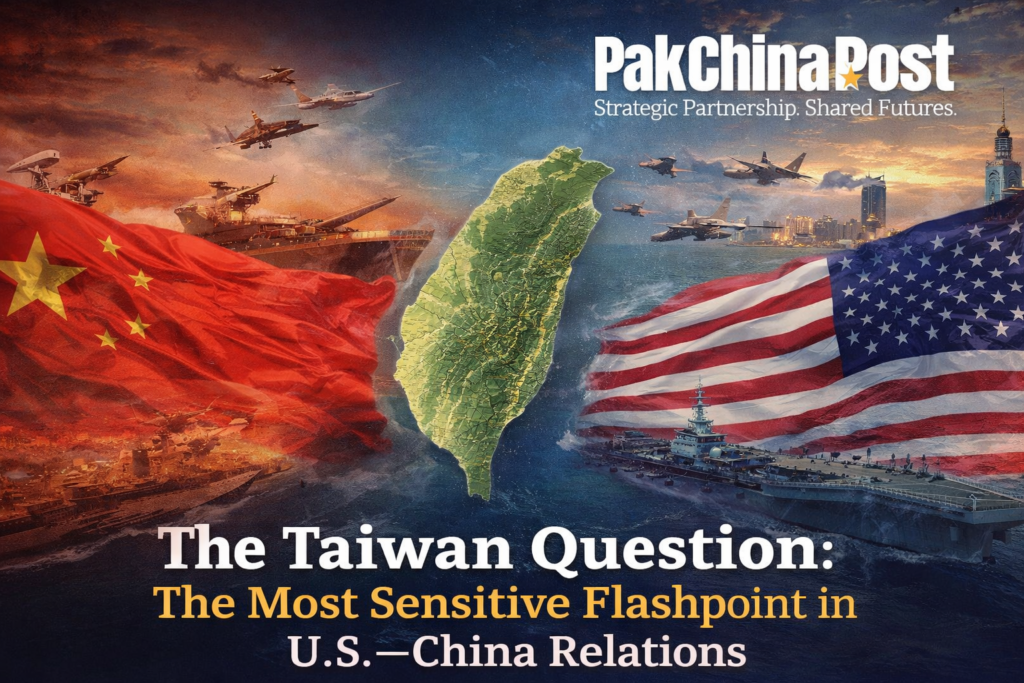
The Taiwan question stands at the very center of strategic tensions between China and the United States. No other issue combines historical grievance, national identity, military rivalry, technological competition, and ideological divergence in such a concentrated and potentially explosive way. The Taiwan Strait is geographically narrow, yet politically it represents one of the widest divides in global politics. Any instability in this region would not remain local. It would reshape security alignments across Asia, disrupt global trade, and potentially draw major powers into direct confrontation.
The roots of the Taiwan issue lie in the outcome of the Chinese Civil War. In 1949, after years of conflict between the Chinese Communist Party and the Kuomintang government, the Communists established the People’s Republic of China in Beijing. The defeated Kuomintang leadership retreated to Taiwan and continued to operate under the name Republic of China. For decades, both governments claimed to represent China. During the Cold War, Washington recognized Taipei as the legitimate government of China. This changed in 1979 when the United States formally recognized the People’s Republic of China, shifting diplomatic ties from Taipei to Beijing. However, the United States did not sever its practical relationship with Taiwan. Instead, it passed the Taiwan Relations Act, which allows continued unofficial relations and commits the United States to provide Taiwan with defensive arms.
The diplomatic complexity deepened with the distinction between Beijing’s One China Principle and Washington’s One China Policy. Beijing insists there is only one China and that Taiwan is an inseparable part of it. Washington acknowledges Beijing’s position but does not explicitly endorse its sovereignty claim over Taiwan. This deliberate ambiguity has preserved relative peace for decades. It deters Taiwan from declaring formal independence while also discouraging Beijing from immediate military action. Yet this balancing act grows increasingly fragile as mistrust rises and military capabilities expand.
Taiwan itself has undergone profound political transformation. Once governed under authoritarian rule, it transitioned in the 1990s into a vibrant multi party democracy. Its elections are competitive, its press is free, and its civil society is active. Over time, a distinct Taiwanese identity has strengthened. Many residents identify primarily as Taiwanese rather than Chinese. Most favor maintaining the status quo, meaning neither unification with the mainland nor a formal declaration of independence. However, the evolution of identity complicates Beijing’s long term goal of peaceful unification. For the United States and other democratic states, Taiwan’s political system represents a successful democratic model in the Chinese speaking world. This adds ideological weight to what might otherwise be seen as a purely territorial dispute.
The military dimension of the Taiwan question is particularly concerning. Over the past two decades, China has significantly modernized the People’s Liberation Army. It has invested heavily in anti ship ballistic missiles, advanced fighter aircraft, naval expansion, cyber warfare capabilities, and space based systems. Military exercises around Taiwan have grown in frequency and scale. Aircraft regularly enter Taiwan’s air defense identification zone. Naval maneuvers simulate blockades or encirclement. These activities are designed to signal resolve, test readiness, and apply psychological pressure.
The United States maintains a strong presence in the Indo Pacific. American naval vessels transit the Taiwan Strait, asserting freedom of navigation. Although Washington does not have a formal defense treaty with Taiwan, it continues to supply defensive weapons and emphasizes the importance of peace and stability in the strait. This creates a deterrence structure that is powerful yet ambiguous. Beijing must consider the possibility of American intervention, while Washington avoids making explicit guarantees that could provoke escalation.
Any potential conflict scenario would be complex and devastating. An amphibious invasion across the Taiwan Strait would be one of the most challenging military operations imaginable. Taiwan’s mountainous terrain and fortified defenses add to the difficulty. Alternatively, Beijing could attempt a blockade, cutting off trade and forcing political concessions without direct invasion. Cyber attacks targeting infrastructure, financial systems, and communications networks could accompany any military action. Even without full scale war, gray zone tactics such as economic coercion, disinformation campaigns, and persistent military pressure could destabilize Taiwan over time.
Taiwan’s strategic importance is magnified by its role in global semiconductor production. The Taiwan Semiconductor Manufacturing Company produces the majority of the world’s most advanced microchips. These semiconductors power everything from smartphones and artificial intelligence systems to advanced weapons platforms. Global supply chains depend heavily on Taiwan’s manufacturing capacity. This reality has led some analysts to describe a silicon shield effect, suggesting that Taiwan’s economic centrality deters military aggression because the costs would be catastrophic not only for China and the United States but for the entire global economy. A conflict disrupting chip production would trigger worldwide shortages, financial panic, and technological paralysis.
Geography also enhances Taiwan’s significance. The island lies within what strategists call the First Island Chain, a line of territories stretching from Japan through the Philippines. This chain forms a natural barrier that limits China’s naval access to the broader Pacific Ocean. Control over Taiwan would shift the regional balance of power dramatically. From Beijing’s perspective, Taiwan’s alignment with Washington constrains China’s maritime expansion. From Washington’s perspective, Taiwan’s autonomy prevents the consolidation of Chinese dominance in the Western Pacific.
Domestic politics further intensify the issue. In Beijing, reunification with Taiwan is closely linked to narratives of national rejuvenation and overcoming historical humiliation. Political leaders frame the issue as unfinished business of the civil war. Any sign of permanent separation could be interpreted domestically as weakness. In Washington, bipartisan consensus increasingly views China as a strategic competitor. Support for Taiwan often garners strong political backing. In Taipei, electoral cycles influence cross strait policy. Political parties differ in tone toward Beijing, yet public opinion remains cautious about provoking conflict.
Economic interdependence adds another layer of complexity. China is Taiwan’s largest trading partner, and many Taiwanese businesses operate on the mainland. Despite political tensions, economic ties remain deep. However, strategic competition between the United States and China has led to calls for supply chain diversification and partial decoupling. Taiwan finds itself at the center of this restructuring. It must balance economic opportunities with security concerns, navigating pressures from both major powers.
The risk of miscalculation is significant. Military aircraft operating in close proximity increase the possibility of accidents. Political rhetoric can escalate rapidly during crises. A unilateral move by any side could trigger unintended consequences. A formal declaration of independence by Taiwan would almost certainly provoke a severe response from Beijing. Conversely, a sudden Chinese blockade or use of force would compel Washington to confront difficult strategic choices. Even a limited clash could spiral if communication channels fail or nationalist sentiment overwhelms caution.
Regional actors also influence the strategic environment. Japan has indicated that stability in the Taiwan Strait is linked to its own security. The Philippines has expanded defense cooperation with the United States. Australia has strengthened security ties within broader Indo Pacific frameworks. While not all regional partners would necessarily engage in direct combat, their political and logistical support could affect calculations in Beijing and Washington alike.
The future of the Taiwan question depends on deterrence, diplomacy, and restraint. For now, deterrence appears to hold. Both Beijing and Washington understand that open war would be catastrophic. The economic costs alone would be immense, not to mention the human toll. Nuclear armed powers confronting each other directly presents unimaginable risks. Yet deterrence is not static. As military capabilities shift and political narratives harden, maintaining stability becomes more challenging.
The Taiwan question embodies nearly every dimension of modern great power competition. It is a dispute rooted in civil war history yet shaped by contemporary strategic realities. It involves sovereignty claims, democratic identity, military modernization, technological dominance, and maritime strategy. It tests whether rising and established powers can manage rivalry without descending into conflict.
The Taiwan Strait may be a narrow body of water, but it carries the weight of global expectations and anxieties. Its future will influence not only relations between China and the United States but also the broader architecture of international order. Whether it remains a managed tension or transforms into open confrontation will depend on strategic prudence, political wisdom, and sustained dialogue among all parties involved.
A Public Service Message