
Industrial War and Strategic Partnership: Lessons from Russia’s Military-Industrial Regression for the Pakistan–China Defense Nexus

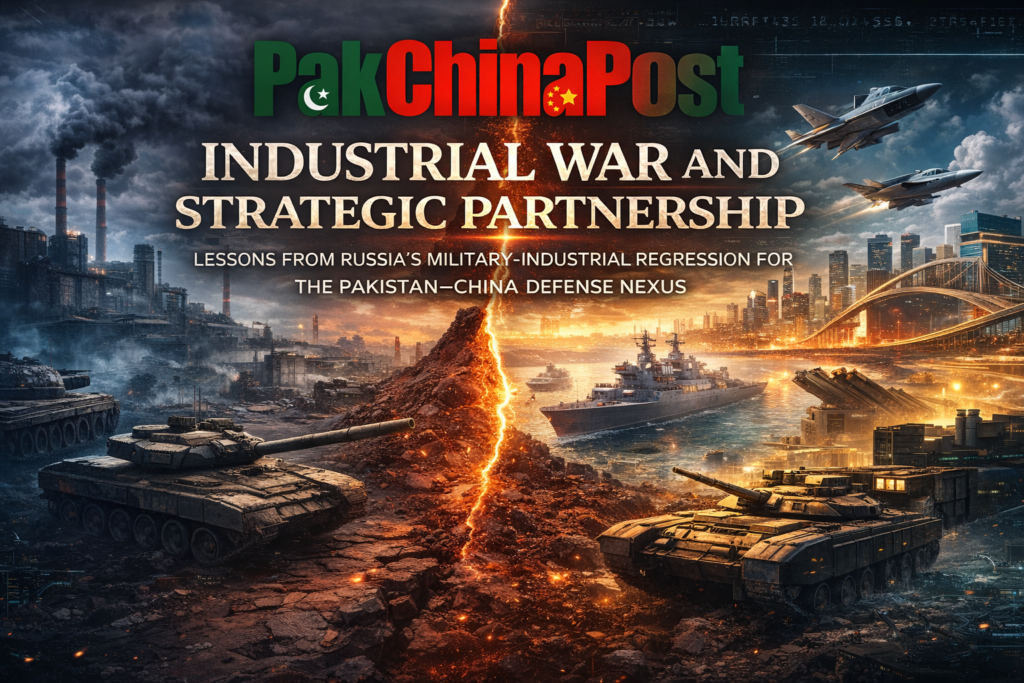
The protracted war between Russia and Ukraine has evolved into far more than a conventional military confrontation; it has become an empirical stress test of modern defense-industrial resilience under conditions of systemic isolation, technological denial, and sustained high-intensity attrition warfare. At the ce of this unfolding reality lies a profound and increasingly visible regression within Russia’s military-industrial complex, a regression catalyzed not merely by battlefield losses but by the cumulative constraining effects of sanctions imposed by the United States and its Western allies. This phenomenon offers critical insights into the structural vulnerabilities of defense production ecosystems that remain dependent on external technological inputs, fragmented supply chains, and legacy industrial architectures. For the evolving defence partnership between Pakistan and China, the Russian experience constitutes both a cautionary tale and a strategic reference point, underscoring the imperative of building a resilient, vertically integrated, and technologically autonomous defense-industrial base capable of sustaining long-duration conflict while maintaining innovation trajectories.
The sanctions regime imposed on Russia following its invasion of Ukraine represents one of the most comprehensive attempts in modern history to weaponize economic interdependence against a major military power. These measures have systematically targeted Russia’s access to advanced microelectronics, semiconductor technologies, precision manufacturing tools, and dual-use components essential for modern weapons systems. The denial of access to Western-origin chips and industrial inputs has had cascading effects across Russia’s defense production chain, constraining its ability to manufacture high-precision guided munitions, advanced avionics, and next-generation communication systems. In a globalized defense-industrial environment where even ostensibly indigenous platforms rely on internationally sourced components, such restrictions have exposed the fragility of Russia’s technological ecosystem.
The resulting technological regression within Russia’s military apparatus has manifested in multiple dimensions. One of the most visible indicators is the reactivation and deployment of Soviet-era platforms, including older main battle tanks and artillery systems, which lack the sophistication, survivability, and network-centric capabilities of contemporary systems. In parallel, there has been a discernible shift toward the production of simplified weapons systems that prioritize volume over precision, reflecting both industrial constraints and operational necessity. Reports of Russian forces utilizing commercial-grade electronics, repurposed consumer components, and improvised substitutes for critical microchips underscore the extent to which technological denial has forced adaptive but suboptimal solutions. This reversion to lower technological baselines represents not merely a tactical adjustment but a structural degradation of industrial capability.
Equally consequential is the reallocation of Russia’s scientific and engineering capital. Under the pressures of sustained conflict, research and development priorities have been redirected from long-term innovation toward the immediate requirements of maintaining and repairing legacy systems. This shift has significant implications for the future trajectory of Russia’s defense-industrial complex. Innovation ecosystems, once disrupted, are not easily reconstituted; the diversion of intellectual capital toward short-term wartime production risks creating a generational lag in technological advancement. Over time, this dynamic could erode Russia’s competitiveness in high-end defense technologies, further reinforcing its dependence on outdated systems and diminishing its strategic autonomy.
The implications of this regression extend beyond Russia’s national context to the global arms market. Historically, Russia has been one of the world’s leading exporters of military hardware, supplying a wide range of platforms to countries across Asia, Africa, and the Middle East. However, the degradation of its industrial base, combined with the operational exposure of its equipment in Ukraine, has begun to undermine confidence in Russian defense products. Delivery delays, maintenance challenges, and concerns about technological obsolescence are prompting traditional clients to diversify their procurement strategies. This evolving landscape is creating opportunities for alternative suppliers, including emerging defense-industrial partnerships that can offer competitive, reliable, and technologically credible platforms.
Within this shifting environment, the defense collaboration between Pakistan and China represents a strategically significant alternative model, one that emphasizes co-production, technology transfer, and industrial integration. Unlike traditional buyer–seller relationships, this partnership is structured around joint development initiatives that enable the localization of manufacturing capabilities and the gradual absorption of technological expertise. A prominent example of this model is the JF-17 Thunder, a multirole combat aircraft co-developed by the Pakistan Aeronautical Complex and the Aviation Industry Corporation of China. The JF-17 program exemplifies how collaborative frameworks can facilitate the development of indigenous production capacity while leveraging external technological inputs.
The strategic significance of such co-developed platforms lies in their capacity to mitigate dependency on Western-controlled supply chains. By diversifying sources of technology and embedding production processes within domestic industrial ecosystems, Pakistan enhances its resilience against external shocks, including sanctions and export controls. Moreover, the integration of Chinese technological support provides access to a broad spectrum of capabilities, ranging from avionics and radar systems to weapons integration and maintenance infrastructure. This symbiotic arrangement allows Pakistan to progressively expand its defense-industrial base while maintaining operational readiness.
From a defense economics perspective, the Pakistan–China model also offers advantages in terms of cost efficiency and scalability. The JF-17, for instance, is positioned as a relatively affordable yet capable platform, making it attractive to countries with limited defense budgets. This affordability, combined with the prospect of technology transfer and local maintenance capabilities, enhances its appeal in emerging markets. As a result, Pakistan has been able to position itself as a credible exporter of defense equipment, engaging with clients across Africa, the Middle East, and Southeast Asia. In a global arms market increasingly characterized by diversification and competition; this represents a significant strategic opportunity.
However, the expansion of defense exports also introduces a set of complex challenges. One of the primary constraints is production capacity. Scaling up manufacturing to meet international demand requires substantial investment in industrial infrastructure, skilled labor, and supply chain management. Any bottlenecks in these areas can lead to delays, cost overruns, and reputational risks. For Pakistan, ensuring that its defense-industrial base can sustain both domestic requirements and export commitments is a critical priority. This necessitates not only physical capacity expansion but also institutional reforms aimed at improving efficiency, coordination, and quality control.
Another challenge relates to technological evolution. While platforms like the JF-17 provide a solid foundation, the rapidly changing nature of modern warfare demands continuous innovation. Advances in areas such as stealth technology, artificial intelligence, unmanned systems, and network-centric warfare are redefining the parameters of military capability. To remain competitive, the Pakistan–China partnership must extend beyond current platforms to encompass next-generation research and development initiatives. This includes the exploration of advanced aerospace programs, collaborative design frameworks, and joint innovation ecosystems that can sustain long-term technological advancement.
The Russian experience underscores the dangers of technological stagnation and overreliance on legacy systems. For Pakistan and China, avoiding a similar trajectory requires a deliberate and sustained commitment to innovation. This involves not only investing in research and development but also cultivating a skilled workforce capable of driving technological progress. Educational institutions, research centers, and industrial entities must be integrated into a cohesive ecosystem that supports the continuous evolution of defense capabilities. In this context, the alignment of academic research with industrial and military requirements becomes a strategic imperative.
At the same time, the geopolitical environment in which the Pakistan–China defense partnership operates is inherently complex. While the partnership offers a pathway to greater autonomy, it also exists within a broader context of strategic competition involving major powers. The increasing scrutiny of defense collaborations, particularly those involving advanced technologies, necessitates careful navigation of diplomatic and regulatory frameworks. Balancing strategic alignment with China while maintaining functional relations with other global actors is essential for preserving strategic flexibility.
The intersection of industrial policy and strategic doctrine is particularly salient in this regard. Defense-industrial integration is not merely a technical process; it is a manifestation of broader strategic choices regarding alignment, autonomy, and capability development. For Pakistan, deepening its partnership with China reflects a calculated decision to prioritize long-term resilience over short-term dependency. For China, collaboration with Pakistan enhances its ability to project influence and build networks of strategic cooperation. Together, they are constructing an alternative paradigm of defense-industrial development that contrasts with traditional hierarchical models.
In light of these dynamics, the lessons derived from Russia’s industrial regression assume heightened significance. The erosion of technological capability under conditions of isolation highlights the critical importance of supply chain diversification, domestic production capacity, and innovation continuity. It also underscores the limitations of relying on legacy systems in an era of rapidly evolving technological competition. For Pakistan and China, these lessons translate into a strategic imperative to institutionalize deeper forms of industrial integration, encompassing joint ventures, shared research initiatives, and coordinated production frameworks.
Such integration must be underpinned by robust governance structures that ensure transparency, efficiency, and accountability. Institutional mechanisms for coordinating defense production, managing intellectual property, and aligning strategic objectives are essential for maximizing the benefits of collaboration. Additionally, the development of standardized processes and interoperability frameworks can enhance the effectiveness of joint platforms and facilitate their adoption in international markets.
The future trajectory of the global arms market will be shaped by a combination of technological innovation, geopolitical competition, and economic constraints. In this context, the ability to offer reliable, cost-effective, and technologically credible defense solutions will be a key determinant of success. The Pakistan–China partnership, if effectively managed, has the potential to emerge as a significant player in this evolving landscape. By leveraging their respective strengths, Pakistan’s geographic position and growing industrial base, and China’s technological and financial capabilities, the two countries can create a synergistic ecosystem that supports both domestic security and export-oriented growth.
In conclusion, the war in Ukraine has provided a stark illustration of how structural weaknesses within a defense-industrial complex can be exposed and amplified under conditions of sustained conflict and external pressure. The regression of Russia’s military-industrial system serves as a cautionary example of the consequences of technological dependency, supply chain vulnerability, and innovation stagnation. For Pakistan and China, the challenge is to internalize these lessons and translate them into a coherent strategy for defense-industrial development. This requires a comprehensive approach that integrates production, innovation, and strategic planning within a unified framework. By institutionalizing deeper collaboration, expanding joint research initiatives, and investing in next-generation technologies, Pakistan and China can build a resilient and autonomous defense-industrial ecosystem capable of withstanding external shocks and adapting to evolving strategic demands. In doing so, they not only enhance their own security but also position themselves as influential actors in a rapidly transforming global arms market, one in which industrial capability and strategic foresight are increasingly inseparable.
A Public Service Message