
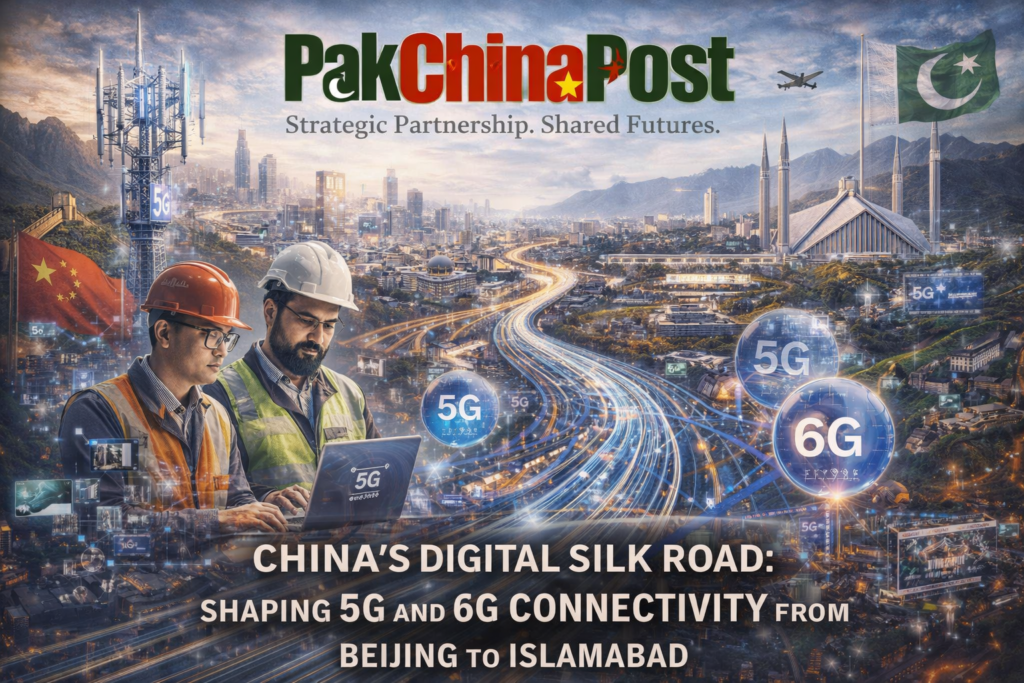
China’s Digital Silk Road: Shaping 5G and 6G Connectivity from Beijing to Islamabad

In the unfolding architecture of the twenty-first century’s geopolitical landscape, the frontier of global influence is no longer defined solely by highways, ports, and pipelines. It is increasingly shaped by signals carried on invisible waves, by cables running beneath deserts and mountains, and by data centers humming with the work of artificial intelligence. China’s strategy in technology and connectivity has moved from a peripheral emphasis to a central pillar of its international engagement, weaving a new kind of infrastructure that is as strategic as any physical corridor of concrete and steel. Nowhere is this more visible than in the partnership with Pakistan, where the Digital Silk Road has emerged not merely as a technical project but as an expression of China’s broader ambitions in global digitization, technological leadership, and normative influence.
From the earliest days of the Belt and Road Initiative, China envisaged a network of connectivity that would bind economies and societies in expanding circles of shared commerce and cooperation. The Digital Silk Road was originally a concept of digital infrastructure cooperation deploying fiber-optic networks, satellite communications, cloud services, and data exchange facilities across partner countries. It expressed a vision in which data flows were as vital as freight flows and connectivity extended beyond physical movement to include the digital pulse of economies. Over the last several years, this vision has evolved into a concrete strategy of technological engagement, particularly in countries like Pakistan where long-term partnerships provide platforms for depth and scale.
In Pakistan, the Digital Silk Road has transitioned from theory to practice as the China Pakistan Economic Corridor enters a second phase of cooperation that places advanced technology collaboration at its core. Historically, the first phase of the corridor addressed energy shortages, transportation linkages, and port development, binding western China with the Arabian Sea through major investments and infrastructure projects. The second phase reimagines that partnership for the digital age, positioning advanced technologies such as 5G and 6G networks, cloud computing, artificial intelligence, smart manufacturing, and cybersecurity cooperation as the backbone of a new chapter in Sino-Pakistani strategic collaboration.
The shift toward digital cooperation is not incidental. It is a reflection of China’s broader strategic priorities. Beijing has recognized that leadership in next-generation wireless technologies, particularly 5G and the emergent future of 6G, is not merely a matter of commercial competition, but a cornerstone of future economic, military, and governance capabilities. China’s domestic deployment of millions of 5G base stations, linking hundreds of millions of users and integrating 5G technologies into manufacturing, logistics, and smart city frameworks, reflects an internal narrative of technological ascendancy and an external ambition to share, shape, and export that model. The development and eventual commercialization of 6G is the next horizon in this technological odyssey, representing the cutting edge of next-generation connectivity and global influence.
Within this context, Pakistan is not merely a recipient of technology but a strategic partner in expanding China’s digital footprint. The Pakistan China Fiber Optic Cable Project, extending across high mountain passes and connecting into Pakistan’s interior, is emblematic of this. It provides a high-capacity digital backbone that reduces Pakistan’s reliance on undersea cables routed through other jurisdictions and strengthens the integration of digital infrastructure between the two countries. This cable is more than fiber; it is an artery in a vision of shared digital space, enabling faster data transit, enhanced network reliability, and the capacity for sophisticated cross-border services.
Under the auspices of the corridor’s Joint Working Group on Information Technology Cooperation, Pakistan and China are expanding the reach of this digital collaboration. This cooperation covers the deployment of ICT infrastructure, innovation in digital applications, cybersecurity enhancement, policy coordination, radio spectrum regulation, and human resource development, all within a framework designed to accelerate the rollout of high-speed networks and digital services.
For China, the strategic value of this engagement is multifaceted. It provides Beijing with a foothold in shaping how next-generation networks and digital infrastructure are deployed in a key regional partner. As China has moved aggressively into 5G, with domestic commercialization and industrial integration, exporting that experience and establishing it across allied borders strengthens China’s position in global telecom ecosystems. It also allows China to set standards and provide platforms that are interoperable with its own digital infrastructure, contributing to a unified technological ecosystem across a wider geographical span.
Deep engagement in 5G and emerging 6G technologies positions China as a central node in global data flows and digital services, not just as a builder of networks but as a provider of technology norms. Control over infrastructure like cross-border fiber and shared cloud facilities carries implications for digital governance, cybersecurity protocols, and future norms of internet architecture. As data becomes a source of strategic power, these infrastructures become geopolitical instruments as much as economic assets.
The emphasis on technologies such as artificial intelligence, cloud computing, smart cities, and intelligent manufacturing reflects China’s early strategic choice to integrate its domestic innovation agenda with its international outreach. By positioning these technologies as part of bilateral discussions through joint ventures in 5G and 6G research and hardware manufacturing, China exports not only equipment but a philosophy of digital modernization that aligns with its own industrial trajectory. This approach goes beyond selling hardware; it is an invitation to adopt a model of technological modernization that is co-developed and co-owned by partners.
From Islamabad’s perspective, aligning with China’s digital strategy is pragmatic and strategic. It offers Pakistan the opportunity to leapfrog legacy development stages and integrate into a digital ecosystem that can support economic transformation, job creation, and innovation capacity building. The technology collaboration under the corridor is not limited to infrastructure; it extends to cloud systems, cybersecurity, data centers, AI systems, and workforce skills, all of which have profound implications for Pakistan’s future digital economy.
Yet within this cooperation lies a reflection of the asymmetry of scale and capability that characterizes the China Pakistan partnership. China, as a global innovator in 5G and an early mover in shaping 6G trajectories, brings to the table significant technical expertise, industrial scale, and capital. Pakistan offers geographic connectivity, market potential, and strategic alignment. The intersection of these assets creates a partnership that is mutually beneficial but embedded within China’s broader strategy of building technological ecosystems anchored by its own standards, practices, and industrial outputs.
The strategic dimensions of this cooperation are also apparent in the efforts to develop human capital and talent ecosystems that are compatible with next-generation technologies. Beyond infrastructure, discussions between Pakistan’s tech leadership and Chinese counterparts have emphasized talent exchange, cybersecurity training, and joint research ventures. These initiatives reflect China’s interest not simply in exporting technology but in nurturing ecosystems that can sustain and extend its digital influence through education, skills development, and localized innovation capacity.
China’s approach to technology engagement also reflects an evolving philosophy of external influence. Rather than imposing its model, Beijing often frames cooperation as mutual development, where partner countries gain access to advanced technology while China’s own technologies gain legitimacy and adoption across broader regions. In this way, digital infrastructure becomes a language of shared destiny, where cooperation is framed not in terms of dominance but of shared horizons and collective advancement.
On the global stage, the implications of China’s Digital Silk Road and its leadership in 5G and 6G are significant. The competition over next-generation technology standards is not merely technical; it is geopolitical. As countries align with different technology ecosystems, they inadvertently choose standards of data governance, digital interoperability, and cyber governance. China’s expanding influence in portions of Asia, Africa, and now increasingly South Asia suggests a future in which technological order may be multi-polar, with competing centers of influence rooted in different industrial and normative foundations.
In the case of Pakistan, the embrace of Chinese technology cooperation opens doors to digital modernization but also demands a nuanced understanding of how strategic interests align. Pakistan’s ambition to become a regional digital transit hub, integrate digital industry clusters, and build new economic pathways through technology is amplified through its cooperation with China. That ambition must also be balanced with efforts to cultivate local capacity, protect digital autonomy, and diversify partnerships.
This balancing act is not unique to Pakistan. Across the global south, countries engaging with China’s Digital Silk Road are navigating the dual imperatives of accessing advanced infrastructure and protecting sovereign control over their digital futures. For these states, the promise of leapfrogging developmental stages through connectivity and technology must be weighed against concerns over dependency, standard setting, and locus of control over critical digital infrastructure.
Yet the reality remains that China’s technological ascendancy and its strategic push into 5G and the early stages of 6G are reshaping global expectations of connectivity and digital cooperation. As policymakers, technologists, and industry leaders convene in forums for global telecommunication and innovation, the dialogues around joint ventures in hardware manufacturing, ICT components, and innovation ecosystems reflect a convergence of national ambitions with China’s long-term vision of digital connectivity.
Ultimately, the story of China’s Digital Silk Road in Pakistan is not merely one of cables and towers but of a deeper transformation in how technology is integrated into national strategies, how global influence is exerted, and how digital futures are imagined. The transformation from physical highways to fiber conduits, from standalone networks to cloud-integrated platforms, and from isolated innovation to collaborative ecosystems is emblematic of a new phase in international engagement where technology is both instrument and language of global partnership.
The challenge for Pakistan and for many nations engaging with China will be to harness the potential of this cooperation to catalyze domestic innovation, protect sovereign digital space, and cultivate a future in which technological progress contributes to shared prosperity rather than unilateral dependency. In this unfolding script of technology and transformation, China’s role as a strategic architect of connectivity will continue to define not only how networks are built but how power, influence, and opportunity are distributed in the digital age from Beijing to Islamabad and beyond.
A Public Service Message