
Narrative Sovereignty and Competing Information Ecosystems in Pakistan’s Social and Media Environment

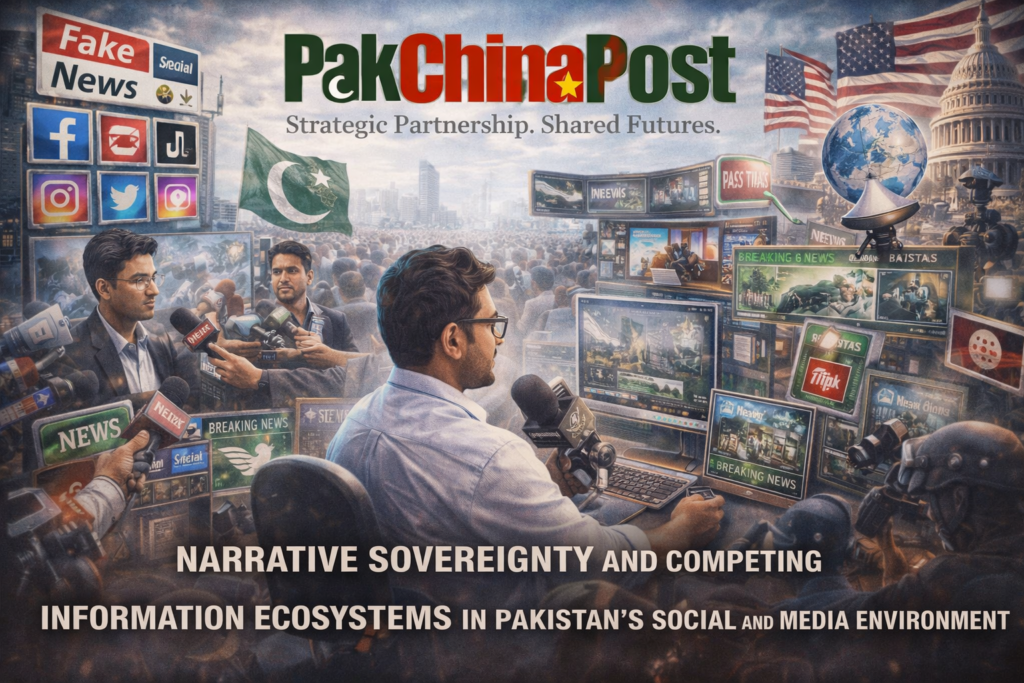
The struggle over narrative in the contemporary global order is no longer confined to diplomatic corridors or military alignments; it has migrated into the very architecture of information through which societies perceive reality. In Pakistan, this transformation has assumed a particularly complex form, shaped by the intersecting influences of China and the United States, two powers whose rivalry extends beyond economics and security into the domain of meaning making itself. The social and media environment thus emerges not as a neutral space of communication but as a contested terrain where competing epistemologies vie for legitimacy, authority, and emotional resonance among the public.
At the heart of this contest lies the concept of narrative sovereignty, a nation’s capacity to define its own story, interpret its own interests, and communicate its strategic realities without disproportionate external mediation. For Pakistan, narrative sovereignty is neither an abstract ideal nor a purely academic concern; it is a strategic necessity in an era where perception often precedes policy and where public opinion can shape the contours of foreign engagement. The difficulty, however, lies in the fact that Pakistan’s media ecosystem is deeply embedded within global flows of information that are structured by asymmetrical power relations.
The Chinese information model operates through a centralized and state calibrated system that prioritizes coherence, developmental messaging, and long-term strategic framing. Platforms such as China Global Television Network exemplify this approach by projecting narratives that emphasize economic cooperation, infrastructural connectivity, and the promise of multipolar stability. These narratives are not merely informational; they are aspirational, designed to align domestic and international audiences with a vision of global order in which sovereignty and noninterference are foundational principles. For Pakistan, which has historically valued its strategic partnership with China, such narratives resonate with existing policy orientations and developmental aspirations.
In contrast, the United States operates within a decentralized yet globally dominant media ecosystem characterized by pluralism, investigative critique, and a normative commitment to liberal democratic values. Outlets such as CNN and The New York Times function as influential nodes in a broader network that shapes global discourse on governance, human rights, and international legitimacy. While this system allows for diversity of perspectives, it also embeds certain ideological assumptions that influence how countries like Pakistan and China are represented. Issues related to governance, transparency, and strategic alignment are often framed through a lens that privileges Western institutional norms, thereby creating a subtle but persistent hierarchy of credibility.
Pakistan’s media landscape does not passively absorb these narratives; rather, it reflects, refracts, and at times amplifies them through its own institutional and cultural filters. Traditional media outlets, including television news channels and print journalism, operate within regulatory frameworks and ownership structures that influence editorial direction. At the same time, digital platforms such as X (formerly Twitter) and YouTube have introduced a level of decentralization that complicates any attempt at coherent narrative formation. These platforms enable a multiplicity of voices but also create conditions in which competing narratives coexist without resolution, often leading to fragmentation rather than synthesis.
The result is a hybrid information environment in which pro-China developmental optimism coexists with skepticism shaped by Western critique, and where public opinion oscillates between these poles depending on context, issue, and emotional appeal. This hybridity is not inherently problematic; indeed, it reflects a form of pluralism that can enrich democratic discourse. However, in the absence of a strong indigenous narrative framework, it can also lead to confusion, inconsistency, and susceptibility to external influence.
One of the central challenges in this context is the question of epistemic authority. Who defines what counts as credible knowledge in Pakistan’s media environment? Historically, this role was performed by established journalistic institutions that adhered to professional norms of verification and accountability. Today, however, authority is increasingly diffused across a wide range of actors, including independent commentators, social media influencers, and algorithmically amplified content creators. This diffusion democratizes information but also undermines the hierarchy of expertise that is necessary for informed public discourse.
The interplay between global narratives and local reception is further complicated by cultural and historical factors. Pakistan’s identity has been shaped by a complex interplay of colonial legacy, Islamic civilization, and postcolonial state formation. These layers influence how external narratives are interpreted and internalized. For instance, Chinese narratives of noninterference and economic partnership resonate with a historical sensitivity to sovereignty, while American narrative of democracy and accountability intersect with domestic debates on governance and institutional reform. The coexistence of these interpretive frameworks creates a dynamic but often unstable discursive environment.
The role of language is also significant in shaping narrative sovereignty. English language media in Pakistan tends to be more closely aligned with global discourse, often reflecting Western analytical frameworks and terminology. Urdu and regional language media, on the other hand, engage more directly with local cultural sensibilities and political dynamics. This linguistic bifurcation can lead to parallel discourses that rarely intersect, further complicating the formation of a unified national narrative. In such a context, the challenge is not merely to produce content but to bridge these discursive divides in a manner that preserves intellectual rigor while ensuring accessibility.
Another critical dimension is the temporal nature of contemporary media. The speed at which information circulates has fundamentally altered the relationship between event and interpretation. In the past, there was a temporal gap that allowed for reflection, verification, and contextualization. Today, narratives are often constructed in real time, driven by the immediacy of digital platforms and the demand for constant engagement. This acceleration favors simplicity over complexity, emotion over analysis, and immediacy over accuracy. For a country navigating complex geopolitical relationships, such conditions can distort public understanding and constrain policy flexibility.
The economic structure of media also plays a crucial role in shaping narrative outcomes. Advertising driven models incentivize content that maximizes viewership and engagement, often at the expense of depth and nuance. In the digital sphere, this logic is amplified by algorithms that prioritize content based on user interaction. As a result, narratives that are sensational, polarizing, or emotionally charged tend to gain greater visibility. This creates a feedback loop in which public preference and media production reinforce each other, potentially marginalizing more balanced and analytical perspectives.
In this environment, the question of strategic communication becomes paramount. Narrative sovereignty cannot be achieved solely through defensive measures such as countering misinformation or regulating content. It requires a proactive approach that involves the deliberate construction and dissemination of coherent narratives that reflect national interests and values. This involves not only state institutions but also academia, media professionals, and civil society. The goal is not to impose a monolithic narrative but to create a framework within which diverse perspectives can coexist without undermining strategic clarity.
For Pakistan, this task is particularly urgent in the context of its relationships with China and the United States. Both partnerships are critical, yet they operate within different normative and strategic frameworks. The ability to articulate a balanced narrative that acknowledges the benefits and challenges of each relationship is essential for maintaining autonomy and credibility. This requires moving beyond reactive discourse toward a more reflective and forward-looking approach that situates Pakistan’s interests within a broader vision of regional and global engagement.
The role of specialized platforms such as Pak China Post becomes crucial in this regard. Such platforms have the potential to function as sites of intellectual mediation, where complex geopolitical dynamics are analyzed with rigor and communicated with clarity. By prioritizing depth over immediacy and nuance over polarization, they can contribute to the development of a more informed and resilient public sphere. This is not merely a matter of editorial policy but of epistemic responsibility, a commitment to shaping how reality is understood rather than merely reporting on how it appears.
Education and media literacy also form an essential component of narrative sovereignty. An informed public is better equipped to navigate competing narratives and to distinguish between analysis and propaganda. This requires integrating critical thinking skills into educational curricula and promoting awareness of how media systems operate. In a digital age where information is abundant but attention is scarce, the ability to critically evaluate content becomes a form of civic competence.
At a deeper level, the struggle for narrative sovereignty reflects a broader transformation in the nature of power. Traditional metrics such as military capability and economic strength remain important, but they are increasingly complemented by the ability to shape perceptions and influence discourse. In this sense, media is not merely a reflection of power but a constituent element of it. Countries that can effectively manage their information environments are better positioned to navigate the uncertainties of the global order.
Pakistan’s position within this evolving landscape is both challenging and promising. Its strategic location, demographic diversity, and complex history provide a rich foundation for narrative construction. At the same time, its exposure to competing global influences requires a level of strategic coherence that is difficult to achieve in a fragmented media environment. The task, therefore, is not to eliminate diversity of perspectives but to anchor them within a coherent framework that reflects national priorities and values.
Ultimately, narrative sovereignty is about more than controlling information; it is about cultivating a shared understanding of reality that enables collective action. In a world where truth is increasingly contested and where information flows are shaped by powerful external actors, the ability to define one’s own narrative becomes a form of sovereignty in its own right. For Pakistan, achieving this sovereignty will require not only institutional reform and strategic communication but also a deeper engagement with the intellectual foundations of media and society.
The social and media environment is thus revealed as a space of profound significance, where the future of national identity, policy direction, and international engagement is continuously negotiated. In this space, the competition between Chinese and American narratives is not simply a reflection of their global rivalry but a catalyst for Pakistan’s own process of self-definition. The outcome of this process will shape not only how Pakistan is perceived by others but how it understands itself in an increasingly interconnected and contested world.
A Public Service Message