Internal Security, Social Control, and the Question of Political Legitimacy in Contemporary China


The durability of the Chinese political system has long rested on a carefully maintained equilibrium between economic performance, social stability, and centralized authority. In the contemporary era, this equilibrium is being recalibrated through an intensified emphasis on internal security and social control under the leadership of Xi Jinping. As China navigates a period of economic adjustment and geopolitical competition, the internal dimension of governance has assumed heightened significance. The question is no longer simply how the state maintains order, but how it sustains legitimacy in an increasingly complex and evolving society.
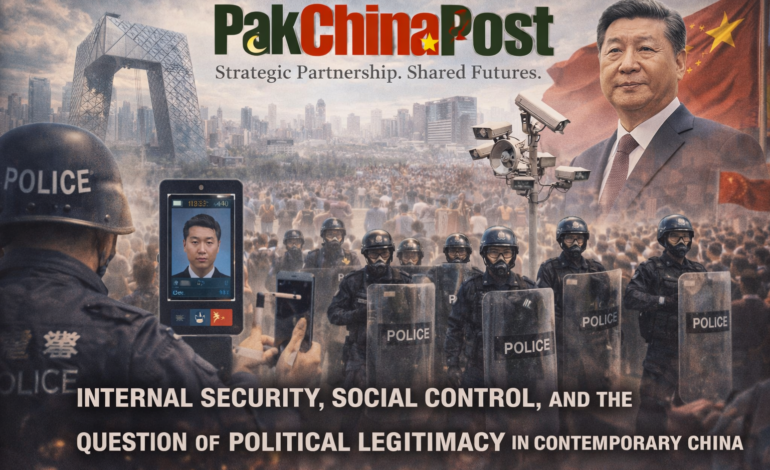
China’s governance model has historically prioritized stability as a foundational principle. Stability is not treated as a passive condition but as an actively managed outcome, requiring constant monitoring, intervention, and adaptation. In recent years, the mechanisms through which this stability is pursued have become more sophisticated and expansive. Advances in digital technology have enabled the development of comprehensive surveillance systems that integrate facial recognition, big data analytics, and real-time monitoring. These tools allow the state to anticipate and respond to potential disruptions with a level of precision that was previously unattainable.
The expansion of surveillance infrastructure is closely linked to broader efforts to reinforce ideological cohesion. The Chinese Communist Party has placed renewed emphasis on political education, party discipline, and the centralization of authority. This reflects a strategic assessment that social fragmentation, if left unchecked, could undermine both governance capacity and national unity. By strengthening ideological alignment, the leadership seeks to ensure that rapid economic and social changes do not translate into political instability.
However, the reliance on control mechanisms also introduces a set of tensions that are difficult to ignore. Chinese society today is far more diverse, urbanized, and interconnected than it was in previous decades. The rise of a large middle class, increased access to education, and exposure to global cultural and economic trends have shaped new expectations among citizens. These expectations extend beyond material well-being to include issues of fairness, opportunity, and participation. Managing these expectations within a highly centralized political framework presents an ongoing challenge.
One of the most significant pressures emerges from the labor market, particularly among younger generations. Youth unemployment has become a persistent concern, reflecting both structural changes in the economy and a mismatch between educational outcomes and job opportunities. Graduates entering the workforce encounter a more competitive environment, with fewer guarantees of upward mobility. This has implications not only for economic productivity but also for social confidence. A generation that once associated education with assured progress is now confronting uncertainty, which can influence broader perceptions of the system’s effectiveness.
Urban-rural disparities continue to represent another dimension of internal complexity. While China has achieved remarkable success in poverty reduction, inequalities between regions and social groups remain pronounced. Access to quality education, healthcare, and public services varies significantly, shaping lived experiences in ways that are not always aligned with the narrative of uniform national progress. Addressing these disparities requires sustained policy attention and resource allocation, particularly as fiscal pressures at the local level constrain the capacity for redistribution.
The management of ethnic and regional diversity further illustrates the interplay between security and legitimacy. In regions such as Xinjiang and Tibet, policies have been implemented with the stated aim of ensuring stability and countering extremism. These measures include enhanced surveillance, restrictions on certain cultural and religious practices, and programs designed to promote economic integration. While the state frames these policies as necessary for national cohesion, they have also attracted international scrutiny and raised questions about the balance between security objectives and cultural autonomy.
Information control constitutes another critical component of China’s internal governance strategy. The digital ecosystem within China is characterized by a high degree of regulation, with platforms subject to content monitoring and censorship requirements. This system enables the state to shape public discourse, limit the spread of information deemed harmful, and maintain a narrative that supports policy objectives. At the same time, it creates an environment in which public expression is mediated through institutional filters, potentially constraining the diversity of viewpoints that can be openly articulated.
Despite these constraints, Chinese society is not static. It exhibits forms of adaptation and negotiation that operate within the boundaries set by the state. Public feedback mechanisms, local governance experiments, and targeted policy adjustments demonstrate that responsiveness remains an important element of the system. The leadership is acutely aware that legitimacy cannot be sustained through control alone; it must also be reinforced through performance and the perception of fairness.
The concept of performance legitimacy has been central to the Chinese political model. Economic growth, infrastructure development, and improvements in living standards have historically served as key indicators of success. As growth moderates, the emphasis on quality of life becomes more pronounced. Environmental protection, public health, and social welfare are increasingly important in shaping public satisfaction. The state’s ability to deliver in these areas influences how citizens evaluate its effectiveness.
The experience of recent public health challenges has further highlighted the complexities of governance in a highly controlled system. Strict measures implemented to contain health crises demonstrated the state’s capacity for rapid mobilization and enforcement. However, they also revealed the social and economic costs associated with such approaches. Public reactions to these measures varied, reflecting both compliance and, at times, frustration. This underscores the delicate balance between ensuring collective safety and maintaining individual well-being.
Technological advancement continues to play a dual role in this landscape. On one hand, it enhances the state’s ability to monitor, predict, and manage social dynamics. On the other, it empowers citizens with new forms of communication and access to information, even within regulated environments. This dynamic creates an ongoing interplay between control and agency, where both the state and society adapt to the opportunities and constraints presented by digital transformation.
The centralization of authority under Xi Jinping has reinforced the coherence of policy direction but has also concentrated responsibility. Decision making at the highest levels is closely associated with the leadership’s vision, linking political outcomes directly to perceptions of leadership effectiveness. This can strengthen accountability but also heightens the stakes associated with policy success or failure.
It is important to situate China’s internal security framework within its broader historical and cultural context. The emphasis on order, hierarchy, and collective stability has deep roots, shaping both governance practices and societal expectations. While contemporary mechanisms may appear distinctive due to their technological sophistication, they are part of a longer tradition that prioritizes cohesion and continuity.
Nevertheless, the scale and speed of change in modern China introduce variables that have no direct historical precedent. The integration of digital systems, the globalization of economic activity, and the emergence of new social identities create a landscape that is inherently fluid. Governing this landscape requires not only control but also adaptability and innovation in institutional design.
The question of political legitimacy ultimately revolves around the relationship between the state and its citizens. In China, this relationship is mediated through a combination of performance, nationalism, and institutional authority. National achievements, including economic development and technological progress, contribute to a sense of collective pride that reinforces support for the system. At the same time, the effectiveness of governance at the local level, where citizens interact directly with state institutions, plays a crucial role in shaping everyday perceptions.
Looking ahead, the sustainability of China’s internal governance model will depend on its ability to navigate multiple, intersecting challenges. Economic adjustment, demographic change, and social diversification all require responses that go beyond traditional control mechanisms. The capacity to integrate these responses into a coherent strategy will determine how effectively the state can maintain both stability and legitimacy.
China’s experience offers a distinctive perspective on the relationship between security and governance in the twenty first century. It illustrates how technological innovation can be harnessed to enhance state capacity, while also highlighting the complexities that arise when control and responsiveness must coexist. The outcome of this ongoing process will not only shape China’s domestic trajectory but will also influence global debates about governance, development, and the future of political systems.
In this sense, internal security and social control in China are not merely instruments of policy but central elements of a broader narrative about state resilience and transformation. As the country continues to evolve, the interplay between authority, society, and legitimacy will remain a defining feature of its path forward.
A Public Service Message