Co-Designing Maritime Multipolarity in the Strait of Hormuz

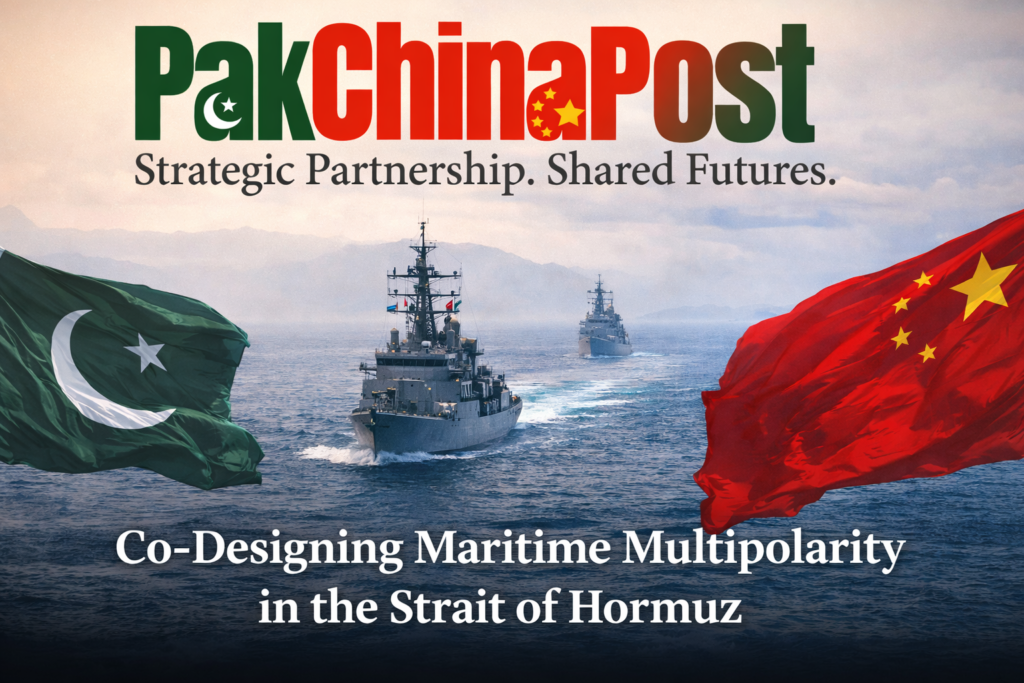
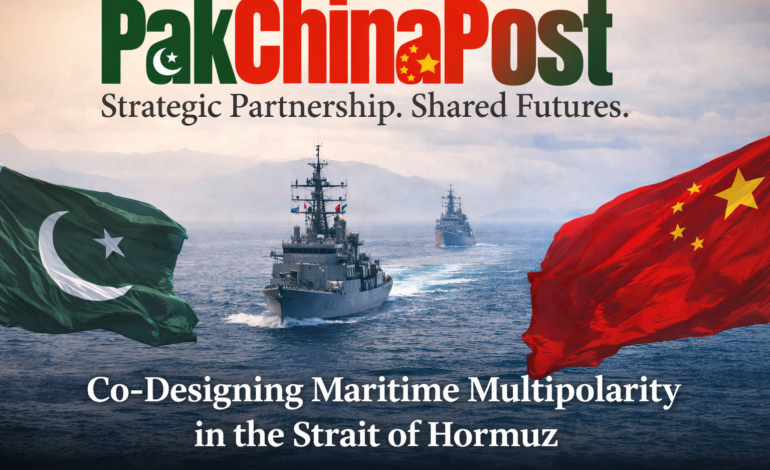
The evolution of global maritime order in the twenty first century is no longer being scripted through singular assertions of dominance but through intricate processes of co design, where multiple actors converge to construct systems that are simultaneously resilient, adaptive, and non escalatory. Within this shifting landscape, the strategic partnership between China and Pakistan has emerged as a defining axis in the reconfiguration of control over critical maritime geographies. Nowhere is this transformation more evident than in their joint conceptualization and operationalization of what may be termed the Hormuz framework, a prototype for multipolar maritime governance centered on the Strait of Hormuz.
This framework does not represent a conventional alliance in the traditional military sense, nor does it conform to the historical patterns of hegemonic substitution. Instead, it reflects a deeper structural shift in how power is conceived, distributed, and exercised across strategic waterways. The Sino Pak approach is rooted in the recognition that the age of unilateral naval supremacy is gradually giving way to an era of distributed control, where influence is exercised through systems integration rather than force projection alone.
At the heart of this transformation lies a deliberate synthesis of complementary capabilities. China brings to the partnership its unparalleled technological depth, financial capital, and experience in large scale infrastructural development. Pakistan contributes its geostrategic positioning, operational proximity to the Gulf, and an increasingly sophisticated understanding of regional security dynamics. The convergence of these attributes generates a composite capability that transcends the limitations of each actor in isolation.
The operational manifestation of this convergence is most visible in the development of Gwadar as a multifunctional node within a broader maritime architecture. The port of Gwadar, situated at the crossroads of major energy routes, serves as both a logistical hub and a strategic interface through which surveillance, coordination, and response mechanisms are integrated. Yet Gwadar’s significance extends beyond its physical infrastructure. It embodies a new logic of control, one that prioritizes connectivity, information flow, and systemic regulation over overt militarization.
This logic is reinforced by the integration of advanced technological systems that enable real time maritime domain awareness. Through the deployment of satellite based monitoring, remote sensing capabilities, and networked intelligence platforms, the Sino Pak framework establishes a persistent presence across the maritime space without necessitating constant physical deployment. This form of presence, characterized by invisibility and continuity, allows for the modulation of control in ways that are both subtle and effective.
The concept of multipolar maritime governance, as articulated through this framework, is predicated on the idea that stability is best achieved not through the exclusion of other actors but through the creation of conditions that incentivize compliance. By embedding regulatory mechanisms within the operational environment, China and Pakistan are effectively shaping the behavior of all stakeholders without resorting to coercion. The result is a system where access to the Strait is maintained, yet its terms are increasingly influenced by the norms and capabilities established by the Sino Pak partnership.
This approach stands in marked contrast to the legacy model dominated by the United States, which has historically relied on visible deterrence and the capacity for rapid escalation to maintain control. While effective in certain contexts, this model is inherently resource intensive and politically contentious, particularly in an era where perceptions of sovereignty and regional autonomy are becoming more pronounced. The Sino Pak framework, by contrast, offers a more sustainable and less intrusive alternative, one that aligns with the broader trend toward multipolarity in international relations.
A critical dimension of this framework is its emphasis on co authorship rather than hierarchy. Unlike traditional alliances where one partner assumes a dominant role, the Sino Pak partnership is characterized by a degree of strategic symmetry. This symmetry is not absolute, given the disparities in economic and military capabilities, but it is nonetheless significant in shaping the nature of their collaboration. Decision making processes are increasingly coordinated, operational responsibilities are distributed, and strategic objectives are jointly defined.
This co design extends to the doctrinal level, where both countries are actively engaged in redefining the principles that underpin maritime governance. The shift from deterrence to controlled access, from unilateral enforcement to coordinated regulation, and from episodic intervention to continuous management reflects a shared understanding of the complexities of contemporary geopolitics. In this sense, the Hormuz framework is not merely an operational construct but a conceptual innovation that challenges established paradigms.
Furthermore, the economic dimension of this partnership reinforces its strategic depth. The integration of Gwadar into broader connectivity initiatives enhances its role as a conduit for trade and energy flows, thereby increasing the stakes for all actors involved. As investments from multiple regions converge upon this node, the incentives for maintaining stability within the Strait are correspondingly amplified. This interdependence creates a feedback loop in which economic and strategic considerations mutually reinforce each other.
It is also important to consider the broader implications of this framework for global maritime governance. If successfully sustained, the Sino Pak model could serve as a template for managing other critical chokepoints, such as the Strait of Malacca or the Bab el-Mandeb. In each case, the emphasis would be on integrating local geostrategic realities with global technological capabilities to create systems of control that are both effective and acceptable to a diverse set of stakeholders.
However, the replication of this model is contingent upon a range of factors, including the willingness of regional actors to participate in such frameworks, the availability of resources for infrastructural and technological development, and the ability to manage potential conflicts of interest. The Sino Pak experience provides valuable insights into these dynamics, demonstrating both the possibilities and the challenges inherent in co designing complex strategic systems.
Another salient aspect of this framework is its reliance on information as a primary vector of power. In an environment where data can be collected, processed, and disseminated in real time, the ability to understand and anticipate developments becomes a critical determinant of influence. By investing in intelligence fusion and data analytics, China and Pakistan are effectively shifting the locus of control from the physical to the informational domain. This shift not only enhances their operational capabilities but also reduces the likelihood of miscalculation by providing a more accurate picture of the maritime environment.
The normative implications of this shift are equally significant. As new forms of control emerge, they bring with them new expectations regarding transparency, accountability, and cooperation. The Sino Pak framework, by emphasizing managed stability and shared responsibility, contributes to the gradual evolution of these norms. While still in its formative stages, this process has the potential to reshape the legal and institutional foundations of maritime governance in the years to come.
Nevertheless, it would be premature to assume that this transition will be seamless or uncontested. Existing powers may perceive the emergence of such frameworks as a challenge to their established interests and may seek to counterbalance them through alternative strategies. Similarly, internal dynamics within the partnership, including differences in priorities or approaches, could introduce complexities that need to be carefully managed. The success of the Hormuz framework will therefore depend on the ability of China and Pakistan to navigate these challenges while maintaining the coherence of their vision.
In evaluating the significance of this development, it is essential to move beyond simplistic narratives of rivalry or alignment and to appreciate the deeper structural changes that are unfolding. The Sino Pak co design of maritime governance represents a shift toward a more nuanced and sophisticated understanding of power, one that recognizes the limitations of force and the potential of systems. It is an approach that seeks to reconcile the imperatives of security, stability, and sovereignty within a single operational framework.
In conclusion, the joint conceptualization and operationalization of the Hormuz framework by China and Pakistan marks a pivotal moment in the evolution of global maritime order. By combining technological innovation, geostrategic positioning, and doctrinal creativity, they have created a model of multipolar governance that challenges traditional paradigms and offers a viable alternative for managing critical chokepoints. Whether this model will be widely adopted remains to be seen, but its implications are already reshaping the discourse on maritime strategy and the future of international relations.
A Public Service Message