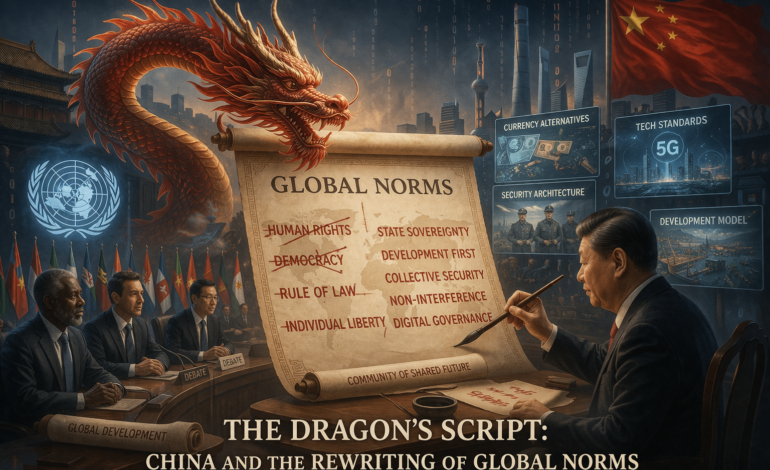
The Dragon’s Script: China and the Rewriting of Global Norms

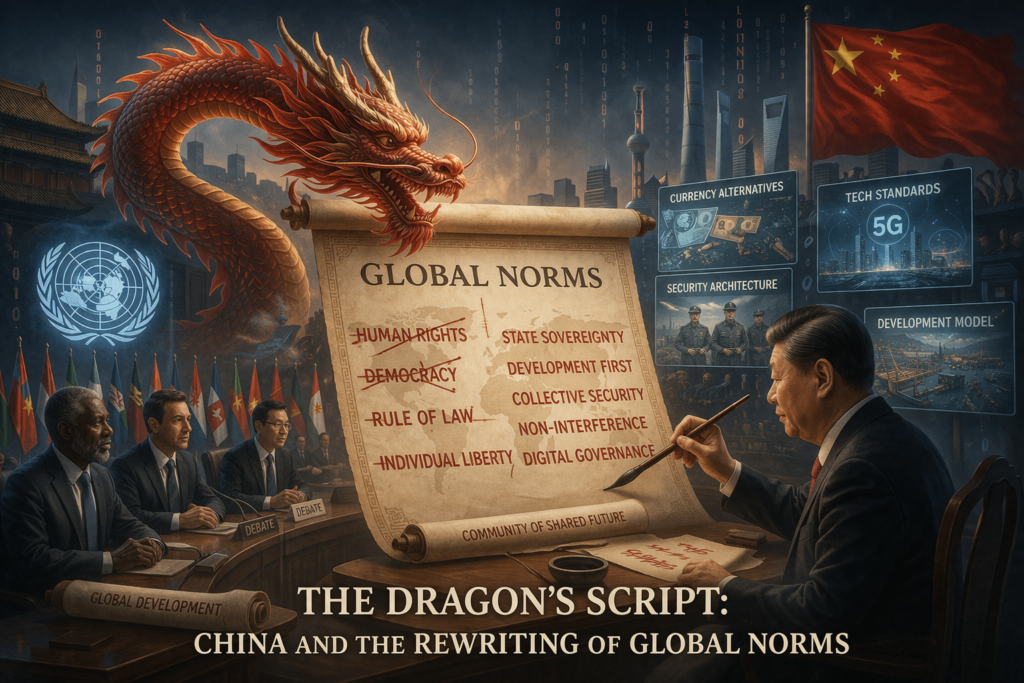
In the unfolding theater of the international system, where states and societies perform on stages constructed over centuries of law, diplomacy, and philosophical reasoning, China does not merely participate; it authors its own script while quietly inviting the world to read between the lines. This authorship is not obvious, for it does not consist in loud proclamations or overt revisionism. Rather, it manifests as a meticulous layering of economic practice, political principle, technological standard, and cultural narrative that collectively forms a trans-normative architecture. China’s engagement with global norms is thus not a rebellion but a rewriting, a philological exercise where the semantics of governance, sovereignty, and legitimacy are reinterpreted through the prism of centuries of intellectual tradition and contemporary strategic calculus. The Dragon’s script, as it may be poetically called, is both textual and performative, blending pragmatism with philosophy, action with metaphor, and law with ethical reasoning.
Trans-normativity, in this context, is the deliberate navigation of spaces where established global norms exist but are neither rigid nor universally enforced. It is the capacity to operate simultaneously within conventional frameworks and beyond them, creating alternative epistemic orders that challenge the assumption of universality inherent in Western-centric models. Economically, this trans-normativity is vividly evident in China’s institutional innovations. The Asian Infrastructure Investment Bank and the governance frameworks underpinning the Belt and Road Initiative exemplify a system that reinterprets the semantics of loans, investment, and development. While Western institutions often impose conditionality, structural reforms, or governance prescriptions tied to liberal economic orthodoxy, China’s model privileges flexibility, sovereignty, and long-term infrastructural vision. In this respect, China does not simply offer financial capital; it offers a narrative of partnership in which rules are written as shared scripts rather than externally imposed edicts. The subtle recalibration of economic language is a demonstration of philology in practice, where words such as “loan,” “sovereignty,” and “mutual benefit” are intentionally endowed with a semantic weight that differs from their established Western interpretations.
China’s trans-normative engagement is equally sophisticated in the political sphere. The principle of non-interference, a cornerstone of Chinese diplomacy, functions not merely as a policy statement but as a philosophical metaphor for its approach to international relations. Drawing from the Confucian conception of harmony and Han Fei’s legalist emphasis on pragmatic governance, non-interference is an ethical and strategic posture in which influence is exercised indirectly and subtly. Like the river shaping rocks over centuries, China’s diplomacy molds outcomes with patience, allowing relationships and structures to align with its vision without provoking overt resistance. This long-duration perspective distinguishes Chinese strategy from Western models, which often favor immediacy, declarative norms, and moralistic imperatives. By privileging stability over confrontation, China establishes a normative grammar in which legitimacy derives not from conformity to universal standards but from coherence with historical context, local values, and mutual recognition of sovereignty.
Technological development represents another domain in which China’s trans-normative logic exerts profound influence. Companies such as Huawei and ZTE, along with China’s participation in international standard-setting forums, do not merely export equipment; they export frameworks of technological governance. Issues of data privacy, cybersecurity, and digital sovereignty are reframed through a Confucian lens, emphasizing collective welfare, hierarchical responsibility, and social cohesion. In this environment, norms emerge not as abstract prescriptions but as embedded scripts, designed to harmonize the operation of infrastructure, state oversight, and public engagement. This is trans-normativity in its most concrete form: the rules of the digital domain are rewritten in practice, and global audiences encounter them not as edicts but as lived reality, a lesson in pragmatic philology that challenges preexisting assumptions of technological governance.
Cultural influence and ideational power are equally central to China’s trans-normative strategy. Soft power, exercised through Confucius Institutes, global media, academic collaborations, and cultural diplomacy, is an exercise in epistemic seduction. China transmits a lexicon of legitimacy, ethical order, and historical continuity, inviting other societies to read its civilization as living grammar rather than as relic or artifact. These initiatives reinterpret global narratives of authority, governance, and development, offering an alternative to the liberal individualist ethos dominant in Western thought. By embedding philosophical concepts such as li, meaning ritual propriety, and ren, denoting ethical benevolence, into international engagement, China conveys a mode of legitimacy that is simultaneously ethical, cultural, and practical. In this sense, trans-normativity is not mere contrarianism; it is a hermeneutic exercise in which the global order itself becomes a text to be read, interpreted, and subtly edited.
The theoretical foundation for this approach is deeply rooted in Chinese intellectual traditions. Confucianism, with its focus on harmony, ethical hierarchy, and the interdependence of social roles, provides a normative lens through which legitimacy is assessed. Legalist thought, particularly the work of Han Fei, contributes an understanding of law as a tool of order and structured authority, emphasizing pragmatism over moral idealism. Together, these traditions inform a philosophical grammar in which political action, economic negotiation, and technological implementation are coherent extensions of an integrated worldview. In the global context, this creates a space of normative plurality, where China’s alternative frameworks coexist with, interact with, and sometimes subtly challenge Western norms, reshaping expectations of sovereignty, responsibility, and ethical governance.
The implications of China’s trans-normativity extend far beyond theoretical interest; they shape material realities and strategic alignments. For Pakistan, engagement with China is not merely transactional but epistemic. Participation in Belt and Road projects, adoption of technological platforms, and alignment with Chinese development paradigms constitute a negotiation with an alternative normative order. Pakistan is required to interpret, internalize, and operationalize principles that are rooted in a distinct epistemology, balancing them against expectations derived from Western frameworks. This dual engagement requires sophistication and strategic literacy, as policymakers, institutions, and civil society navigate overlapping normative scripts with differing philosophical foundations.
This trans-normative strategy is as much about temporality as it is about principle. China’s view of time is long-term, echoing Confucian reflections on the cultivation of virtue and statecraft over decades and centuries. Projects, agreements, and standards are measured not by immediate impact but by cumulative influence, the gradual shaping of institutions, public expectations, and regional dynamics. In global affairs, this creates a form of normative gravity, drawing states into alignment with Chinese practices through the allure of coherence, stability, and strategic foresight. The patience of the Dragon is thus both philosophical and tactical, a reminder that trans-normativity operates over decades and generations, not election cycles.
Language and philology play a subtle but decisive role in this strategy. Terms such as “development,” “sovereignty,” “cooperation,” and “mutual benefit” are semantically calibrated, their meanings carefully sculpted through policy discourse, diplomatic statements, and media narratives. In the process, these terms acquire resonance that differs from their use in Western contexts. This linguistic craftsmanship exemplifies the trans-normative approach: norms are not imposed; they are communicated, interpreted, and naturalized, allowing external actors to adopt them as if spontaneously coherent with their own logic. It is a strategy that blends rhetoric, philosophy, and institutional practice into a seamless semiotic system.
China’s trans-normativity also interacts with global contestation, subtly challenging the assumption that Western frameworks of governance, finance, and technology are universal. By offering credible alternatives, China creates space for normative pluralism, encouraging a multipolar architecture in which different ethical, cultural, and strategic logics coexist. For developing states, this is an invitation to exercise agency, select models suited to local conditions, and negotiate power asymmetries without relinquishing sovereignty. For scholars and policymakers, it is a prompt to recognize that legitimacy, effectiveness, and ethical governance need not be singularly defined by liberal norms, but may emerge from contextually grounded epistemologies.
The Dragon’s Script, therefore, is both literal and metaphorical. It is literal in the sense that China establishes institutions, standards, and practices that materially shape international behavior. It is metaphorical in the sense that it constructs a narrative grammar that reinterprets ideas of legitimacy, hierarchy, and reciprocity. Reading this script requires more than technical understanding; it demands philosophical literacy, appreciation for cultural semantics, and sensitivity to historical temporality. Observers must learn to see law, policy, and technology as texts to be interpreted, ethical principles as metaphors for collective action, and diplomacy as a dialogue not merely between states but between civilizations.
For Pakistan, the implications of engaging with this trans-normative order are profound. Alignment with Chinese frameworks involves more than infrastructure investment or technology transfer; it entails participation in a project of global semantic reinterpretation, a process in which meanings, practices, and expectations are negotiated and sometimes rewritten. Policymakers, analysts, and civil society actors must cultivate the capacity to interpret multiple normative scripts simultaneously, ensuring operational coherence while maintaining intellectual flexibility. Such engagement is a form of strategic literacy, a recognition that global norms are contested texts and that sovereignty, legitimacy, and ethical governance are continuously negotiated.
Ultimately, China’s trans-normative approach illustrates a fundamental evolution in the exercise of global influence. Power is no longer solely measured by military capability, economic size, or diplomatic reach; it is measured by the capacity to shape the semiotic architecture of international relations, to influence perception, and to embed philosophical and cultural logics into operational frameworks. China’s strategy demonstrates that norms are neither static nor universal, but alive, interpretive, and adaptable, constructed over time and through practice. The Dragon’s Script is a lesson in patient, philosophical authorship, reminding the global audience that the writing of international order is an ongoing, contested, and profoundly intellectual act.
Reading, interpreting, and participating in this script is therefore not optional for states seeking influence, security, or development in the twenty-first century; it is essential. For Pakistan, the Dragon’s Script offers both opportunity and responsibility, a chance to engage with a trans-normative order that challenges assumptions, expands possibilities, and invites reflection on the nature of sovereignty, legitimacy, and civilization itself. To engage effectively is to become literate not only in economics, politics, or technology, but in the philosophy, history, and semiotics through which global reality is constructed, contested, and continually rewritten.
A Public Service Message