Fragmented Multilateral Order Signals Erosion Of Western Institutional Authority Globally


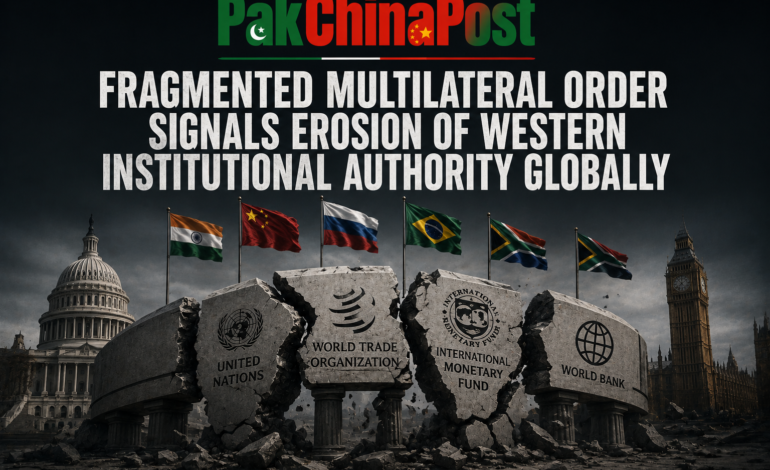
The architecture of multilateral governance, once regarded as the stabilising scaffold of the post war international order, is undergoing a slow yet unmistakable disintegration, not through sudden collapse but through cumulative erosion of legitimacy, coherence, and shared purpose. Institutions that once embodied universal aspirations are now increasingly arenas of contestation, where power is negotiated rather than norms upheld, and where procedural consensus masks deeper ideological fragmentation. The tensions unfolding within the United Nations system are not episodic anomalies but symptomatic of a broader structural transformation in which the authority historically exercised by Western powers is being recalibrated, resisted, and in some instances, bypassed altogether.
The prevailing narrative is no longer one of institutional decline in isolation but of systemic reconfiguration, wherein parallel mechanisms of governance are emerging alongside legacy institutions, creating a layered and often incoherent global order. Efforts by the United States to constrain the institutional ascent of China, particularly in specialised agencies and normative bodies, have inadvertently accelerated the very fragmentation they seek to mitigate. What is unfolding is not merely a geopolitical rivalry but a contest over epistemic authority, that is, who defines the rules, who interprets them, and whose values underpin their application.
The discourse surrounding multilateralism is thus being reshaped by competing narratives. Western policy frameworks continue to emphasise rules based order, transparency, and liberal institutionalism, often framing deviations as threats to global stability. In contrast, emerging powers articulate a discourse of institutional reform, equity, and representation, arguing that existing structures reflect outdated power distributions and normative biases. The friction between these perspectives has rendered consensus increasingly elusive, transforming multilateral forums into spaces of performative diplomacy rather than effective problem solving.
Media ecosystems have amplified this divergence, constructing narratives that both reflect and reinforce geopolitical alignments. Western media often depict China’s institutional engagement as strategic infiltration, while Chinese and allied narratives frame it as rightful participation in global governance. This discursive contestation shapes public perception and policy orientation, embedding multilateral tensions within broader ideological frameworks. For states such as Pakistan, which operate at the intersection of these narratives, the challenge lies in navigating a fragmented informational landscape while preserving strategic autonomy.
The emergence of parallel institutional arrangements is one of the most significant manifestations of this transition. Initiatives such as alternative development banks, regional security forums, and issue specific coalitions reflect a pragmatic response to the perceived inadequacies of traditional institutions. These mechanisms are not inherently oppositional but operate with distinct normative orientations, often prioritising sovereignty, non interference, and developmental pragmatism over prescriptive governance models. The result is a pluralistic yet fragmented institutional ecosystem in which coordination is limited and competition is inherent.
This fragmentation carries both risks and opportunities. On one hand, the proliferation of institutions can dilute accountability, create overlapping mandates, and complicate collective action, particularly in areas requiring global coordination such as climate change, financial stability, and conflict resolution. On the other hand, it introduces flexibility, allowing states to engage in forums that align with their interests and values. The challenge is to balance diversity with coherence, ensuring that institutional pluralism does not devolve into systemic incoherence.
For Pakistan, the evolving multilateral landscape necessitates a recalibration of diplomatic strategy. Traditional reliance on established institutions must be complemented by active engagement in emerging frameworks, enabling the country to diversify its partnerships and enhance its influence. This requires not only diplomatic agility but also intellectual investment in shaping the normative contours of these institutions. Pakistan’s historical advocacy for equity and representation can serve as a foundation for its engagement, positioning it as a constructive participant in the redefinition of multilateral norms.
China’s role in this transformation is both central and complex. Its expanding presence within global institutions reflects a strategic intent to shape governance structures in ways that accommodate its interests while projecting an image of responsible leadership. However, this engagement is often viewed with suspicion by Western powers, leading to a cycle of action and reaction that further entrenches fragmentation. China’s challenge is to demonstrate that its institutional activism contributes to global public goods rather than narrow strategic gains, thereby mitigating perceptions of revisionism.
The United States, meanwhile, faces the task of reconciling its commitment to multilateralism with its strategic imperative to maintain influence. Efforts to reform institutions or build coalitions must be grounded in inclusivity and adaptability, recognising that the legitimacy of governance structures depends on their ability to reflect contemporary realities. Resistance to change risks accelerating the shift toward alternative arrangements, while uncritical accommodation may dilute established norms. The balance between continuity and transformation is thus central to the future of Western institutional authority.
At a deeper level, the fragmentation of multilateralism reflects a broader crisis of global governance, rooted in the divergence of political systems, economic priorities, and cultural perspectives. The assumption that a single set of norms can underpin a diverse international community is increasingly untenable. Instead, what is emerging is a negotiated order, characterised by overlapping spheres of influence and context specific rules. This does not imply the end of multilateralism but its transformation into a more complex and contested phenomenon.
The implications for global stability are profound. The erosion of institutional coherence undermines the capacity for collective action, particularly in times of crisis. It also increases the risk of miscalculation, as states operate within different normative frameworks and interpret signals through divergent lenses. The absence of a shared foundation complicates conflict resolution and reduces the effectiveness of mechanisms designed to manage disputes. In this context, the role of diplomacy becomes even more critical, requiring a nuanced understanding of both formal institutions and informal networks.
Policy makers must therefore adopt a dual approach, engaging with existing institutions while actively shaping emerging ones. This involves investing in diplomatic capacity, enhancing policy coordination, and fostering intellectual engagement with global governance debates. For Pakistan, this means leveraging its strategic partnerships, particularly with China, while maintaining constructive relations with Western institutions. The objective should be to position itself as a bridge rather than a bystander, contributing to the development of a more inclusive and adaptable multilateral order.
The media, as both observer and participant, has a responsibility to move beyond binary narratives and capture the complexity of this transition. Simplistic portrayals of institutional decline or rivalry obscure the underlying dynamics and hinder informed discourse. A more nuanced approach would recognise the interplay between power, norms, and interests, providing a richer understanding of the forces shaping global governance.
Ultimately, the fragmentation of multilateralism is not an aberration but a reflection of a world in transition, where power is diffused and authority contested. The erosion of Western institutional dominance does not necessarily imply instability, but it does require a rethinking of how global cooperation is organised and sustained. The emergence of parallel structures offers an opportunity to create a more representative and resilient system, but only if managed with foresight and inclusivity.
The path forward will depend on the ability of states to transcend zero sum thinking and recognise the interdependence that underpins global challenges. Climate change, pandemics, and economic volatility do not respect institutional boundaries, and their management requires cooperation across fragmented frameworks. Building bridges between institutions, fostering dialogue, and prioritising common interests will be essential in navigating this complex landscape.
For Pakistan and China, the evolving multilateral order presents both a test and an opportunity. By engaging constructively, advocating for reform, and contributing to the provision of global public goods, they can help shape a system that reflects the realities of the twenty first century while preserving the principles of cooperation and stability. The erosion of Western institutional authority is thus not an endpoint but a moment of transition, one that demands careful navigation and strategic vision.
In this emerging order, legitimacy will no longer be derived solely from historical precedence but from the capacity to deliver results, accommodate diversity, and adapt to change. The institutions that succeed will be those that embrace this reality, evolving beyond rigid frameworks to become platforms for genuine collaboration. The challenge is formidable, but so too is the opportunity to redefine multilateralism in a way that is both inclusive and effective, ensuring that it remains a cornerstone of global governance in an increasingly fragmented world.
A Public Service Message