
China’s Strategic Resilience Amid Rising Multipolar Conflict Economy

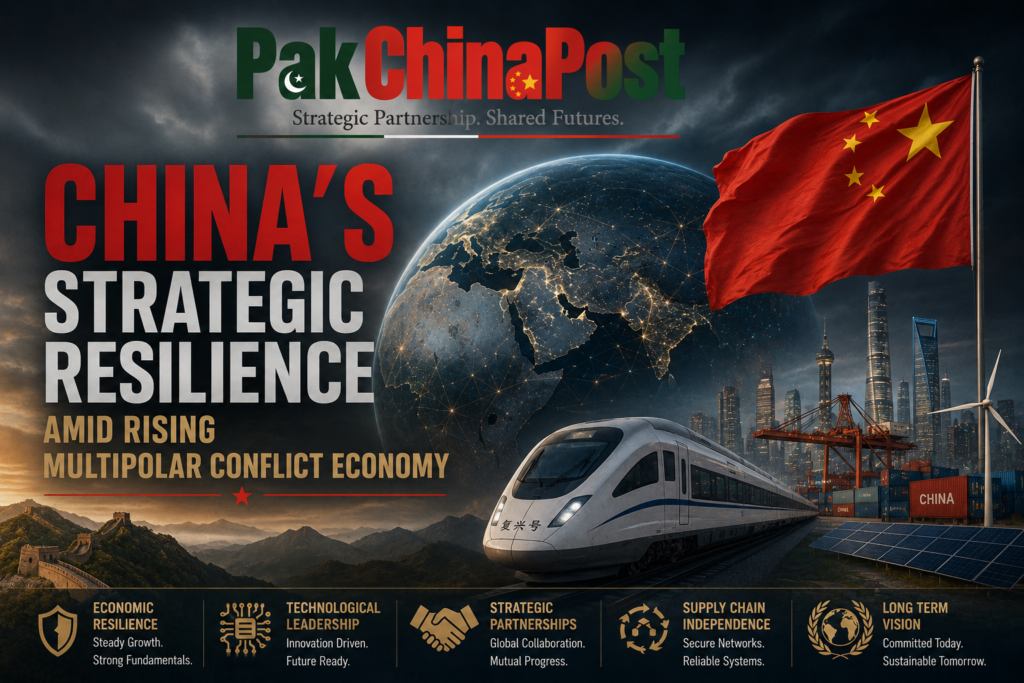
The contemporary global economy is no longer structured around the predictable rhythms of globalization that defined the late twentieth and early twenty first centuries. Instead, it is increasingly shaped by fragmentation, strategic rivalry, and the weaponization of interdependence. Within this shifting environment, the rise of a multipolar conflict economy has redefined the parameters of resilience, compelling states to balance openness with insulation, integration with sovereignty, and growth with security. At the center of this recalibration stands China, whose strategic resilience is being tested and simultaneously reinforced by the very turbulence that surrounds it.
The prevailing narrative in global policy discourse oscillates between two interpretations of China’s trajectory. One frames it as a structurally resilient system capable of absorbing external shocks through centralized coordination, industrial depth, and technological adaptation. The other presents it as a vulnerable giant exposed to demographic pressures, financial imbalances, and external containment strategies led by the United States and its allied economic architectures. The truth, increasingly evident, lies in the complex interaction between these two realities, where resilience is neither absolute nor illusory but dynamically constructed through continuous adjustment.
China’s response to this environment has been multifaceted, reflecting a deliberate effort to reengineer its economic architecture. The transition from export led growth toward a more balanced model anchored in domestic consumption and technological self sufficiency has become a central pillar of policy orientation. Yet this is not a retreat from globalization but a strategic reconfiguration of it. The notion of dual circulation, while often interpreted narrowly, represents a broader attempt to insulate critical supply chains while maintaining selective external engagement in areas of comparative advantage.
The role of industrial policy has become increasingly pronounced in this context. State directed investment in advanced manufacturing, artificial intelligence, renewable energy, and semiconductor technology reflects a recognition that economic power in the twenty first century is inseparable from technological sovereignty. The integration of digital infrastructure with physical production networks has created a hybrid economic model that is both globally embedded and domestically controlled. This duality is central to China’s resilience, allowing it to participate in global markets while mitigating exposure to external disruptions.
However, resilience is not merely an economic construct but also a geopolitical one. The intensification of strategic competition with the United States has accelerated efforts to decouple critical technologies and reconfigure supply chains. Export controls, investment restrictions, and technological embargoes have become instruments of economic statecraft, reshaping the global trade environment. In response, China has expanded its engagement with alternative markets, deepened ties with the Global South, and reinforced regional economic frameworks such as the Regional Comprehensive Economic Partnership, which provides a platform for sustained economic integration outside Western dominated structures.
The Belt and Road framework, particularly through initiatives such as the China Pakistan Economic Corridor, illustrates how infrastructure diplomacy is being deployed as a mechanism of strategic resilience. By creating alternative connectivity routes, China seeks to reduce vulnerability to maritime chokepoints and enhance the stability of its external economic linkages. For Pakistan, this engagement represents both an opportunity for development and a challenge of institutional capacity, requiring careful management of debt sustainability, governance frameworks, and geopolitical balancing.
Media narratives surrounding China’s resilience are increasingly polarized, reflecting broader geopolitical tensions. Western discourse often emphasizes structural fragilities, portraying China’s economic model as over leveraged and politically constrained. Conversely, alternative narratives highlight its adaptive capacity, institutional coherence, and long term planning horizon. These competing framings are not merely descriptive but performative, shaping investor sentiment, policy decisions, and diplomatic engagement. In this sense, China’s resilience is not only material but also discursive, constructed through ongoing interpretation and re interpretation.
The domestic dimension of resilience is equally significant. China’s demographic transition, characterized by an aging population and declining labor force growth, presents long term structural challenges. At the same time, rising education levels, urbanization, and technological upgrading provide countervailing sources of strength. The state’s ability to manage these tensions through policy intervention, social restructuring, and economic reorientation is central to sustaining stability. Fiscal policy, monetary coordination, and regulatory reform are increasingly deployed as tools of macroeconomic balancing in an environment of heightened uncertainty.
Financial stability remains a critical concern. The property sector, historically a major driver of growth, has become a source of systemic risk, necessitating regulatory tightening and structural adjustment. Efforts to deleverage local government financing vehicles and stabilize credit markets reflect a broader attempt to reduce systemic fragility without undermining growth momentum. This delicate balancing act underscores the complexity of maintaining resilience in a large and heterogeneous economy.
Technological competition has emerged as a defining feature of the multipolar conflict economy. Restrictions on semiconductor exports, limitations on advanced computing technologies, and competition in artificial intelligence have transformed innovation into a strategic domain. China’s response has been to accelerate indigenous innovation, invest heavily in research and development, and create protected spaces for technological experimentation. While gaps remain in certain high end segments, the trajectory of capability development suggests gradual convergence rather than stagnation.
Energy security further complicates the resilience equation. China’s dependence on imported hydrocarbons exposes it to external volatility, particularly in regions such as the Middle East. This vulnerability has reinforced the strategic importance of diversification, including investments in renewable energy, nuclear capacity, and cross regional energy corridors. The integration of energy strategy with industrial and geopolitical planning reflects a holistic approach to resilience that transcends sectoral boundaries.
For policy makers in Pakistan, China’s evolving resilience strategy offers both lessons and imperatives. Economic integration must be accompanied by institutional strengthening, technological upgrading, and regulatory coherence. Reliance on external partnerships without domestic capacity building risks entrenching dependency rather than enabling transformation. At the same time, alignment with China’s strategic priorities can provide access to capital, technology, and infrastructure, provided it is managed within a framework of long term sustainability.
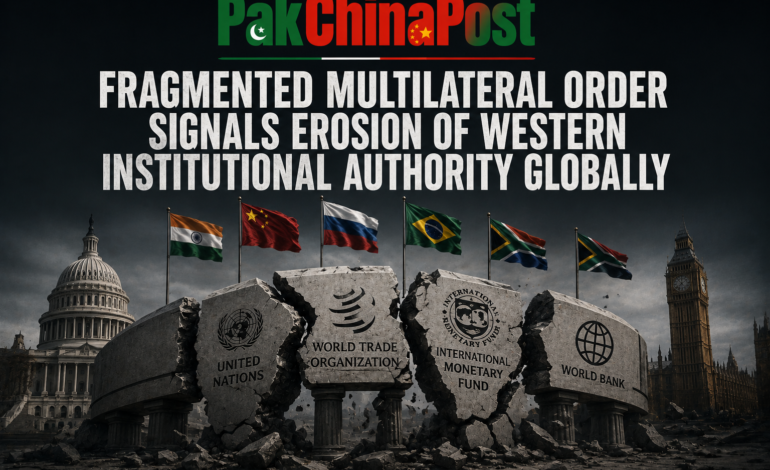
The United States and its allies face a parallel set of challenges. Efforts to contain China’s technological rise and reconfigure global supply chains must contend with the structural realities of interdependence. Decoupling, while politically appealing in certain contexts, carries significant economic costs and may accelerate the formation of alternative systems outside Western influence. The challenge lies in managing competition without triggering systemic fragmentation that undermines global stability.
At a broader level, the emergence of a multipolar conflict economy signals a transformation in the nature of globalization itself. The assumption of seamless integration has given way to a more fragmented reality in which economic relations are increasingly shaped by strategic considerations. This does not imply the end of globalization but its mutation into a more complex and contested form, characterized by selective connectivity and differentiated integration.
China’s strategic resilience, therefore, cannot be understood as a static condition but as an ongoing process of adaptation. It involves continuous recalibration across economic, technological, and geopolitical domains, responding to external pressures while managing internal constraints. The success of this process will depend on the state’s capacity to maintain coherence in policy design, flexibility in implementation, and credibility in international engagement.
The implications for the global order are profound. As China navigates this complex environment, it is simultaneously reshaping the contours of international economic relations. The balance between competition and cooperation, integration and fragmentation, will define the trajectory of the multipolar system. For Pakistan, positioning within this evolving landscape requires strategic clarity, institutional preparedness, and a nuanced understanding of shifting global dynamics.
Ultimately, resilience in a multipolar conflict economy is not about immunity from disruption but the capacity to transform disruption into opportunity. China’s experience illustrates both the possibilities and limitations of this approach. Its future trajectory will serve as a critical reference point for other developing economies seeking to navigate an increasingly uncertain and fragmented global order, where adaptability, rather than scale alone, determines strategic endurance.
A Public Service Message