
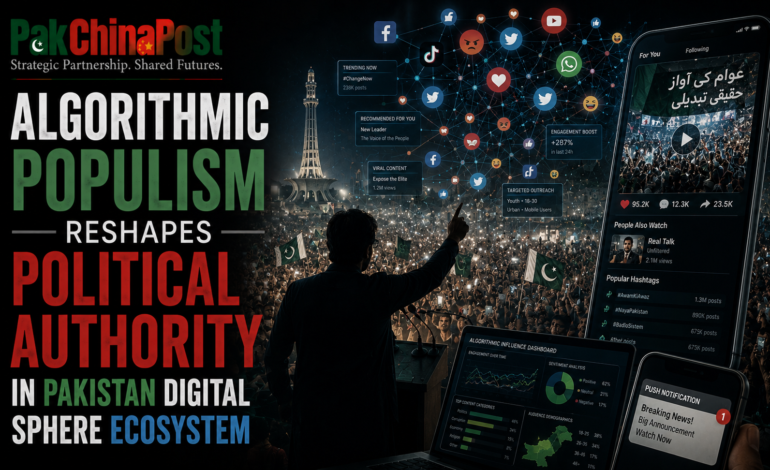
Algorithmic Populism Reshapes Political Authority in Pakistan Digital Sphere Ecosystem


In Pakistan’s contemporary information theatre, political authority is undergoing a structural reconfiguration that is neither linear nor entirely visible within conventional media analytics. The emergence of algorithmically mediated communication ecosystems, particularly short-form video platforms and engagement-optimised social media architectures, has introduced a parallel regime of influence where emotional velocity increasingly supersedes institutional credibility. Within this evolving digital sphere ecosystem, political legitimacy is no longer exclusively derived from party structures, parliamentary discourse, or legacy media validation, but from the volatile arithmetic of virality, engagement metrics, and algorithmic amplification loops that reward immediacy over deliberation.
The transformation is not merely technological; it is epistemic. In Pakistan’s hybrid democratic framework, where institutional authority has historically been negotiated between civilian governance, bureaucratic continuity, and informal power structures, the intrusion of algorithmic populism has introduced a disruptive third layer: platform-mediated perception engineering. Political communication is increasingly shaped not by editorial mediation or ideological coherence but by content that optimises emotional contagion, particularly anger, moral indignation, and aspirational grievance. This shift has profound implications for the stability of public reasoning and the architecture of political accountability.
The TikTokisation of political communication represents one of the most consequential accelerants of this transformation. Short-form video ecosystems privilege narrative compression, aesthetic intensity, and personality-centric storytelling, thereby structurally disadvantaging policy depth, institutional explanation, and procedural nuance. Political actors, once reliant on structured speeches and party manifestos, are increasingly adapting to performative micro-content strategies. In this environment, governance messaging is reframed as entertainment-adjacent content, and electoral persuasion is conducted through symbolic gestures, meme-able statements, and emotionally charged visual fragments that circulate independently of factual grounding.
The algorithmic architecture underlying these platforms functions as an invisible intermediary, determining visibility through opaque optimisation models that prioritise engagement probability rather than informational accuracy. This introduces a systemic distortion in which politically extreme, emotionally polarised, or sensationalised content achieves disproportionate reach compared to moderate or institutionally grounded narratives. The resulting informational asymmetry has begun to weaken the traditional authority of state institutions, electoral bodies, and mainstream media organisations, as their communication outputs are structurally less compatible with platform reward systems.
Within Pakistan’s socio-political context, this dynamic intersects with pre-existing conditions of economic precarity, youth demographic dominance, and fragmented media literacy. A large proportion of the population under thirty is now embedded within digital environments where political understanding is mediated through influencers, semi-professional commentators, and algorithmically surfaced content streams rather than formal civic education or institutional reporting. This has enabled the rise of influencer activism, a hybrid category of political communication in which entertainment figures, lifestyle creators, and non-traditional commentators assume quasi-political roles without corresponding accountability structures.
The implications for institutional authority are profound. State institutions, particularly those responsible for governance communication, are increasingly engaged in asymmetric informational competition with decentralised digital actors who operate without bureaucratic constraints. This asymmetry is not merely about reach but about narrative agility. Institutional communication systems are structurally slower, procedurally constrained, and risk-averse, whereas algorithmically optimised actors can respond in real time, recalibrate messaging, and exploit emotional triggers with high precision. This mismatch generates a perception gap in which institutional narratives appear outdated or disconnected from lived digital realities.
A parallel consequence is the acceleration of emotional polarisation. Algorithmic systems designed to maximise user retention inadvertently incentivise the circulation of content that intensifies affective responses. In Pakistan’s already polarised political environment, this has led to the consolidation of echo chambers where users are continuously exposed to ideologically congruent and emotionally reinforcing content streams. The result is a fragmentation of shared civic reality, where competing interpretations of political events coexist without common epistemic grounding.
This fragmentation is further exacerbated by the monetisation structures of digital platforms. Influencers and content creators are economically incentivised to produce content that maximises engagement rather than informational accuracy. Political discourse is therefore increasingly entangled with attention economies, where controversy is monetised and nuance is penalised. This creates a feedback loop in which sensationalism becomes both economically rational and algorithmically rewarded, reinforcing the structural drift toward emotional populism.
From a strategic governance perspective, the hidden risk lies not merely in misinformation but in the gradual displacement of institutional epistemology. When citizens increasingly derive political understanding from decentralised, algorithmically filtered sources, the state’s capacity to shape collective perception through formal communication channels diminishes. This does not constitute an immediate crisis of authority but rather a slow erosion of interpretive centrality. The state remains formally intact, yet its narrative primacy becomes increasingly contested by distributed digital actors.
Establishment concerns in this context extend beyond electoral cycles and into the domain of cognitive sovereignty. The ability of a state to maintain coherent public reasoning is increasingly dependent on its capacity to engage with algorithmic infrastructures that it does not control. This introduces a new strategic vulnerability: dependency on privately governed, transnational platforms whose operational logic is not aligned with national informational stability. The asymmetry between territorial governance and borderless digital influence networks creates a structural tension that conventional regulatory frameworks are ill-equipped to address.
In addition, the convergence of influencer ecosystems with political mobilisation introduces new forms of informal power brokerage. Influencers with large followings now possess the capacity to shape public sentiment on governance decisions, policy debates, and electoral outcomes without formal accountability. This decentralisation of influence challenges traditional gatekeeping mechanisms and introduces volatility into political communication systems that were previously mediated through party structures and mainstream media hierarchies.
The implications extend into national security considerations. Emotional polarisation amplified through algorithmic systems can be rapidly weaponised during periods of political instability, external conflict, or electoral contestation. Coordinated narrative amplification, whether organic or artificially stimulated, has the potential to destabilise public order by accelerating misinformation cascades faster than institutional correction mechanisms can respond. The temporal asymmetry between viral content propagation and official rebuttal remains one of the most significant vulnerabilities in contemporary information governance.
Policy responses must therefore move beyond conventional media regulation and toward a multi-layered framework of algorithmic governance. First, there is an urgent need for structured algorithmic transparency protocols that require platforms to disclose the general parameters influencing political content distribution. While full access to proprietary systems may remain unrealistic, partial transparency regarding recommendation logic and political content amplification thresholds is essential for regulatory oversight.
Second, electoral governance frameworks must be updated to account for influencer-driven political campaigning. The absence of disclosure requirements for paid political content in influencer ecosystems creates an unregulated advertising space that can significantly distort voter perception. Establishing mandatory registration mechanisms for political content monetisation would enhance accountability without directly restricting expression.
Third, state communication strategies require institutional redesign. Traditional press releases and official statements are insufficient in algorithmically mediated environments. Governments must develop adaptive communication units capable of engaging with digital platforms in real time, utilising platform-native formats while maintaining informational integrity. This necessitates a rethinking of bureaucratic communication culture, moving from hierarchical dissemination to network-responsive engagement.
Fourth, there is a need for public investment in digital literacy infrastructures that go beyond basic media awareness. Citizens must be equipped not only to identify misinformation but to understand the structural logic of algorithmic amplification itself. Without this deeper literacy, efforts at content moderation will remain reactive rather than preventative.
Fifth, regulatory cooperation with platform companies must be institutionalised through formalised bilateral or multilateral agreements that recognise digital information ecosystems as strategic infrastructure. In Pakistan’s geopolitical context, particularly in relation to broader China–Pakistan digital cooperation frameworks, there is scope for developing hybrid governance models that balance innovation with informational stability. However, such cooperation must be carefully structured to avoid over-centralisation or excessive informational control that could undermine open discourse.
The broader strategic implication of algorithmic populism is the gradual redefinition of political authority itself. Authority is no longer solely a function of institutional legitimacy but increasingly a derivative of visibility dynamics within algorithmic systems. This shift challenges foundational assumptions about governance, accountability, and public consent. In such an environment, the primary contest is not only between political actors but between competing regimes of attention production.
If left unaddressed, the long-term trajectory suggests the emergence of a permanently fragmented informational society in which shared political reality becomes increasingly difficult to reconstruct. In such a scenario, governance is conducted under conditions of epistemic instability, where policy decisions are continuously filtered through competing digital narratives that resist consolidation.
The urgency, therefore, is not merely regulatory but civilisational in scope. Pakistan’s digital sphere ecosystem is not an isolated case but part of a broader global reconfiguration of political communication. Yet its demographic structure, geopolitical positioning, and media consumption patterns make it particularly susceptible to accelerated effects of algorithmic populism. The challenge for policymakers is to construct adaptive governance architectures capable of preserving institutional coherence without suppressing digital plurality.
The future of political authority will depend on whether states can internalise the logic of algorithmic systems without becoming subordinate to them. In this tension lies the defining governance challenge of the digital century, where perception is no longer a reflection of reality but an engineered outcome of invisible computational negotiations.
A Public Service Message


