
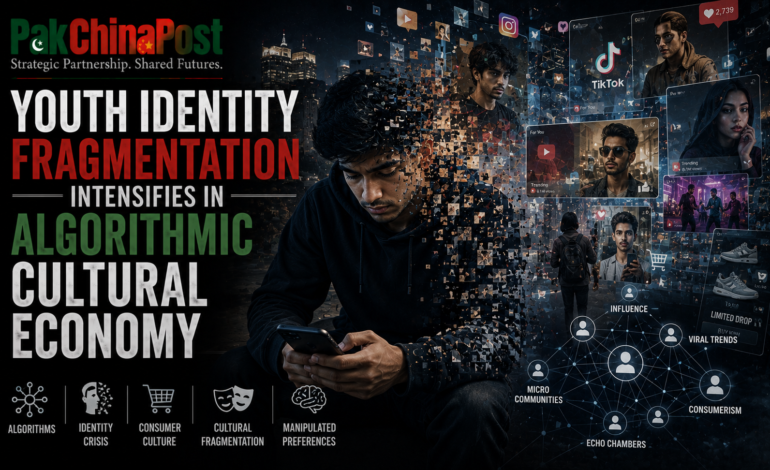
Youth Identity Fragmentation Intensifies in Algorithmic Cultural Economy


Pakistan’s youth demographic, long described in policy discourse as a demographic dividend, is increasingly emerging as a structurally complex information cohort shaped by algorithmic exposure, economic precarity, and transnational cultural saturation. The contemporary youth identity landscape is no longer formed primarily through stable institutions such as family systems, formal education, or civic engagement structures, but through continuous interaction with algorithmically curated digital environments that reconfigure attention, aspiration, and self-perception in real time. This shift is producing a form of identity formation that is fluid, fragmented, and perpetually renegotiated under conditions of visibility-driven social validation.
At the core of this transformation lies the reconstitution of selfhood under platform capitalism. Social media ecosystems, particularly short-form video platforms and algorithmically optimised content feeds, have introduced a regime in which identity is not merely expressed but performed, quantified, and continuously evaluated through metrics of engagement. Likes, shares, comments, and follower counts function as quasi-social indicators of legitimacy, gradually replacing traditional markers of social recognition. In this environment, identity becomes a dynamic performance economy, where selfhood is constructed through iterative optimisation for visibility rather than coherence or continuity.
This shift is intensified by Pakistan’s structural economic conditions. Persistent employment insecurity, inflationary pressures, and limited upward mobility pathways have created a generational context in which economic aspiration is increasingly mediated through digital visibility economies. Influencer culture, freelance digital entrepreneurship, and platform-based micro-celebrity structures now operate as perceived alternatives to conventional labour markets. Consequently, youth identity formation is increasingly entangled with the pursuit of digital monetisation, aesthetic branding, and algorithmic discoverability.
However, this pursuit is structurally unstable. Algorithmic systems are inherently volatile, with visibility determined by opaque recommendation mechanisms that frequently shift without user agency. As a result, identity expression becomes contingent rather than stable, subject to sudden fluctuations in reach, engagement, and platform prioritisation. This produces psychological and sociocultural instability, as individuals continuously recalibrate their self-presentation in response to unpredictable algorithmic feedback loops.
Religious discourse represents another critical axis of identity reconfiguration. In Pakistan’s digitally mediated environment, religious expression is increasingly circulated through influencer-led content ecosystems that translate theological concepts into short-form, emotionally resonant, and visually optimised narratives. This process, while expanding access to religious content, simultaneously alters its interpretive structure. Religious identity becomes partially aestheticised, embedded within platform logics of virality and emotional intensity, thereby introducing new tensions between doctrinal depth and algorithmic simplification.
Parallel to this, global cultural flows exert significant influence on youth identity construction. Exposure to transnational media content, including East Asian pop culture, Western influencer aesthetics, and global lifestyle branding, produces hybrid cultural imaginaries that coexist with local normative frameworks. This results in a condition of cultural simultaneity, where multiple identity scripts operate concurrently without hierarchical resolution. The outcome is not cultural homogenisation but layered hybridity, often accompanied by internalised tension between global aspiration and local expectation.
The role of algorithmic mediation is central to this process. Recommendation systems are not neutral distributors of content but active shapers of cultural perception. By prioritising content that maximises engagement, emotional response, and retention, these systems amplify specific identity models while marginalising others. This creates a feedback loop in which youth are repeatedly exposed to highly curated representations of success, beauty, religiosity, and lifestyle, which then become implicit benchmarks for self-evaluation. The result is a narrowing of perceived life possibilities, even within an environment of apparent informational abundance.
This dynamic has significant implications for mental health. The continuous comparison between lived experience and algorithmically curated idealised identities contributes to rising levels of anxiety, self-doubt, and cognitive dissonance among youth populations. The pressure to maintain a digitally legible identity generates what may be described as performative exhaustion, where individuals experience fatigue not from physical labour but from continuous self-optimisation within visibility economies.
Political socialisation is also being restructured. Traditional pathways of civic engagement, mediated through educational institutions, political parties, and community organisations, are increasingly being displaced by algorithmically curated political content streams. Youth political awareness is thus shaped by fragmented, emotionally charged, and context-deprived information units that circulate within digital ecosystems. This contributes to episodic political engagement characterised by intensity without continuity, and mobilisation without institutional anchoring.
Within Pakistan’s socio-cultural context, this fragmentation is further complicated by generational disparities in digital literacy. While younger cohorts are highly integrated into platform ecosystems, their interpretive capacity to critically assess algorithmic influence remains uneven. This creates a vulnerability in which identity formation occurs under conditions of partial awareness, where users participate in systems whose structural logic they do not fully comprehend.
From a strategic governance perspective, this identity fragmentation carries long-term systemic implications. A population cohort whose identity is continuously reconfigured through unstable digital feedback mechanisms may exhibit reduced capacity for sustained collective action, institutional trust, and long-term civic alignment. The state’s challenge is therefore not merely informational but anthropological: it involves the governance of attention, aspiration, and self-perception within algorithmically mediated environments.
Establishment concerns are increasingly oriented toward the potential for socio-cognitive fragmentation to translate into political and economic instability over time. The absence of stable identity anchors may produce volatility in labour markets, educational outcomes, and civic participation patterns. Moreover, the increasing reliance on external digital platforms for identity validation introduces a structural dependency on transnational technological infrastructures that operate outside domestic regulatory control.
Policy intervention in this domain requires a multi-dimensional approach. First, educational curricula must be redesigned to incorporate advanced digital literacy frameworks that go beyond basic media awareness and include critical understanding of algorithmic systems, attention economies, and platform governance structures. Youth must be equipped not only to consume digital content but to interpret the structural forces shaping that content.
Second, mental health frameworks must be expanded to account for digital-induced cognitive stress. This includes institutional recognition of algorithmic anxiety as a legitimate psychosocial condition and the development of targeted interventions within educational and healthcare systems.
Third, regulatory attention must be directed toward influencer ecosystems that significantly shape youth identity formation. This does not imply restrictive control but rather the introduction of transparency mechanisms regarding monetisation, sponsorship, and algorithmic amplification of identity-related content.
Fourth, there is a need for culturally grounded digital ecosystem development that integrates local epistemologies with global digital participation. This may involve supporting indigenous content production frameworks that offer alternative identity narratives rooted in socio-cultural continuity rather than algorithmic volatility.
Fifth, cross-sector coordination between education ministries, telecommunications regulators, and cultural institutions is essential to construct a coherent national response to identity fragmentation in digital environments. Fragmented institutional responses will be insufficient in addressing a phenomenon that is itself systemic and cross-platform in nature.
The broader implication is that youth identity in Pakistan is no longer a stable sociological category but an evolving computationally mediated construct. Identity is being continuously recalibrated at the intersection of economic constraint, cultural exposure, algorithmic influence, and emotional optimisation systems. This produces a condition in which selfhood is neither fully autonomous nor fully externally determined, but dynamically co-produced within digital infrastructures.
If left unaddressed, the long-term trajectory suggests the emergence of a generation whose collective identity is marked by high adaptability but low continuity, high connectivity but low coherence, and high visibility but uncertain grounding. In such a scenario, the challenge for governance is not only to manage digital systems but to preserve the psychological and cultural integrity of future citizen cohorts.
The strategic question, therefore, is whether institutional frameworks can evolve rapidly enough to provide stabilising structures of meaning within an environment defined by perpetual algorithmic flux. The answer to this question will shape not only the future of youth identity in Pakistan but the broader stability of its social and political order in the decades ahead.
A Public Service Message


