
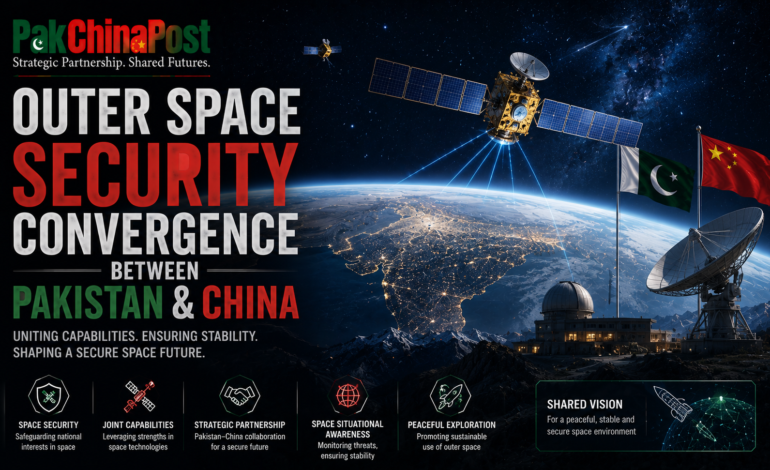
Outer Space Security Convergence Between Pakistan China


The accelerating militarisation of orbital space has altered the grammar of modern security in ways that traditional terrestrial doctrines are still struggling to assimilate. Satellites now constitute the nervous system of military command structures, agricultural forecasting, disaster mitigation, precision navigation, encrypted communication, and real-time intelligence synthesis. In this environment, the question of whether Pakistan and China should institutionalise a joint space security framework is no longer speculative; it is a matter of strategic continuity under conditions of intensifying orbital contestation.
The central transformation is structural rather than rhetorical. Space is no longer an abstract domain of scientific exploration or prestige-based technological competition. It has become an operational theatre where signal disruption, electronic interference, cyber intrusion, and kinetic anti-satellite capabilities are increasingly treated as legitimate instruments of coercive leverage. The fragility of orbital infrastructure has therefore emerged as a silent vulnerability within national security architectures that depend heavily on uninterrupted data flows.
For Pakistan, the dependence on satellite-enabled systems is deepening across both civilian and defence sectors. Precision agriculture, flood prediction models, telecommunication networks, border surveillance systems, and aviation safety mechanisms are all increasingly dependent on stable satellite coverage. Any degradation in orbital reliability would therefore produce cascading disruptions across governance and economic management systems already operating under constraint. China, by contrast, has evolved into one of the most advanced spacefaring states, with extensive satellite constellations supporting navigation, earth observation, communications, and military reconnaissance. Yet even this technological depth does not eliminate exposure to systemic disruption in a contested orbital environment.
The emerging question is not whether satellites can be built or launched, but whether they can be protected, sustained, and rendered resilient under adversarial conditions. This distinction is crucial. Space security is no longer defined by access to launch capability alone; it is defined by survivability, redundancy, and continuity of service under pressure.
A joint Pakistan–China space security architecture would therefore need to move beyond symbolic cooperation into functional integration across multiple domains. The first of these is satellite resilience. This involves designing architectures that can withstand jamming, spoofing, cyber intrusion, and signal degradation. Modern satellite systems increasingly rely on distributed constellations rather than singular high-value assets, precisely because decentralisation reduces vulnerability. A cooperative framework could allow both states to optimise constellation design, share redundancy protocols, and coordinate backup systems to ensure uninterrupted coverage in case of partial system failure.
Closely linked to this is the question of anti-jamming capability. Electronic warfare techniques targeting satellite communication links have become increasingly sophisticated, involving frequency disruption, uplink interference, and ground station targeting. The ability to maintain signal integrity under contested conditions is now as strategically important as the ability to launch satellites themselves. Joint research into adaptive frequency modulation, encrypted signal pathways, and dynamic rerouting systems could significantly enhance operational robustness for both states.
Space Situational Awareness, often abbreviated as SSA, constitutes another foundational pillar of any credible space security framework. SSA refers to the capacity to monitor, track, and predict the movement of objects in orbit, including active satellites, defunct equipment, and emerging debris fields. In an environment where orbital congestion is increasing, SSA becomes indispensable for collision avoidance, threat detection, and operational planning. A coordinated Pakistan–China SSA mechanism would allow shared tracking datasets, integrated monitoring stations, and joint analytical platforms capable of improving predictive accuracy and response time.
However, SSA is not merely a technical function; it is also an intelligence capability. The ability to interpret orbital behaviour patterns can provide indirect insights into the operational doctrines of other spacefaring actors. This introduces a sensitive dimension where data sharing must be calibrated against national security considerations, requiring carefully defined protocols for classification, access control, and strategic segmentation.
The dual-use nature of space technologies further complicates this landscape. Launch vehicles, satellite communication systems, remote sensing platforms, and orbital navigation tools often possess both civilian and military applications. This duality creates ambiguity in interpretation, particularly in periods of heightened geopolitical tension. A cooperative framework must therefore establish clear normative boundaries regarding the permissible scope of civilian-military integration, without undermining technological flexibility.
Pakistan’s participation in such a framework would also require institutional strengthening. At present, the country’s space capabilities are primarily channelled through national agencies focused on earth observation and communications satellites. While these institutions have demonstrated incremental progress, the next phase of development requires integration with advanced modelling systems, artificial intelligence-based analytics, and real-time data processing capabilities. Collaboration with China could accelerate this transition, particularly in areas involving payload design, orbital deployment strategies, and mission lifecycle management.
For China, space security cooperation with Pakistan offers a different but equally significant set of advantages. As Beijing expands its global technological footprint, it increasingly requires trusted partners capable of participating in distributed infrastructure ecosystems. Pakistan, due to its strategic alignment and geographic positioning, can function as an auxiliary node within broader space observation and communication networks. Ground stations, telemetry facilities, and data reception infrastructure located within Pakistani territory could enhance coverage continuity and reduce blind spots in orbital monitoring.
Yet any discussion of space cooperation must also account for the intensifying competitive dynamics among major powers. The increasing deployment of counter-space capabilities, including kinetic interceptors, directed-energy concepts, and cyber-physical disruption tools, has introduced a latent instability into orbital governance. The absence of universally enforceable regulatory mechanisms further exacerbates this uncertainty. In such a context, bilateral or minilateral cooperation frameworks acquire heightened importance as stabilising mechanisms within an otherwise fragmented regulatory environment.
The concept of space deterrence is therefore gradually evolving. Traditional deterrence theory, based on nuclear parity or conventional force balance, does not translate seamlessly into orbital environments where attribution is difficult, response latency is compressed, and collateral damage can extend across global systems. The destruction or impairment of a single satellite can generate disproportionate systemic consequences, affecting financial transactions, aviation systems, emergency response networks, and communication infrastructures across multiple continents.
This asymmetry introduces a paradox. Space systems are simultaneously highly critical and highly vulnerable. This dual condition necessitates the development of resilience-oriented doctrines rather than purely offensive or defensive postures. A Pakistan–China framework could contribute to this doctrinal evolution by prioritising continuity of service, rapid restoration protocols, and distributed redundancy over exclusive reliance on asset protection.
Another dimension that warrants careful consideration is disaster management integration. South Asia remains one of the most climate-vulnerable regions in the world, exposed to glacial melt, monsoon variability, flooding cycles, and seismic activity. Satellite-based early warning systems play an indispensable role in mitigating humanitarian impact. Joint space capabilities could significantly enhance predictive accuracy for extreme weather events, water resource management, and agricultural planning. In this sense, space security cooperation extends beyond military utility into civilian resilience architecture.
However, institutional coordination remains a critical challenge. Effective space governance requires synchronisation between multiple agencies, including defence establishments, telecommunications authorities, meteorological departments, and scientific research institutions. Without coherent inter-agency integration, even advanced technological capabilities risk underperformance. A bilateral framework would therefore need to incorporate governance harmonisation as a core pillar rather than an auxiliary consideration.
Cybersecurity constitutes another layer of vulnerability that cannot be separated from space security. Satellite systems are increasingly reliant on digital command interfaces, ground-based control stations, and networked data transmission systems. This exposes them to cyber intrusion risks that can compromise functionality without physical intervention. Joint development of hardened encryption protocols, intrusion detection systems, and resilient command architectures would therefore be essential to any meaningful cooperation framework.
The economic dimension should not be underestimated either. Space infrastructure is capital intensive, and sustained investment is required to maintain competitiveness. Shared development models, co-financing mechanisms, and technology transfer arrangements could reduce fiscal burdens while accelerating capability expansion. However, such arrangements require careful structuring to ensure equitable access, operational sovereignty, and long-term sustainability.
Environmental considerations in orbital space are also gaining prominence. The accumulation of space debris has introduced long-term risks to satellite operations, increasing the likelihood of collision cascades that could render certain orbital bands unusable. Responsible space conduct now requires active debris management, end-of-life satellite disposal planning, and adherence to sustainable orbital practices. A joint framework could incorporate environmental stewardship as part of its operational doctrine, aligning technological advancement with long-term orbital sustainability.
Ultimately, the evolution of Pakistan–China cooperation in space security will depend on the ability to transition from platform-based collaboration to system-based integration. This means moving beyond isolated satellite projects toward a holistic architecture encompassing launch systems, ground infrastructure, data analytics, cyber protection, and strategic doctrine alignment.
The broader implication is that space is becoming an extension of terrestrial security logic, yet governed by distinct operational constraints. States that fail to adapt to this shift risk structural vulnerability in their command, control, and communication systems. Those that succeed will not only enhance their defensive posture but also shape the emerging norms of orbital governance.
For Pakistan and China, the opportunity lies in constructing a framework that recognises both the fragility and indispensability of space systems. Such a framework would not be defined by maximalist ambition but by calibrated resilience, technological interoperability, and institutional coordination.
In this sense, space security cooperation is not merely a technical undertaking; it is an exercise in strategic architecture design under conditions of accelerating uncertainty. The challenge is to ensure that orbital dependence does not translate into systemic vulnerability, and that technological advancement is matched by governance sophistication.
The future of Pakistan–China space cooperation will therefore be determined not by the scale of satellites deployed, but by the depth of integration achieved across security, scientific, and operational domains. In an era where the silent infrastructure of space increasingly governs the visible dynamics of power on Earth, this integration may prove to be one of the most consequential undertakings of contemporary strategic policy.
A Public Service Message


