
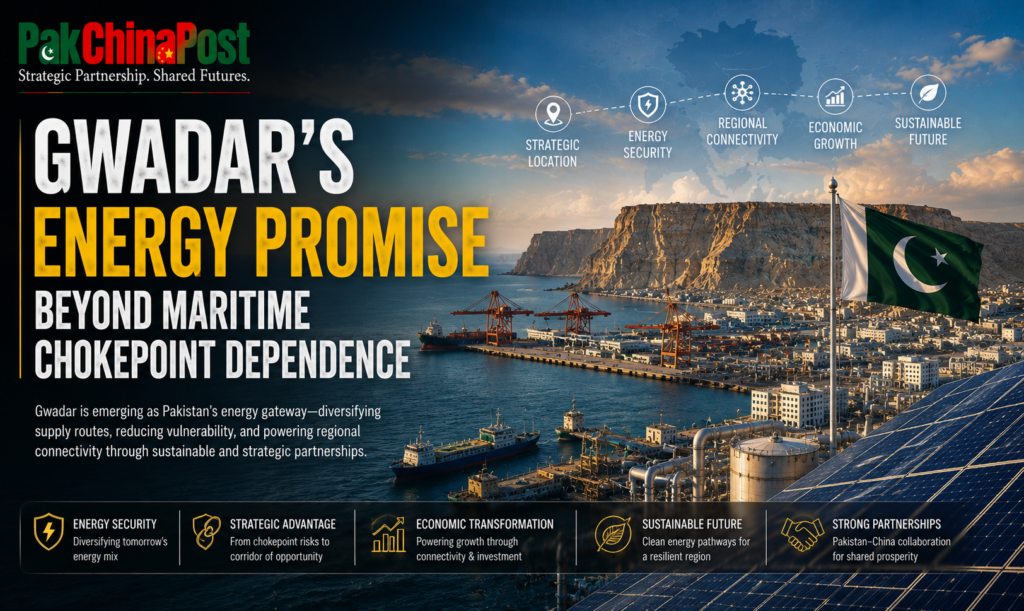
Gwadar’s Energy Promise Beyond Maritime Chokepoint Dependence

Pakistan and China stand at a consequential juncture where expectations surrounding Gwadar Port must now confront the realities of economics, geography, logistics, and security. For more than a decade, Gwadar has occupied a privileged place within strategic discourse. It has been portrayed as a prospective answer to one of Beijing’s most enduring strategic anxieties: excessive dependence upon maritime energy flows traversing the narrow waters of the Malacca Strait. Yet beneath the symbolism, a more complex question demands rigorous examination. Can Gwadar realistically reduce China’s energy vulnerability, or has the concept remained largely confined to geopolitical imagination rather than operational feasibility?
The debate is no longer academic. Rising maritime competition, persistent uncertainty across critical sea lanes, accelerated naval modernization among major powers, and growing concerns over energy security have revived interest in alternative supply architectures. However, the contemporary policy challenge is not whether Gwadar possesses strategic relevance. The more pressing issue is whether Gwadar can transition from a strategic contingency asset into a commercially sustainable component of China’s broader energy security framework.
The attraction of Gwadar is obvious. Situated near the mouth of the Persian Gulf, the port occupies a location through which a substantial share of global hydrocarbon trade passes. From a purely cartographic perspective, energy cargo arriving at Gwadar appears significantly closer to western China than shipments sailing through Southeast Asian waters before reaching China’s eastern seaboard. This geographical observation has often encouraged assumptions that Gwadar could substantially reduce transportation distance and mitigate maritime exposure.
Yet transportation geography rarely operates according to linear calculations. Energy supply chains are determined not merely by distance but by cost efficiency, throughput capacity, infrastructure reliability, regulatory predictability, insurance premiums, and market economics. When these variables are applied, the challenge becomes considerably more complicated.
At present, China’s energy import architecture remains overwhelmingly optimized around maritime transportation. Chinese refineries, petrochemical complexes, storage facilities, industrial clusters, and distribution networks have evolved over decades around coastal economic zones. These ecosystems benefit from economies of scale that are difficult to replicate inland. Energy arriving through eastern ports can be distributed through extensive domestic pipeline systems, railway networks, and industrial supply chains already functioning at massive scale.
Gwadar currently lacks comparable connectivity. The absence of operational oil pipelines connecting Gwadar to western China remains perhaps the most significant obstacle. Without such infrastructure, imported energy would require multimodal transportation involving road and rail movement across challenging terrain before reaching Xinjiang and subsequently entering China’s national distribution network. Such arrangements would struggle to compete economically against established maritime routes.
Pipeline construction therefore becomes central to any serious discussion regarding Gwadar’s future role. However, the economics of cross-border pipelines are frequently underestimated. The proposed route traverses some of the world’s most demanding topographical environments, including mountainous regions, seismic zones, environmentally sensitive areas, and territories requiring extensive engineering intervention. Construction costs would likely extend into tens of billions of dollars before operational considerations are even addressed.
Moreover, modern energy economics increasingly prioritizes efficiency over symbolism. Commercial investors evaluate projects through metrics such as return on investment, transportation cost per barrel, maintenance expenditure, insurance liabilities, throughput consistency, and long-term demand forecasts. Unless pipeline operations can achieve competitive pricing relative to maritime transportation, the commercial rationale remains difficult to establish.
This reality does not necessarily diminish Gwadar’s significance. Rather, it suggests that its value may reside less in replacing existing routes and more in providing redundancy. Strategic planners rarely seek absolute substitutes. They seek optionality. In this context, Gwadar could evolve into a supplementary access mechanism capable of absorbing limited volumes during periods of disruption elsewhere.
Such a role aligns more closely with contemporary resilience planning. Across multiple sectors, governments are increasingly emphasizing redundancy rather than singular dependence. Energy security today is less about replacing one route with another and more about constructing diversified systems capable of functioning under stress conditions.
For Pakistan, however, accepting Gwadar as a strategic hedge rather than a transformative energy artery raises important policy questions. Islamabad has consistently framed the port as a catalyst for industrialization, employment generation, foreign investment attraction, and regional connectivity. If energy transit volumes remain modest, alternative economic models must be developed to ensure sustainable commercial activity.
One possibility involves repositioning Gwadar as a comprehensive energy services hub rather than merely a transit point. Storage facilities, refining capacity, petrochemical processing zones, liquefied natural gas terminals, bunkering services, and export-oriented industrial clusters could generate substantial economic value independent of large-scale pipeline operations. Such diversification would reduce reliance upon any single strategic narrative.
The customs and regulatory dimension is equally critical. Infrastructure alone cannot generate commercial competitiveness. Efficient border management, digital customs systems, harmonized regulations, transparent taxation frameworks, and predictable administrative procedures are indispensable. Investors prioritize certainty. Delays, procedural inconsistencies, and regulatory ambiguity can undermine even the most sophisticated infrastructure investments.
Pakistan therefore faces an institutional challenge alongside its infrastructure challenge. The country’s ability to attract sustained investment into Gwadar will depend significantly upon governance reforms capable of reducing transaction costs and improving operational efficiency. International experience demonstrates that ports succeed not simply because of location but because of the ecosystems constructed around them.
Security considerations further complicate the equation. Any discussion regarding Gwadar’s future must acknowledge persistent concerns surrounding infrastructure protection, personnel safety, and operational continuity. Large-scale energy facilities represent high-value strategic assets. Their viability depends upon investor confidence in long-term security arrangements.
The issue extends beyond traditional physical protection. Contemporary infrastructure security encompasses cybersecurity, supply-chain resilience, maritime domain awareness, intelligence coordination, emergency response capabilities, and critical infrastructure redundancy. Modern energy networks are increasingly vulnerable to digital disruption alongside conventional threats.
Consequently, a credible security architecture for Gwadar requires integration across multiple domains. Maritime surveillance systems, coastal monitoring capabilities, secure communications infrastructure, advanced intelligence fusion mechanisms, and rapid-response frameworks must function cohesively. Such measures are not merely security expenditures. They are prerequisites for commercial confidence.
China’s own evolving security doctrine increasingly emphasizes protection of overseas interests. As Chinese investments expand globally, Beijing has demonstrated growing interest in safeguarding critical economic assets through enhanced security cooperation, intelligence sharing, and capacity-building partnerships. Gwadar may therefore become an important testing ground for future models of infrastructure protection cooperation between the two countries.
Another frequently overlooked factor concerns global energy transition dynamics. The future of hydrocarbon transportation must be evaluated within the broader context of changing energy markets. While oil and natural gas will remain significant components of global energy consumption for decades, investment patterns are increasingly influenced by renewable energy expansion, electrification initiatives, hydrogen development, and decarbonization commitments.
This does not render hydrocarbon infrastructure obsolete. Rather, it necessitates greater flexibility. Infrastructure developed today must remain adaptable to future market conditions. Gwadar’s long-term viability may therefore depend upon its capacity to support multiple energy streams rather than exclusively serving crude oil transportation.
Hydrogen, ammonia, renewable energy exports, critical minerals processing, and green industrial manufacturing could eventually complement traditional energy activities. Policymakers should therefore avoid conceptualizing Gwadar through a purely twentieth-century energy lens. The port’s future competitiveness may derive from diversification rather than specialization.
The international environment also deserves consideration. Energy security calculations are increasingly influenced by geopolitical uncertainty, sanctions regimes, supply-chain disruptions, and technological competition. Under such conditions, states frequently prioritize resilience even when redundancy appears economically inefficient during normal periods.
This logic strengthens the argument for Gwadar as a strategic insurance mechanism. Insurance assets are not judged solely by routine utilization rates. Their value emerges during periods of disruption. From Beijing’s perspective, maintaining alternative access routes may therefore possess significance exceeding immediate commercial returns.
However, strategic insurance remains expensive. Sustaining underutilized infrastructure requires political commitment, financial resources, and institutional patience. Governments must therefore carefully evaluate whether anticipated benefits justify long-term expenditure. This calculation becomes particularly important during periods of economic pressure and competing budgetary demands.
Pakistan’s policymakers should resist the temptation to oversell Gwadar’s energy potential through unrealistic projections. Inflated expectations can generate future disappointment and undermine credibility. A more sophisticated narrative would acknowledge constraints while emphasizing achievable opportunities.
Such an approach would position Gwadar as part of a broader economic transformation agenda encompassing logistics, manufacturing, energy services, digital connectivity, maritime commerce, and industrial development. Within this framework, energy transit becomes one component of a diversified growth strategy rather than its sole foundation.
China likewise faces strategic choices. Beijing must determine whether Gwadar should be pursued primarily as a commercial undertaking, a contingency asset, a developmental partnership initiative, or a combination of all three. Clarity regarding objectives will shape investment priorities and policy decisions.
If the primary objective is commercial profitability, significant emphasis must be placed upon market competitiveness, operational efficiency, and investor confidence. If the objective centers upon strategic resilience, greater tolerance for lower utilization rates may be acceptable. Confusion between these objectives risks producing suboptimal outcomes.
Technological innovation may alter some existing assumptions. Advances in pipeline engineering, digital logistics management, autonomous transportation systems, predictive maintenance technologies, and energy storage solutions could improve future economics. Nevertheless, technology cannot eliminate geography. It can only mitigate certain constraints.
The role of Xinjiang is particularly important. Any meaningful Gwadar-Kashgar energy linkage depends upon robust industrial integration within western China. Energy infrastructure generates maximum value when linked to manufacturing ecosystems, processing facilities, logistics centers, and consumer markets. Therefore, development trajectories in Xinjiang will significantly influence the commercial viability of future energy corridors.
Environmental considerations are becoming increasingly relevant as well. Large infrastructure projects face growing scrutiny regarding ecological impact, water usage, emissions profiles, and sustainability standards. International investors, development institutions, and regulatory authorities increasingly incorporate environmental metrics into decision-making processes. Future planning for Gwadar must therefore align with evolving sustainability expectations.
The broader lesson emerging from the Gwadar debate is that strategic geography alone does not guarantee economic success. Location creates opportunity, but opportunity requires conversion through infrastructure, governance, security, and market integration. Ports become transformative when embedded within efficient economic ecosystems.
For Pakistan, the most productive path forward may involve embracing pragmatism over grandiosity. Rather than framing Gwadar as an imminent replacement for existing global energy routes, policymakers should focus upon incremental capability development. Expanding storage capacity, improving logistics networks, strengthening customs integration, enhancing security frameworks, and attracting industrial investment represent achievable objectives capable of generating tangible benefits.
For China, Gwadar should be viewed through the lens of strategic diversification. Complete substitution of maritime energy routes appears improbable under current conditions. Nevertheless, selective redundancy can contribute meaningfully to resilience planning. In an era characterized by uncertainty, redundancy possesses value that extends beyond conventional commercial calculations.
The future of Gwadar therefore lies not in dramatic declarations but in disciplined execution. The port’s strategic significance remains undeniable. Yet significance alone does not guarantee functionality. Transforming Gwadar from geopolitical aspiration into operational reality will require sustained investment, institutional reform, technological adaptation, and realistic expectations.
The central policy conclusion is clear. Gwadar is unlikely to eliminate China’s dependence upon the Malacca Strait, nor is it positioned to replace established maritime energy networks. However, dismissing it as merely symbolic would be equally inaccurate. Its most plausible future lies between these extremes: a strategically valuable supplementary route, an energy services platform, a logistics hub, and a resilience asset within a broader architecture of diversified connectivity.
For policymakers in Islamabad and Beijing, the challenge is no longer proving Gwadar’s relevance. The challenge is defining its realistic purpose, aligning investments with achievable outcomes, and constructing the institutional foundations capable of converting strategic geography into enduring economic utility. Only through such realism can Gwadar evolve from a persistent geopolitical narrative into a functioning component of twenty-first-century energy security.
A Public Service Message