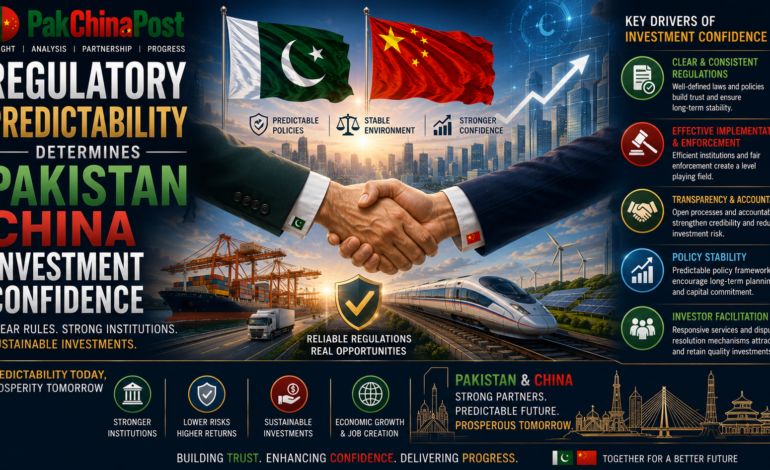
Regulatory Predictability Determines Pakistan China Investment Confidence


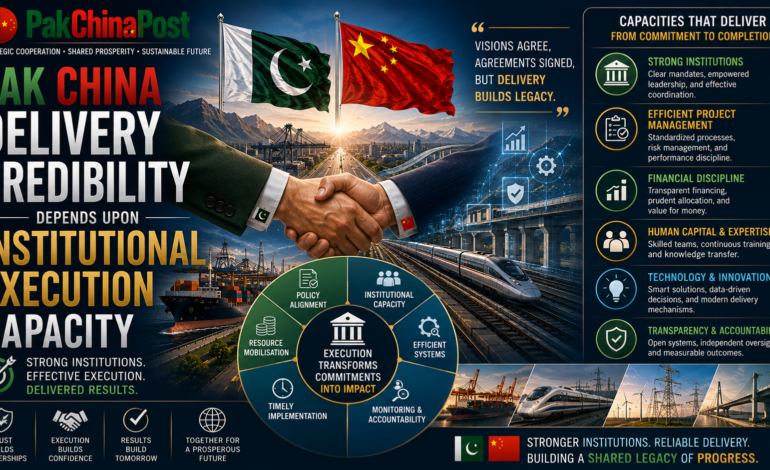
Pak China economic cooperation has gradually entered a phase where regulatory certainty carries greater strategic significance than investment announcements themselves. Infrastructure commitments, industrial relocation, advanced manufacturing partnerships and technology cooperation increasingly depend less upon political declarations than upon confidence that commercial rules will remain stable throughout investment lifecycles extending over several decades. Chinese enterprises evaluating manufacturing facilities, logistics networks, industrial parks, renewable energy installations, mineral processing projects and digital infrastructure now calculate institutional reliability with the same precision as financial returns. The central question confronting Pakistan is therefore no longer whether strategic partnerships remain politically resilient, but whether governmental institutions can consistently deliver predictable commercial governance under changing political administrations, evolving bureaucratic priorities and complex federal provincial regulatory arrangements.
International capital increasingly interprets regulatory predictability as a strategic asset rather than merely an administrative convenience. Investors tolerate commercial risks arising from markets, exchange rates and technological competition because such uncertainties remain inherent within business operations. They demonstrate considerably less tolerance for arbitrary licensing procedures, inconsistent taxation, contradictory institutional directives, delayed approvals or retrospective regulatory modifications that fundamentally alter commercial assumptions after investment commitments have already been undertaken. Within Pakistan’s investment environment, these institutional inconsistencies frequently generate greater concern than macroeconomic volatility itself because they introduce uncertainty that cannot easily be quantified through conventional financial modelling.
Chinese investment institutions operate within planning horizons fundamentally different from speculative international capital. Major state owned enterprises, sovereign investment entities and industrial manufacturers evaluate infrastructure, energy and industrial cooperation through horizons measured across twenty to thirty years. Such investments require predictable environmental regulations, stable taxation arrangements, transparent customs administration, reliable land acquisition procedures, enforceable contracts and credible dispute resolution mechanisms extending well beyond individual political cycles. Regulatory unpredictability therefore increases not merely transactional costs but strategic hesitation regarding future industrial expansion.
Pakistan’s institutional challenge does not principally arise from the absence of regulatory frameworks. Numerous laws governing investment, industrial development, taxation, environmental compliance and commercial licensing already exist across federal and provincial jurisdictions. The greater challenge emerges from overlapping institutional mandates, inconsistent administrative interpretation, fragmented implementation procedures and frequent policy revisions introduced without comprehensive regulatory impact assessments. Investors consequently encounter multiple administrative authorities exercising concurrent oversight while applying divergent interpretations of identical legal provisions.
Licensing uncertainty illustrates this broader governance dilemma. Commercial approvals often involve numerous ministries, provincial departments, environmental authorities, utility regulators, customs administrations and local government institutions operating according to independent administrative timelines. Delays frequently originate not from legal barriers but from institutional fragmentation where sequential approvals lack integrated coordination. Project implementation consequently becomes vulnerable to administrative bottlenecks rather than commercial feasibility.
Chinese industrial investors increasingly compare Pakistan not only against regional competitors but against international jurisdictions demonstrating superior regulatory coordination. Countries attracting sustained manufacturing relocation typically provide integrated approval mechanisms, digital licensing platforms, legally defined administrative timelines and transparent compliance procedures reducing discretionary bureaucratic intervention. Predictability rather than preferential incentives increasingly distinguishes successful investment destinations.
Policy reversals produce particularly significant consequences because infrastructure and industrial investments involve substantial irreversible capital expenditure. Investors constructing ports, rail facilities, transmission infrastructure, industrial zones or advanced manufacturing plants cannot rapidly relocate assets following unexpected regulatory modifications. Consequently they assign considerable importance to institutional assurances preventing retrospective contractual alterations, arbitrary tariff adjustments or inconsistent concession interpretations.
Pakistan has periodically demonstrated impressive policy ambition through industrial strategies, investment facilitation initiatives and infrastructure development frameworks. Yet implementation continuity has frequently weakened because institutional memory remains insufficiently protected from administrative restructuring, ministerial transitions and changing bureaucratic priorities. Regulatory consistency therefore requires institutional architecture capable of preserving commercial commitments independently from evolving political environments.
Commercial governance increasingly constitutes an essential component of national strategic credibility. Diplomatic relationships undoubtedly facilitate investment discussions, yet sustained economic cooperation ultimately depends upon domestic institutions translating bilateral understandings into reliable commercial environments. Every delayed approval, contradictory administrative interpretation or unresolved contractual dispute gradually influences international perceptions regarding institutional capability.
Special Economic Zones established under bilateral cooperation frameworks represent an instructive illustration. Their long term success depends not solely upon physical infrastructure but equally upon customs efficiency, taxation clarity, labour regulation consistency, utility pricing transparency and integrated administrative management. Investors evaluate operational predictability throughout production cycles rather than merely initial establishment incentives. Competitive industrial ecosystems therefore emerge through regulatory coherence instead of isolated fiscal concessions.
Dispute resolution constitutes another decisive determinant shaping investment confidence. Commercial disagreements inevitably arise within complex infrastructure and industrial partnerships. The strategic issue concerns institutional capacity to resolve disputes transparensively, impartially and efficiently without prolonged uncertainty. Investors distinguish between commercial disagreements and governance failures. Confidence declines primarily where institutional mechanisms lack predictability, procedural clarity or timely enforcement.
International experience demonstrates that specialised commercial courts, independent arbitration frameworks and technologically integrated judicial administration substantially enhance investment confidence. Jurisdictions recognised for commercial reliability frequently maintain dedicated benches possessing technical expertise regarding infrastructure contracts, international investment agreements and complex commercial litigation. Such institutional specialisation reduces procedural delays while strengthening legal consistency.
Singapore offers an instructive institutional example because regulatory agencies operate through clearly defined statutory mandates, integrated licensing systems and extensive digital governance reducing administrative discretion. Investors benefit from transparent regulatory guidance, publicly accessible compliance requirements and legally enforceable administrative timelines. The resulting certainty substantially lowers transaction costs despite comparatively limited natural resources.
The United Arab Emirates similarly transformed investment perceptions through institutional simplification rather than exclusively through fiscal incentives. Unified commercial licensing, specialised economic jurisdictions, independent arbitration institutions and integrated digital government platforms collectively created predictable operating conditions attractive to international investors across multiple sectors.
China itself has progressively strengthened commercial governance through regulatory modernisation, specialised intellectual property courts, streamlined administrative approvals and expanded digital government systems supporting investment efficiency. Although China’s governance model reflects unique domestic characteristics, its emphasis upon implementation discipline, administrative coordination and institutional continuity provides valuable lessons regarding predictable commercial management.
Malaysia presents another relevant regional comparison. Successive governments preserved essential industrial investment policies despite political transitions while gradually refining implementation mechanisms instead of repeatedly redesigning strategic frameworks. Institutional continuity consequently strengthened investor confidence across electronics manufacturing, logistics and industrial development.
Pakistan can similarly enhance strategic credibility by institutionalising regulatory impact assessment before introducing significant commercial policy modifications. Proposed regulations affecting taxation, customs administration, industrial licensing or investment conditions should undergo rigorous economic evaluation assessing implementation feasibility, administrative capacity and commercial consequences before adoption. Such assessments reduce unintended regulatory disruption while improving policy quality.
Federal provincial coordination deserves particular attention because constitutional decentralisation creates overlapping investment responsibilities. Industrial regulation, environmental approvals, land administration and taxation frequently involve multiple governmental levels operating according to independent procedures. Establishing integrated coordination mechanisms capable of synchronising administrative decisions would significantly reduce uncertainty confronting investors without requiring constitutional restructuring.
A permanent Pakistan China Regulatory Coordination Council composed of senior representatives from economic ministries, provincial governments, investment authorities, legal institutions and regulatory agencies could systematically identify implementation obstacles affecting bilateral commercial projects. Rather than addressing individual disputes after escalation, such a mechanism would continuously monitor regulatory performance, recommend procedural improvements and harmonise institutional interpretations.
Digital governance offers another transformative opportunity. Integrated electronic licensing platforms connecting relevant ministries, provincial authorities and regulatory institutions would substantially improve transparency while reducing discretionary administrative intervention. Investors could monitor application progress, identify pending approvals and access standardised compliance requirements through unified digital interfaces. Administrative accountability naturally strengthens where procedural visibility increases.
Predictable taxation represents another essential governance requirement. Investors require confidence that tax obligations remain transparent, consistently interpreted and protected from retrospective modifications. Stable fiscal administration does not imply inflexible taxation but rather structured consultation, adequate transition periods and clearly communicated implementation schedules allowing businesses to adjust operational planning accordingly.
Customs administration similarly influences industrial competitiveness. Manufacturing enterprises integrated within international supply chains depend upon efficient border procedures, predictable documentation requirements and consistent tariff classifications. Digital customs management, advance rulings and coordinated border administration substantially reduce operational uncertainty while enhancing export competitiveness.
Environmental governance increasingly shapes international investment decisions, particularly regarding advanced manufacturing, renewable energy and critical mineral processing. Regulatory predictability requires transparent environmental standards applied consistently across jurisdictions while balancing ecological protection with commercial feasibility. Investors generally accept rigorous environmental obligations provided implementation remains impartial and administratively coherent.
Labour regulation also deserves institutional modernisation supporting both workforce protection and industrial competitiveness. Consistent occupational safety standards, transparent employment regulations and efficient dispute resolution contribute positively towards investment confidence by reducing operational ambiguity while strengthening social stability.
Public procurement reform carries strategic significance because infrastructure partnerships frequently involve government contracting. Transparent tender procedures, standardised evaluation methodologies, digital procurement systems and independent review mechanisms reduce perceptions of administrative unpredictability while improving fiscal efficiency. International investors increasingly evaluate procurement governance when assessing broader institutional reliability.
Performance monitoring should evolve beyond expenditure measurement towards implementation outcomes. Regulatory agencies require measurable indicators assessing approval timelines, licensing efficiency, dispute resolution duration, investor satisfaction and administrative consistency. Public reporting against objective performance benchmarks strengthens institutional accountability while identifying areas requiring procedural improvement.
Institutional professionalism ultimately represents the foundation of regulatory predictability. Civil service reforms emphasising technical expertise, administrative continuity, specialised commercial knowledge and performance evaluation reduce dependence upon individual personalities while strengthening organisational capability. Stable institutions rather than exceptional individuals sustain long term investment confidence.
Strategic communication equally influences international perceptions. Regulatory reforms produce maximum credibility when governments consistently communicate implementation progress through evidence based reporting instead of promotional narratives. Investors respond more positively to measurable administrative improvements than optimistic declarations unsupported by operational performance.
Independent regulatory agencies overseeing telecommunications, energy, financial services and competition policy should maintain professional autonomy insulated from short term political pressures while remaining accountable through transparent legal frameworks. Regulatory independence enhances market confidence because commercial decisions appear governed by predictable legal principles rather than discretionary intervention.
Parliamentary oversight also contributes positively towards institutional credibility. Regular legislative review of regulatory performance, investment climate indicators and implementation effectiveness strengthens democratic accountability while reinforcing policy continuity across political transitions. Institutional transparency consequently becomes compatible with long term strategic planning.
Establishment institutions possess an important enabling role regarding strategic infrastructure security, critical asset protection and investment continuity. Their contribution should increasingly focus upon safeguarding stable operating environments, supporting interagency coordination during major project implementation and facilitating national resilience against external disruptions affecting strategic investments. Economic security and national security increasingly converge where critical infrastructure, digital networks and industrial supply chains become essential components of national resilience.
Pakistan’s investment narrative should therefore evolve from promotional messaging towards institutional credibility. International investors increasingly evaluate administrative competence, regulatory consistency and implementation discipline as indicators of long term strategic reliability. Diplomatic goodwill undoubtedly opens commercial opportunities, yet enduring investment partnerships ultimately depend upon domestic governance capability translating political commitments into predictable operational realities.
Global competition for industrial relocation will intensify as geopolitical diversification, technological transformation and supply chain restructuring accelerate across Asia. Countries demonstrating institutional predictability will attract disproportionate shares of advanced manufacturing, technology cooperation and strategic infrastructure investment. Those characterised by regulatory volatility risk gradual marginalisation regardless of geographic advantages or bilateral relationships.
Pakistan possesses significant comparative strengths including strategic geography, expanding infrastructure, favourable demographics, established bilateral partnerships and growing industrial potential. Transforming these structural advantages into sustained investment confidence requires comprehensive governance reforms prioritising regulatory stability above episodic policy innovation. Investors consistently reward jurisdictions where institutional behaviour remains more predictable than political rhetoric.
The future trajectory of Pakistan China economic cooperation will therefore depend increasingly upon administrative excellence rather than diplomatic symbolism. Stable regulations, coordinated institutions, transparent dispute resolution, integrated digital governance, professional regulatory agencies and measurable implementation performance collectively constitute strategic capital capable of attracting long term industrial investment. Regulatory predictability has consequently become an indispensable instrument of national competitiveness, strengthening Pakistan’s international reputation while reinforcing the strategic foundations of one of Asia’s most consequential economic partnerships. As global investors increasingly prioritise governance reliability over promotional incentives, Pakistan’s enduring strategic advantage will ultimately rest upon its capacity to transform institutional consistency into the defining characteristic of its commercial statecraft.
A Public Service Message