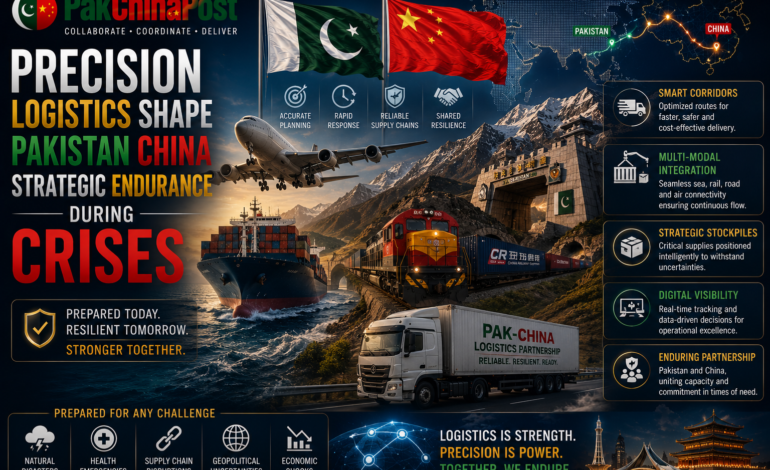
Precision Logistics Shape Pakistan China Strategic Endurance During Crises


Pak China strategic cooperation is entering a period where the decisive variable in national defence is no longer measured solely by the number of combat platforms, precision munitions or force deployments, but by the capacity to preserve uninterrupted logistical momentum under sustained operational pressure. Contemporary conflicts have demonstrated with increasing clarity that armies rarely collapse because they exhaust military courage. They falter when transportation corridors become fragmented, repair cycles lengthen beyond operational tolerance, fuel distribution networks become unpredictable, ammunition replenishment loses synchronization, and command authorities are forced to allocate scarce resources through improvised rather than preplanned mechanisms. Strategic endurance has therefore become a function of logistics resilience, transforming supply architecture from a supporting military function into the principal determinant of national staying power. For Pakistan and China, whose partnership increasingly encompasses defence industrial cooperation, infrastructure development and regional connectivity, the construction of wartime supply chain continuity mechanisms deserves recognition as one of the most consequential dimensions of future strategic cooperation.
Military historians traditionally distinguished tactics from logistics, yet recent operational experience has steadily dissolved that distinction. High intensity warfare now consumes precision weapons, fuel, spare parts, electronic components and maintenance resources at a tempo previously associated only with total wars. Sophisticated combat systems depend upon uninterrupted software updates, secure communications, encrypted data transmission, resilient electrical power and globally distributed manufacturing chains. Even the most advanced missile battery becomes strategically irrelevant when replacement components remain stranded inside congested ports or vulnerable transport corridors. Consequently, logistical superiority increasingly determines whether military capabilities retain operational relevance beyond the opening stages of conflict.
Pakistan confronts a distinctive strategic geography that simultaneously offers opportunity and vulnerability. Its ports connect continental Asia with the Arabian Sea, while extensive road and railway corridors link maritime infrastructure with inland economic centres and strategic regions. China possesses unparalleled industrial production capacity, sophisticated transportation engineering and advanced digital logistics management. Together, these complementary strengths create the foundations for an integrated strategic logistics architecture capable of supporting both economic resilience and national security. Nevertheless, realizing such an architecture requires moving beyond infrastructure construction toward institutional integration, predictive planning and operational interoperability.
The strategic lesson emerging from multiple theatres is that logistics networks must be designed not for peacetime efficiency but for wartime survivability. Commercial transportation systems frequently prioritize cost optimization, centralized warehousing and streamlined inventories. Military contingencies require the opposite philosophy. Redundancy, distributed storage, alternative transportation routes, diversified suppliers and decentralized decision making become indispensable. Supply chains optimized exclusively for economic efficiency frequently prove fragile when confronted by cyber attacks, infrastructure sabotage, sanctions or kinetic disruption. Pakistan and China therefore require logistics planning that integrates commercial productivity with strategic resilience rather than treating the two objectives as competing priorities.
Protected transport systems represent one of the most immediate areas for bilateral collaboration. Conventional assumptions regarding uninterrupted highway movement are becoming increasingly obsolete. Precision strike capabilities, long range surveillance, unmanned aerial systems and satellite reconnaissance expose transportation corridors to persistent observation. Railway infrastructure, inland freight terminals, tunnel networks and hardened logistics hubs therefore acquire renewed strategic significance. Pakistan’s railway modernization initiatives, when synchronized with Chinese engineering expertise, could produce transport corridors capable of maintaining operational continuity despite localized infrastructure degradation.
Strategic inventory planning constitutes another domain demanding institutional transformation. Traditional procurement models frequently depend upon just in time supply principles that minimize storage costs. Such models perform effectively during commercial stability but become liabilities under geopolitical disruption. Pakistan and China should instead develop strategic reserve frameworks encompassing fuel, ammunition, telecommunications equipment, industrial raw materials, semiconductor components, medical supplies, engineering machinery and critical spare parts. These reserves should remain geographically dispersed, digitally monitored and protected through multilayered security protocols. Inventory resilience should be evaluated through regular stress simulations rather than static accounting procedures.
Artificial intelligence offers unprecedented opportunities for predictive logistics management. Rather than merely automating transportation schedules, advanced analytical systems can anticipate consumption rates, identify emerging bottlenecks, calculate infrastructure vulnerabilities and recommend adaptive distribution patterns before disruptions become operational crises. AI supported logistics platforms capable of integrating satellite imagery, transportation telemetry, warehouse inventories, weather forecasting and maintenance data could substantially enhance strategic decision making. Pakistan’s expanding digital governance initiatives, combined with China’s leadership in industrial artificial intelligence, create favourable conditions for collaborative development of secure military logistics algorithms.
Cyber interference has emerged as one of the most underestimated threats to strategic logistics. Modern transportation increasingly depends upon digital scheduling systems, automated customs processing, financial settlement platforms, navigation services and interconnected industrial control systems. A sophisticated cyber intrusion targeting freight management software may produce operational consequences comparable to physical infrastructure destruction. Bilateral cybersecurity cooperation should therefore extend beyond traditional military networks toward transportation ministries, railway authorities, port operators, customs agencies, energy distribution companies and logistics enterprises. Strategic logistics cannot remain resilient if its digital backbone remains fragmented or inconsistently protected.
Emergency port management requires similarly comprehensive modernization. Ports represent critical nodes where maritime commerce intersects with national security. During crises, civilian cargo, humanitarian assistance, military equipment and essential commodities compete simultaneously for limited unloading capacity. Without predetermined prioritization mechanisms, congestion rapidly develops into strategic paralysis. Pakistan’s maritime gateways should therefore incorporate contingency operating procedures permitting rapid transition from commercial operations toward emergency logistics management without generating administrative confusion. Chinese expertise in automated port operations, digital cargo tracking and intelligent scheduling could significantly accelerate this transition.
Infrastructure redundancy should become an organizing principle rather than an auxiliary consideration. Single point dependence upon individual highways, bridges, communication links or energy transmission systems creates exploitable vulnerabilities. Parallel transportation corridors, modular bridge construction capabilities, rapidly deployable engineering assets and mobile repair units enhance resilience by ensuring that localized disruption does not cascade into systemic logistical failure. Bilateral infrastructure planning should therefore evaluate projects according to redundancy indices alongside conventional economic feasibility assessments.
Sanctions resilience has assumed growing strategic significance within international security calculations. Financial restrictions, export controls and technology transfer limitations increasingly influence military preparedness long before armed confrontation begins. Pakistan and China should identify sectors where concentrated supplier dependence creates unacceptable strategic exposure. Diversified sourcing arrangements, indigenous manufacturing capacity and reciprocal industrial support agreements would reduce vulnerability to external economic coercion. Defence logistics can no longer be separated from industrial policy because manufacturing continuity directly influences operational sustainability.
Railway redundancy deserves renewed attention because rail transportation offers advantages that road convoys frequently cannot replicate during prolonged crises. Rail systems transport heavy equipment efficiently while consuming comparatively fewer fuel resources and reducing highway congestion. Dedicated freight corridors, protected marshalling yards, dispersed maintenance facilities and interoperable signalling systems enhance both commercial productivity and military responsiveness. Pakistan’s railway modernization strategy should therefore incorporate contingency operating concepts developed jointly with Chinese transportation planners.
Energy logistics remain central to military endurance. Fuel distribution networks frequently become priority targets during conflict because mechanized forces, aviation assets and industrial production all depend upon uninterrupted energy availability. Bilateral cooperation could explore protected pipeline infrastructure, underground storage facilities, mobile refuelling systems, diversified import terminals and renewable backup generation for critical logistics installations. Energy resilience should be treated as an integral component of defence planning rather than exclusively an economic policy concern.
The expanding importance of unmanned systems further transforms logistics planning. Autonomous aerial vehicles already support battlefield resupply, infrastructure inspection and surveillance missions. Future developments may enable autonomous ground convoys, robotic warehouse management, automated engineering equipment and intelligent cargo distribution. Pakistan and China possess opportunities to jointly develop autonomous logistics technologies capable of reducing personnel exposure while maintaining operational tempo during contested environments. Such systems require secure communications, resilient navigation and sophisticated artificial intelligence capable of functioning despite electronic interference.
Critical infrastructure protection extends beyond physical security toward operational continuity. Transportation networks depend upon electricity, telecommunications, water supply, financial transactions and digital coordination. Cascading failures across interconnected infrastructure sectors can rapidly overwhelm even well prepared logistics organizations. National preparedness therefore requires integrated risk assessments examining interdependencies among energy systems, telecommunications, transportation, manufacturing and emergency services. Bilateral exercises simulating complex infrastructure disruption would generate valuable operational insights while strengthening institutional coordination.
Military logistics increasingly overlaps with civilian industrial capacity. Modern conflicts consume resources at rates exceeding the production capabilities of many defence industries operating independently. Civilian manufacturers, transportation firms, engineering companies and technology enterprises therefore become essential components of national mobilization. Pakistan should consider establishing strategic industrial mobilization frameworks identifying commercial enterprises capable of supporting defence logistics during emergencies. Chinese experience integrating industrial production with national strategic planning offers practical lessons adaptable to Pakistani circumstances.
Supply bottlenecks frequently emerge not because of inadequate production but because of insufficient coordination. Competing institutional authorities, fragmented procurement systems and incompatible information platforms delay resource movement despite adequate inventories. Pakistan and China should therefore prioritize logistics interoperability through standardized digital protocols, harmonized customs procedures, compatible transportation documentation and coordinated emergency planning. Administrative friction often produces greater operational delay than physical infrastructure limitations.
The strategic significance of maintenance logistics is frequently underestimated. Combat equipment requires continuous inspection, repair and component replacement. Establishing bilateral maintenance cooperation encompassing spare part manufacturing, predictive diagnostics, technical training and distributed repair facilities would substantially enhance operational sustainability. Maintenance resilience should be integrated into defence industrial cooperation rather than treated as a separate technical activity.
Maritime security directly influences logistics continuity because commercial shipping remains vulnerable to disruption arising from regional instability, piracy, cyber attacks and geopolitical competition. Pakistan’s coastline occupies a strategically important position connecting maritime trade with continental transportation networks. Enhanced maritime domain awareness, coordinated port security, underwater infrastructure monitoring and integrated coastal surveillance would strengthen the reliability of logistics flows supporting both commercial activity and national defence.
Financial logistics constitute another essential dimension of resilience. Payment systems, insurance mechanisms, customs settlements and banking infrastructure facilitate international trade even during geopolitical uncertainty. Developing secure bilateral financial channels, resilient settlement mechanisms and protected digital payment platforms would reduce vulnerability to external financial disruption while supporting uninterrupted commercial exchange essential for industrial production.
Education and institutional culture require equal attention. Logistics professionals must increasingly understand cybersecurity, artificial intelligence, infrastructure engineering, financial risk management and strategic planning alongside traditional transportation management. Pakistan should encourage specialized defence logistics education integrating military institutions, civilian universities and industrial partners. Joint academic programmes, professional exchanges and simulation exercises with Chinese institutions would cultivate the multidisciplinary expertise required for future strategic logistics management.
Strategic reserves should extend beyond physical commodities toward manufacturing capability itself. Retaining surge production capacity, preserving specialized engineering skills and protecting critical industrial ecosystems become increasingly important when international supply chains experience disruption. Bilateral industrial cooperation should therefore prioritize production resilience alongside technological advancement. Shared manufacturing standards and reciprocal emergency production arrangements would enhance collective adaptability.
Climate related disruptions introduce additional complexity. Floods, extreme temperatures, coastal storms and water scarcity increasingly threaten transportation infrastructure, energy systems and industrial facilities. Logistics planning should incorporate environmental resilience through elevated infrastructure, climate resistant engineering standards, emergency drainage systems and adaptive transportation planning. National preparedness must anticipate simultaneous natural disasters and geopolitical crises rather than treating them as isolated contingencies.
Strategic communications also influence logistics resilience. Public confidence, market stability and industrial productivity deteriorate rapidly when misinformation spreads regarding shortages or transportation disruption. Coordinated crisis communication strategies supported by credible information dissemination reduce panic behaviour while preserving commercial continuity. Information resilience should therefore accompany physical logistics planning.
Pakistan and China possess an opportunity to institutionalize annual strategic logistics dialogues encompassing defence authorities, transportation ministries, customs administrations, port operators, railway agencies, energy planners, cybersecurity organizations and industrial representatives. Such institutional mechanisms would gradually replace fragmented consultations with structured policy coordination capable of addressing emerging vulnerabilities before they evolve into strategic liabilities.
Joint logistics exercises should become increasingly sophisticated by simulating sanctions scenarios, cyber disruptions, infrastructure damage, maritime blockages, energy shortages and simultaneous humanitarian emergencies. These exercises would identify procedural weaknesses, refine contingency planning and strengthen interagency coordination. Practical operational testing provides considerably greater strategic value than theoretical planning documents alone.
Future defence cooperation should increasingly evaluate infrastructure investments according to resilience metrics including redundancy, repairability, cyber protection, modularity, distributed storage capacity and operational flexibility. Infrastructure capable of adapting under pressure contributes more substantially to national security than facilities optimized exclusively for peacetime efficiency. Strategic investment decisions should therefore incorporate defence logistics assessments from the earliest planning stages.
Ultimately, the emerging strategic environment suggests that military power can no longer be measured exclusively through visible weapon systems. Endurance, adaptability and logistical coherence increasingly determine whether nations retain strategic initiative during prolonged crises. For Pakistan and China, constructing integrated wartime supply chain continuity mechanisms represents not merely a defence modernization objective but a comprehensive national resilience strategy linking industrial capacity, transportation infrastructure, technological innovation, economic security and institutional coordination into a unified framework. The partnership’s future strategic credibility will depend less upon symbolic declarations of cooperation than upon its demonstrated ability to sustain uninterrupted operational functionality when geopolitical pressures become most severe. Nations capable of preserving logistical continuity amid uncertainty will shape the strategic balance of the coming decades, while those relying upon fragile supply architectures may discover that operational superiority cannot survive the collapse of the systems that sustain it.
A Public Service Message.