South China Sea Disputes: Sovereignty, Security Depth, and the Geopolitical Contest Shaping Asia’s Maritime Future


The South China Sea has emerged as one of the most strategically sensitive maritime regions in the world. Stretching across vital sea lanes that connect the Pacific and Indian Oceans, this body of water carries an estimated one third of global maritime trade and serves as a conduit for energy supplies, industrial goods, and digital infrastructure. For China, the South China Sea is not simply a maritime expanse but a critical component of national security, economic sustainability, and strategic depth. For the United States and its regional partners, it represents a central arena for upholding maritime norms, alliance credibility, and balance of power in the Indo Pacific. At the heart of the dispute lies China’s claim to large portions of the South China Sea under what is commonly known as the Nine Dash Line. This demarcation, rooted in historical maps produced during the early twentieth century, encompasses much of the sea’s waters and features. Beijing maintains that historical usage, fishing patterns, and administrative activities support its claim. However, several Southeast Asian states including the Philippines, Vietnam, Malaysia, and Brunei assert overlapping claims based on modern interpretations of maritime law, particularly the United Nations Convention on the Law of the Sea.
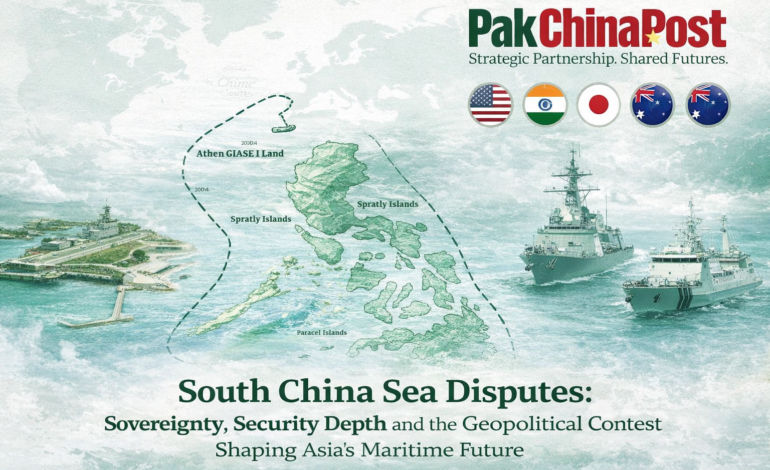
While freedom of navigation has generally not been obstructed in commercial terms, the geopolitical contest has centered on sovereignty, maritime jurisdiction, and military positioning. The United States conducts Freedom of Navigation Operations to challenge what it considers excessive maritime claims and to reinforce the principle that international waters must remain open under established legal frameworks. Washington also supports regional allies such as the Philippines through defense agreements and joint exercises. These actions are presented as preserving a rules based order, yet from Beijing’s perspective they represent strategic encirclement and external interference. China’s construction of artificial islands and military facilities across the Spratly and Paracel Islands has intensified tensions. Beijing argues that these installations provide defensive depth necessary to secure its southern coastline, major ports, and densely populated economic hubs such as Guangzhou, Shenzhen, and Hong Kong. The logic is rooted in strategic vulnerability. Historically, China experienced foreign incursions through maritime routes during periods of weakness. Ensuring layered maritime defense is therefore viewed as essential to prevent coercion and maintain national sovereignty.
Artificial island development has included airstrips, radar systems, missile platforms, and port facilities. Critics argue that militarization destabilizes the region. Chinese officials counter that the facilities are defensive in nature and necessary to safeguard sea lanes, respond to natural disasters, and combat piracy. From Beijing’s standpoint, security in the South China Sea is not expansionist ambition but a rational response to perceived encirclement by U.S. alliances and surveillance activities. The strategic importance of the South China Sea extends beyond sovereignty disputes. The sea floor is believed to contain significant reserves of oil and natural gas. Fisheries support millions of livelihoods across Southeast Asia. Undersea cables transmitting global internet traffic traverse its depths. Control or influence over these resources enhances economic resilience and technological security. For China, whose economy depends heavily on maritime trade and energy imports, ensuring uninterrupted access through these waters is a fundamental national priority.
The Philippines has played a pivotal role in internationalizing the dispute. In 2013, Manila initiated arbitration proceedings under the United Nations Convention on the Law of the Sea, challenging the legal basis of the Nine Dash Line. In 2016, the arbitral tribunal ruled that China’s expansive claims lacked legal foundation under UNCLOS. Beijing rejected the ruling, asserting that it would neither recognize nor comply with the decision. This legal episode underscored the divergence between historical claims and contemporary maritime law interpretations. Regional dynamics have further complicated the landscape. Countries indirectly aligned with the United States have raised concerns over sovereignty and exclusive economic zones. Naval patrols, coast guard confrontations, and fishing incidents have become more frequent. The South China Sea has thus transformed into a contested maritime theater where law, history, and power intersect.
The involvement of external powers has reshaped perceptions of control and influence. The United States, though not a claimant state, conducts regular naval operations and strengthens defense partnerships in the region. India has increased naval cooperation with Southeast Asian nations and enhanced its presence in the Indo Pacific. Japan contributes through maritime capacity building and defense cooperation. Australia participates in joint exercises and strategic dialogues. These four states, often associated with broader Indo Pacific frameworks, are perceived by Beijing as forming an indirect managing coalition that constrains China’s maritime expansion.
From China’s perspective, this emerging alignment constitutes a security dilemma. The presence of external naval forces near its coastline increases strategic anxiety. The South China Sea is viewed not merely as disputed territory but as a buffer zone essential for protecting economic corridors and maritime approaches. The concept of strategic depth is central to Chinese defense planning. Without forward positions, major coastal cities and industrial zones would be exposed to surveillance and rapid strike capabilities from adversaries. Freedom of Navigation Operations conducted by the United States are framed as routine assertions of international law. Yet Beijing interprets these patrols as deliberate demonstrations of military presence near sensitive installations. While commercial shipping continues largely unhindered, the military dimension of navigation rights remains contentious. The dispute is therefore less about trade obstruction and more about strategic signaling.
The South China Sea also reflects broader competition between continental and maritime powers. Historically, sea control has enabled global influence. The United States maintains extensive naval capabilities across the Pacific. China’s growing naval modernization seeks to protect its expanding global interests. Aircraft carriers, submarines, and anti ship missile systems represent efforts to deter intervention and safeguard maritime claims. The contest is not confined to islands and reefs but extends to doctrines of deterrence and sea denial. India’s involvement adds another layer to the equation. Though geographically outside the South China Sea, India views freedom of navigation and balance of power as aligned with its strategic interests. Participation in joint exercises and dialogue mechanisms reinforces its role in shaping Indo Pacific security. Japan’s proximity to East Asian sea lanes makes stability in the South China Sea integral to its energy security. Australia’s maritime trade routes similarly depend on open sea lanes. These states perceive their engagement as contributing to regional stability. China, however, often interprets such coordination as containment.
The notion that the South China Sea could become a future hotspot is widely debated. Accidental collisions, miscalculations, or escalatory responses to minor incidents could trigger broader confrontation. Military assets from multiple powers operate in close proximity. The absence of a comprehensive binding code of conduct heightens uncertainty. While ASEAN and China have engaged in negotiations toward a code of conduct, progress has been gradual. For China, the South China Sea dispute represents a core national security issue. It touches upon sovereignty, territorial integrity, maritime rights, and protection of economic lifelines. Any perceived erosion of control could weaken domestic legitimacy and strategic posture. The narrative of national rejuvenation emphasizes overcoming historical vulnerabilities, including maritime weakness. Consequently, compromise on sovereignty claims is politically sensitive.
The United States frames its involvement as safeguarding international norms and supporting allies. Yet from Beijing’s viewpoint, the cumulative effect of alliance strengthening, surveillance operations, and diplomatic pressure suggests an attempt to institutionalize a framework that limits Chinese influence. This perception reinforces China’s determination to consolidate its presence and infrastructure in contested areas. The legal and diplomatic dimensions remain complex. While UNCLOS provides mechanisms for maritime delimitation, interpretations differ. Historical claims intersect uneasily with modern legal frameworks. Multilateral negotiations through ASEAN face challenges due to differing national interests among member states. Smaller claimant states often balance economic engagement with China against security ties with the United States.
Energy security further heightens the stakes. China imports substantial volumes of oil and liquefied natural gas through sea lanes passing the South China Sea and the Strait of Malacca. Disruption could have severe economic consequences. Ensuring secure passage is therefore integral to China’s broader maritime strategy, including initiatives to diversify energy routes through pipelines and alternative corridors. Military modernization trends indicate that all major actors are preparing for contingencies. China continues to enhance anti access and area denial capabilities designed to deter intervention near its coastline. The United States maintains forward deployed forces and carrier strike groups. Regional partners expand naval procurement and surveillance capacity. The maritime domain has become technologically sophisticated, incorporating satellite reconnaissance, unmanned systems, and cyber capabilities.
Despite heightened tensions, outright conflict remains unlikely in the immediate term. Economic interdependence and diplomatic engagement provide stabilizing incentives. However, the structural drivers of competition persist. As China’s economic and naval capabilities grow, and as the United States reinforces alliances, the South China Sea will likely remain a focal point of strategic rivalry. In broader geopolitical terms, the dispute reflects the transition from unipolar dominance to contested multipolarity. The United States seeks to maintain maritime leadership and uphold established norms. China seeks recognition of historical rights and strategic autonomy in its near seas. Southeast Asian states navigate between these powers, balancing sovereignty claims and economic opportunities.
Ultimately, the South China Sea dispute encapsulates the intersection of sovereignty, security depth, resource competition, and great power rivalry. For China, it is a matter of safeguarding territorial integrity and ensuring maritime resilience. For the United States and its partners, it is about maintaining open sea lanes and alliance credibility. The evolving contest will shape not only regional stability but also the broader trajectory of Indo Pacific order. As global power dynamics continue to shift, the South China Sea stands as a litmus test of how emerging and established powers manage overlapping interests. Whether it becomes a managed competition or escalates into open confrontation will depend on diplomatic restraint, crisis management mechanisms, and mutual recognition of red lines. What remains certain is that the South China Sea is far more than a collection of disputed reefs. It is a strategic arena where national security imperatives, economic lifelines, and visions of regional order converge.
A Public Service Message