
Technology and Semiconductor War: The Strategic Contest That Will Shape the Next Superpower

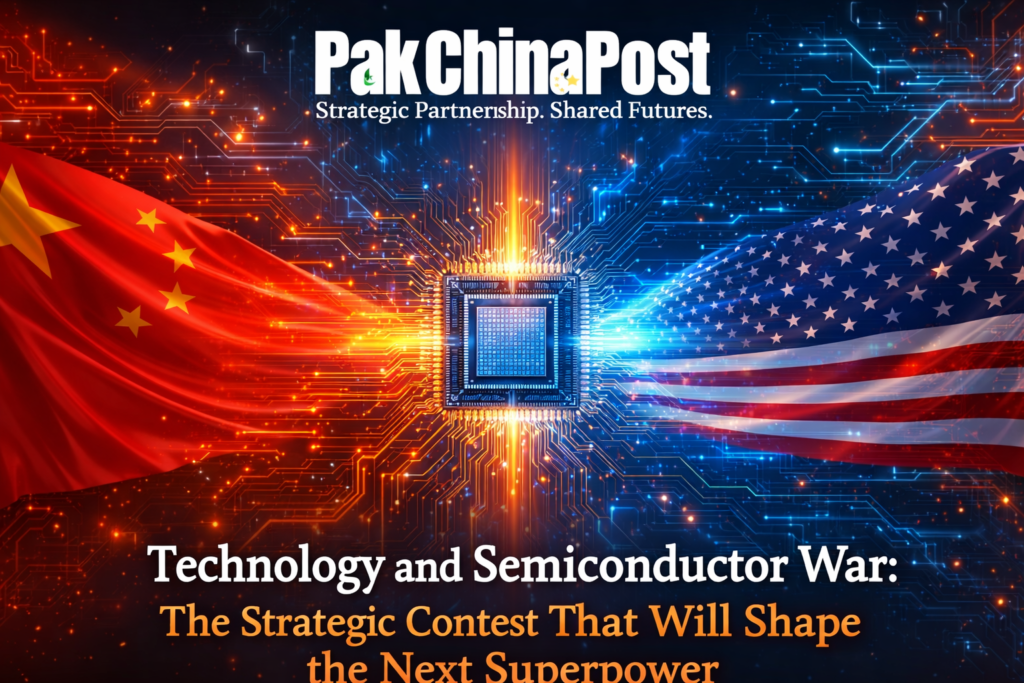
The rivalry between China and the United States has moved far beyond tariffs, diplomatic protests, or naval maneuvers. At its core, the defining battlefield of the twenty first century lies in technology. Control over advanced innovation ecosystems, semiconductor supply chains, artificial intelligence platforms, telecommunications infrastructure, and quantum computing research has become central to national power. The competition is no longer simply about economic growth. It is about shaping the architecture of global influence, military superiority, financial systems, and digital governance. The country that secures technological dominance will likely set the rules of the next international order. The United States entered the modern era as the undisputed leader in advanced research, digital platforms, semiconductor design, aerospace engineering, and defense innovation. China, however, has rapidly transformed itself from a manufacturing hub into a serious technological competitor. What began as economic interdependence has evolved into a strategic contest, and increasingly into a form of technological decoupling. Export controls, investment screening, supply chain restrictions, and competing standards are redefining the global landscape.
Technology is not merely a sector of competition. It is the foundation upon which military power, economic resilience, and political influence are built. Artificial intelligence enhances weapons systems and economic forecasting. Advanced semiconductors power everything from smartphones to missile guidance. Fifth generation telecommunications networks shape global data flows. Quantum computing promises to disrupt encryption and cybersecurity. Each of these domains intersects with national security. As a result, the technology race between China and the United States has become the defining axis of their relationship. The semiconductor industry sits at the center of this rivalry. Semiconductors are the essential components inside computers, medical devices, automobiles, satellites, and modern defense systems. Advanced chips determine the performance of artificial intelligence systems and military platforms. The global semiconductor supply chain is extraordinarily complex. Design often occurs in the United States, fabrication in East Asia, equipment production in Europe, and assembly in multiple countries. This interdependence once promoted efficiency. Today, it exposes vulnerabilities.
The United States has taken decisive steps to restrict China’s access to the most advanced semiconductor technologies. Export controls limit the sale of high end chips and advanced manufacturing equipment. Restrictions also apply to software tools required for designing and producing cutting edge processors. These measures aim to slow China’s progress in high performance computing and military modernization. Washington views advanced semiconductor capacity as a strategic asset that must not be leveraged by a geopolitical rival. China, in response, has accelerated efforts to build domestic semiconductor capability. Massive state funding supports fabrication plants, research institutions, and talent recruitment. National strategies emphasize self reliance in core technologies. The logic is clear. Dependence on foreign chip supply chains creates vulnerability. If access can be restricted during times of tension, technological development can stall. Therefore, achieving indigenous production of advanced chips is not simply an economic goal for Beijing. It is a matter of strategic survival.
Artificial intelligence represents another crucial front in this technology contest. AI systems are transforming industries ranging from healthcare to finance. In the military domain, AI enhances surveillance, autonomous weapons, logistics, and strategic planning. The United States has historically led in foundational AI research, particularly through its universities and private technology firms. However, China has made rapid advances, fueled by large data sets, strong state coordination, and substantial investment. AI competition extends beyond innovation to governance. The country that sets global AI standards may influence how data privacy, surveillance, and algorithmic accountability are handled worldwide. Competing models of digital governance are emerging. The United States promotes open innovation frameworks tied to private enterprise and democratic oversight. China emphasizes state guided development and integrated civil military fusion. The winner in AI leadership may shape not only technological infrastructure but also political norms.
Fifth generation telecommunications networks, commonly known as 5G, illustrate how infrastructure becomes geopolitically sensitive. Control over 5G networks means influence over data transmission, industrial automation, and smart city architecture. Chinese telecommunications firms expanded rapidly across global markets, offering cost effective infrastructure. The United States raised security concerns, arguing that such networks could be vulnerable to state influence or espionage. As a result, several countries faced pressure to choose suppliers aligned with either Washington or Beijing. Telecommunications thus became a proxy arena for broader strategic competition. Quantum computing represents the next horizon. Though still in developmental stages, quantum systems promise computational power far beyond classical machines. Such capabilities could break current encryption standards, revolutionize materials science, and transform artificial intelligence. Both China and the United States invest heavily in quantum research laboratories and academic partnerships. The stakes are enormous. If one country achieves a breakthrough in scalable quantum computing, it could gain decisive advantage in cybersecurity and defense.
The technology rivalry is not occurring in isolation. It intersects with military modernization. Advanced chips power hypersonic missile systems, satellite networks, and secure communications. AI supports battlefield analytics and drone swarms. Quantum encryption could secure military transmissions. Technological leadership thus translates directly into defense capability. Strategic planners in both Beijing and Washington understand that technological inferiority could mean military vulnerability. Economic influence is also at stake. Technology companies drive productivity growth and global investment flows. Nations that dominate emerging sectors capture supply chains, intellectual property revenues, and high value employment. The United States built its post Cold War prosperity partly on technological leadership in software, microelectronics, and internet platforms. China seeks to replicate and potentially surpass this trajectory. Programs aimed at upgrading industrial capacity focus on robotics, biotechnology, aerospace, and advanced materials.
The competition has introduced a new phase of industrial policy in both countries. The United States has increased public investment in domestic semiconductor manufacturing and research incentives. Supply chain resilience has become a strategic priority. China continues to deploy state subsidies and long term planning frameworks to accelerate innovation. What was once a globalized technology ecosystem is gradually fragmenting into parallel spheres of influence. This fragmentation affects allies and partners. Countries in Europe, Asia, and beyond face strategic decisions about supply chains, research collaboration, and market access. Should they align with American export controls or maintain economic engagement with China’s expanding market? The answer often depends on national security assessments, economic dependencies, and political values. The technology war thus radiates outward, shaping global alliances.
One of the most consequential aspects of this rivalry is talent competition. Innovation requires skilled engineers, researchers, and entrepreneurs. For decades, the United States benefited from attracting international talent to its universities and technology firms. China has invested heavily in education, research infrastructure, and incentives to retain domestic scientists. The race for intellectual capital is as critical as the race for physical semiconductor fabrication plants. Cybersecurity and digital sovereignty further complicate the landscape. As digital infrastructure expands, vulnerabilities increase. Both nations accuse each other of cyber espionage and intellectual property theft. Defensive measures include stricter investment screening and protection of sensitive research. The line between civilian innovation and military application grows increasingly blurred.
Despite the competitive tone, complete technological decoupling remains difficult. Global supply chains are deeply integrated. Many multinational companies operate across both markets. Semiconductor equipment suppliers rely on global customers. Software platforms integrate international development teams. An abrupt separation would impose significant economic costs on all sides. Yet strategic mistrust continues to push toward selective decoupling in the most sensitive technologies. The broader question is whether technological supremacy equates to superpower status. Historically, leadership in transformative technologies has correlated with geopolitical dominance. Industrialization propelled nineteenth century empires. Nuclear technology reshaped mid twentieth century power balances. Information technology defined late twentieth century American influence. Today, mastery of semiconductors, artificial intelligence, telecommunications, and quantum systems may determine the hierarchy of the twenty first century.
For China, technological leadership aligns with aspirations of national rejuvenation and global influence. For the United States, preserving innovation leadership is tied to maintaining its role as the central architect of international institutions and security frameworks. The stakes are therefore existential in strategic terms. The rivalry also carries risks. Rapid escalation of export controls can disrupt global markets. Excessive nationalism may undermine collaborative scientific research that benefits humanity. A fragmented technological order could slow innovation and reduce efficiency. There is a delicate balance between protecting national security and sustaining global scientific exchange.
The outcome of this technology and semiconductor war remains uncertain. The United States retains strengths in advanced research universities, venture capital ecosystems, and foundational semiconductor design. China possesses advantages in scale, manufacturing capacity, state coordination, and a vast domestic market. Both sides continue to innovate and adapt policies. Ultimately, the defining factor may not be isolated breakthroughs but the ability to integrate technology into broader national strategy. Leadership requires aligning research institutions, industrial capacity, military planning, regulatory frameworks, and international partnerships. Whichever nation successfully harmonizes these elements will likely shape the digital architecture of the global future.
The contest between China and the United States is therefore not only about chips or algorithms. It is about whose technological standards, governance models, and strategic vision will dominate. Whoever prevails in this competition will not simply enjoy economic advantage. They will influence how information flows, how security is maintained, and how societies function in an increasingly digital world. In this sense, the technology and semiconductor war is the defining struggle of our era, and its outcome will determine who stands as the next superpower in the evolving international order.
A Public Service Message