Pakistan Balances Riyadh Beijing In Fragmented Regional Order


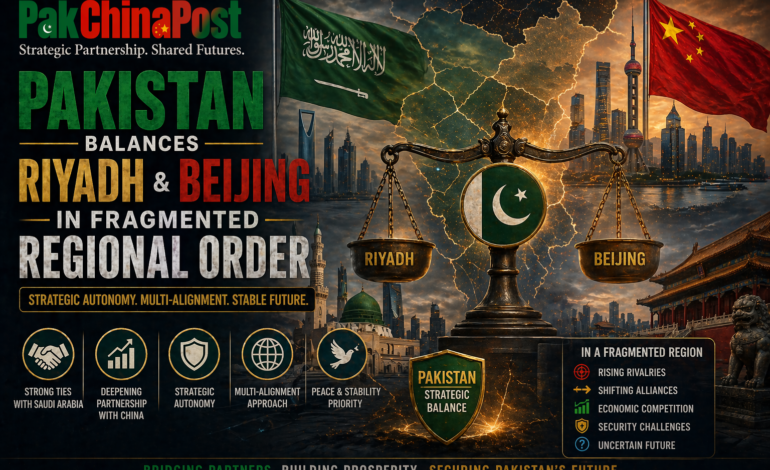
Pakistan’s contemporary foreign policy is increasingly defined by an intricate and unstable equilibrium between two structurally different centres of power, China and Saudi Arabia, within a wider international system that has moved beyond predictable polarity into fragmented multipolarity. The old vocabulary of alliance politics no longer fully explains Islamabad’s external behaviour. Instead, what is emerging is a form of calibrated survival diplomacy, where economic necessity, strategic geography, and political volatility intersect in constantly shifting combinations.
In 2026, this triangular relationship is shaped less by ideology and more by asymmetries of time, capital, and strategic expectation. China represents long horizon structural investment, embedded in infrastructure corridors, industrial relocation strategies, and technological ecosystems linked to the China Pakistan Economic Corridor second phase. Saudi Arabia represents short horizon liquidity, stabilisation financing, energy arrangements, and labour driven remittance flows that remain essential for Pakistan’s external account equilibrium. Between these two poles, Pakistan is not choosing alignment but attempting continuous adjustment under constraint.
The global context amplifies this tension. The international economy is no longer organised around stable blocs but around overlapping networks of energy security arrangements, digital governance ecosystems, and regional connectivity frameworks. The fragmentation of globalisation has produced what analysts increasingly describe as selective interdependence, where states are deeply connected in some domains and partially decoupled in others. Pakistan’s external relations reflect this condition in its purest form.
China’s engagement with Pakistan has evolved significantly beyond its earlier infrastructure centric phase. In the current phase, Chinese policy emphasizes industrial relocation, supply chain diversification, and integration of Pakistan into broader Eurasian production systems. Special economic zones are no longer isolated projects but components of a wider attempt to reconfigure regional manufacturing geography. Mining partnerships, agricultural modernization initiatives, and digital infrastructure expansion are being positioned as the next frontier of bilateral cooperation.
This shift has important geopolitical implications. It embeds Pakistan into China’s long term strategy of reducing exposure to maritime vulnerabilities and over concentration of manufacturing in coastal regions. Pakistan’s geographic position along the Arabian Sea and its proximity to Central Asian corridors make it structurally relevant to this diversification strategy. However, this relevance does not automatically translate into economic transformation. Execution capacity, governance stability, and energy reliability remain persistent constraints.
Saudi Arabia’s role in Pakistan’s external economy has also evolved. The kingdom’s Vision 2030 transformation agenda has reoriented its global financial behaviour, shifting from passive oil rent redistribution to active sovereign investment deployment across infrastructure, logistics, and technology sectors. For Pakistan, this has meant a more strategic form of engagement, including investment discussions, energy payment restructuring, and labour export stabilization frameworks.
Yet Saudi engagement remains fundamentally liquidity driven. It is designed to stabilise balance of payments pressures rather than restructure Pakistan’s production base. This creates a structural divergence between Saudi and Chinese economic logics. One is corrective and short term, the other is transformative and long term. Pakistan must operate simultaneously within both logics, often under conditions of fiscal stress and political uncertainty.
This dual dependency generates what can be described as asymmetric strategic balancing. Unlike classical Cold War balancing, which involved clear alignment choices, Pakistan’s current positioning requires simultaneous engagement with multiple external systems without full absorption into any of them. This produces a diplomatic posture that is flexible but structurally exposed to external shocks.
The complexity of this balancing act has intensified due to shifting global energy and security dynamics. Volatility in Middle Eastern energy markets, periodic escalation between regional powers, and recalibration of United States engagement in the Gulf have created a fluid environment in which financial assistance, energy pricing, and strategic partnerships are increasingly interlinked. Pakistan is directly affected by these fluctuations through fuel imports, remittance flows, and external financing conditions.
China’s growing role in Gulf diplomacy further complicates this landscape. Beijing’s expanding involvement in energy security dialogues and selective mediation efforts positions it as an increasingly important actor in regions traditionally influenced by Western strategic frameworks. This creates indirect overlap between Chinese and Saudi strategic interests, particularly in areas of infrastructure investment and energy corridor development.
Pakistan’s position within this overlapping system is both advantageous and vulnerable. It benefits from diversified external partnerships but also faces the risk of overexposure to competing expectations. Saudi Arabia expects financial discipline and labour market cooperation. China expects long term policy stability and corridor security. Multilateral institutions expect fiscal consolidation and structural reform. These expectations do not always align.
Within this context, Pakistan’s policy space is defined less by choice and more by constraint management. External dependency limits autonomy, but geographic positioning ensures continued relevance. This paradox lies at the heart of Pakistan’s contemporary foreign policy challenge.
Another dimension of this triangle is the evolving role of infrastructure diplomacy. Chinese financed projects in Pakistan are no longer viewed solely as economic assets. They function as strategic indicators of alignment and as material anchors of geopolitical connectivity. Ports, energy corridors, and industrial zones are interpreted by external actors as signals of Pakistan’s embeddedness in alternative global supply chain architectures.
Saudi Arabia, while not directly part of these infrastructure networks, interacts with them indirectly through investment flows, energy agreements, and financial stabilisation mechanisms. This creates a layered structure of interdependence where capital from the Gulf stabilises short term liquidity while Chinese investment shapes long term structural transformation.
The United States remains an indirect but influential factor in this configuration. Its selective engagement strategy in South Asia and the Middle East introduces an additional layer of uncertainty. Washington’s emphasis on strategic competition with China intersects with its continued interest in regional stability, counterterrorism cooperation, and energy security. Pakistan therefore operates in an environment where all three major external actors maintain partial but inconsistent engagement.
This inconsistency is critical. It prevents the formation of stable blocs and reinforces the logic of fragmented multipolarity. In such a system, states like Pakistan do not anchor themselves to fixed alliances but instead navigate overlapping systems of influence.
The result is a form of diplomatic modularity, where different external relationships are activated for different purposes. China for infrastructure and long term planning, Saudi Arabia for financial stabilisation, multilateral institutions for macroeconomic adjustment, and Western actors for selective technological and financial engagement. This modular structure increases flexibility but reduces predictability.
The sustainability of this model depends on internal coherence. Without domestic economic restructuring, export diversification, and institutional strengthening, external balancing becomes increasingly reactive rather than strategic. Each external shock requires ad hoc adjustment rather than coordinated response.
At the same time, Pakistan’s strategic geography ensures that it remains central to multiple connectivity visions. Whether through China’s Eurasian corridor system, Gulf energy logistics networks, or emerging Central Asian trade routes, Pakistan occupies a nodal position in overlapping regional architectures. This geographic centrality is both an opportunity and a burden.
The opportunity lies in potential transit revenues, industrial relocation, and geopolitical relevance. The burden lies in the need to maintain stability across multiple external expectations simultaneously.
In conclusion, Pakistan’s balancing act between Riyadh and Beijing is no longer a simple diplomatic exercise. It is a structural condition embedded in the fragmentation of global order itself. China provides depth, Saudi Arabia provides liquidity, and the international system provides volatility. Pakistan operates at the intersection of all three, constantly adjusting, recalibrating, and negotiating space within constraints that are increasingly systemic rather than temporary.
The future of this triangle will depend not only on external relations but on Pakistan’s ability to convert external engagement into internal resilience. Without that transformation, balancing will remain a necessity rather than a strategy, and equilibrium will remain temporary rather than institutionalised.
A Public Service Message