
Navigating Strategic Rivalry: China’s Response to the European Union’s Systemic Competitor Designation

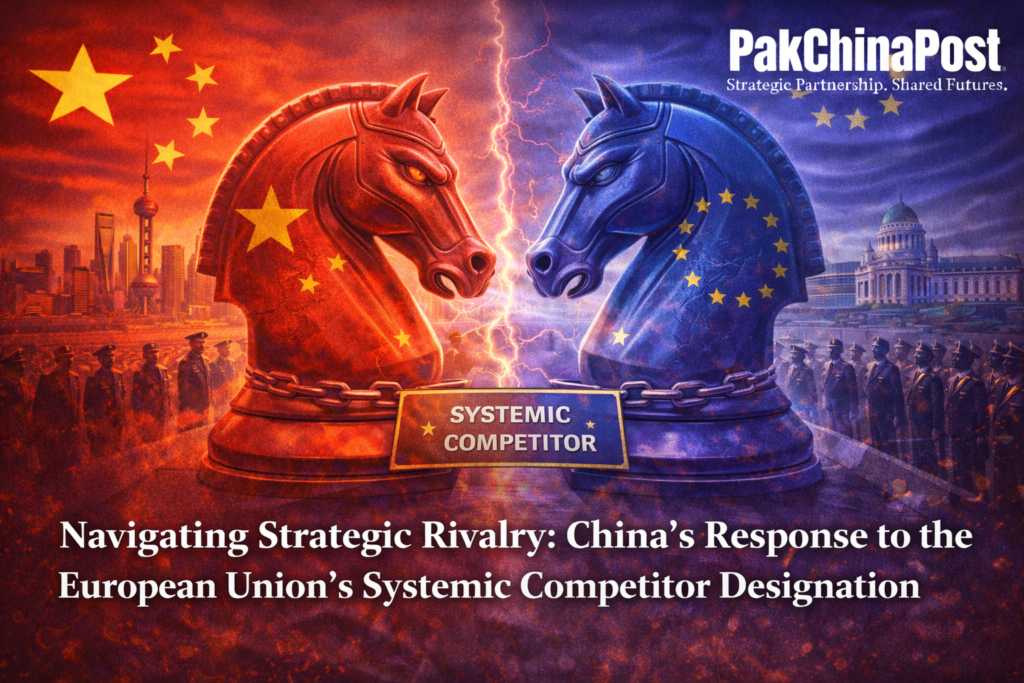
The evolving landscape of Europe-China relations has entered a critical juncture, marked by an increasingly pronounced perception of systemic rivalry. The European Union’s articulation of China as a “systemic rival” represents a formal recognition of the duality inherent in the relationship: China is simultaneously a vital economic partner and a strategic competitor. This dual perception reflects broader geopolitical shifts, technological anxieties, and security concerns, while also encapsulating the European effort to navigate between economic interdependence and strategic caution. For China, this development necessitates a recalibrated approach to engagement—one that safeguards its strategic and technological interests, maintains robust trade ties, and manages Europe’s apprehensions without precipitating unnecessary confrontation. Effectively navigating this complex duality requires a sophisticated understanding of European political and economic structures, perceptual dynamics, and the underlying motivations that shape policy-making within the EU framework.
The designation of China as a systemic rival is emblematic of Europe’s heightened sensitivity to issues of technological dominance, supply chain security, and geopolitical influence. Over the past decade, the EU has increasingly scrutinized Chinese investments in strategic sectors, ranging from advanced manufacturing and telecommunications to critical infrastructure and artificial intelligence. European policymakers express concern that China’s growing technological and industrial capabilities could undermine European competitiveness, create dependencies in sensitive sectors, and pose challenges to the integrity of European strategic autonomy. In this context, labeling China as a systemic rival functions as a signaling mechanism, clarifying the parameters within which engagement is deemed acceptable while reinforcing Europe’s commitment to defending its technological, economic, and security interests.
From China’s perspective, this classification poses both challenges and opportunities. On one hand, it highlights a perception gap: while China seeks to present itself as a cooperative global actor, capable of contributing to innovation, sustainable development, and multilateral governance, Europe perceives certain aspects of its rise as competitive or threatening. On the other hand, the recognition of China as a systemic rival underscores the significance of the EU as a partner: Europe is a market of unmatched sophistication, a hub of technological innovation, and a strategic actor whose policies influence global norms and supply chains. Consequently, China cannot afford disengagement; rather, it must craft a strategy that reconciles its systemic ambitions with the sensitivities and expectations of European stakeholders.
A central dimension of this strategy is technological diplomacy. Europe’s concerns about Chinese technological capabilities, particularly in sectors such as 5G, semiconductor production, artificial intelligence, and quantum computing, are predicated on potential risks to economic competitiveness and security. To address these concerns, China must emphasize transparency, regulatory alignment, and collaborative frameworks that demonstrate a commitment to mutually beneficial outcomes. Initiatives that involve joint research, standard-setting collaboration, and technology transfer agreements in non-sensitive sectors can showcase China’s willingness to engage constructively while maintaining its proprietary capabilities. Moreover, framing technological engagement within a narrative of shared innovation and sustainable growth can mitigate perceptions of unilateral advantage and foster a more balanced understanding of the bilateral technological relationship.
Economic interdependence represents another critical lever for managing systemic rivalry. Trade and investment remain foundational to EU-China relations, with Europe serving as a crucial destination for Chinese goods and a source of advanced technologies, capital, and knowledge. By reinforcing economic ties through initiatives that prioritize joint value creation, China can demonstrate the benefits of engagement despite strategic apprehensions. Mechanisms such as co-investment in infrastructure, sustainable energy projects, and industrial partnerships offer tangible proof of reciprocity and reduce the salience of competitive anxieties. Additionally, China can leverage its Belt and Road initiatives selectively, highlighting alignment with European sustainability and innovation priorities to reinforce the perception of constructive collaboration rather than coercive influence.
The strategic communication dimension is equally vital. Europe’s perception of China as a systemic rival is shaped not only by material interactions but also by narratives circulating in political discourse, media, and civil society. Cognitive biases, historical frames of reference, and domestic political dynamics amplify concerns regarding dependency, influence, and technological security. China must therefore adopt a comprehensive narrative management strategy, articulating its intentions, clarifying its strategic posture, and addressing European anxieties through consistent messaging. Engagement through think tanks, academic partnerships, and policy dialogues can reinforce these narratives, creating a more nuanced understanding of China’s actions and long-term objectives.
Security considerations add another layer of complexity to the systemic rivalry framework. European apprehensions regarding critical infrastructure, cyber capabilities, and strategic supply chains intersect with broader geopolitical calculations, particularly in light of transatlantic alignment with the United States. China’s response requires a careful balance: acknowledging European security concerns without compromising national strategic objectives, and seeking cooperative modalities that reduce the perception of threat. Confidence-building measures, such as transparency in investment practices, adherence to international norms, and dialogue on regulatory and operational standards, can help bridge the trust deficit. By signaling a willingness to engage responsibly in security-sensitive sectors, China can mitigate the adversarial framing implicit in the systemic rival designation.
The geopolitical dimension of systemic rivalry further complicates engagement. Europe’s positioning reflects both autonomous strategic calculation and the influence of external actors, particularly the United States, which encourages a cautious approach to China. For China, this necessitates sophisticated diplomacy that differentiates bilateral EU-China interactions from broader strategic contests while reinforcing the benefits of collaboration. Multilateral engagement, participation in regional initiatives, and adherence to international norms can signal China’s commitment to cooperative global governance, thereby counterbalancing perceptions of unilateralism or strategic assertiveness. By integrating these approaches, China demonstrates that its rise is compatible with European interests and global stability, reducing the salience of rivalry in the perception calculus.
Internal European dynamics must also be accounted for in China’s strategy. The EU is not a monolithic entity; member states vary in their economic dependencies, security perspectives, and political orientations. Germany, France, and Italy, for instance, exhibit differing appetites for engagement with China, reflecting industrial, technological, and historical priorities. China must adopt a calibrated approach that balances pan-European engagement with targeted bilateral initiatives, ensuring that its actions resonate with national priorities while maintaining coherence across the EU framework. This requires sophisticated diplomacy that identifies points of convergence, addresses sector-specific sensitivities, and mitigates intra-European divergence that could amplify strategic apprehensions.
Soft power remains an underutilized yet crucial dimension in managing systemic rivalry. Cultural diplomacy, educational exchange, and people-to-people initiatives provide channels to reduce cognitive biases and foster mutual understanding. By highlighting contributions to global challenges such as climate change mitigation, pandemic response, and sustainable development China can demonstrate alignment with European values and priorities. Effective deployment of soft power complements institutional and economic engagement, creating a holistic framework within which systemic rivalry is tempered by tangible cooperation and shared achievement.
Strategic patience and long-term vision underpin China’s response to the systemic rival label. While immediate reactions may emphasize defensive measures or assertive messaging, a durable approach requires incremental trust-building, institutionalized cooperation, and the gradual demonstration of reciprocal benefit. By embedding collaborative initiatives within multilateral structures, joint economic projects, and scientific partnerships, China creates a durable foundation for engagement that reduces the perceived zero-sum nature of the bilateral relationship. This approach also signals to Europe that systemic rivalry is not synonymous with inevitable conflict, but rather reflects a stage in a complex, evolving partnership.
In conclusion, the European Union’s designation of China as a systemic rival encapsulates the duality at the heart of contemporary relations: a juxtaposition of strategic competition and indispensable economic interdependence. China’s response must integrate technological diplomacy, economic engagement, strategic communication, security confidence-building, geopolitical nuance, soft power, and long-term vision. By carefully calibrating these dimensions, China can navigate the perception of rivalry, reinforce the benefits of partnership, and manage European apprehensions without compromising its strategic objectives. The systemic rival designation, while challenging, offers an opportunity for China to demonstrate sophistication, adaptability, and a commitment to constructive engagement establishing a framework for resilient, balanced, and mutually advantageous Europe-China relations in an era defined by complexity, interdependence, and strategic recalibration.
A Public Service Message