Narrative Rivalry Shapes South Asia Developmental Geopolitics Contest

By: Shafqat Ali Qureshi
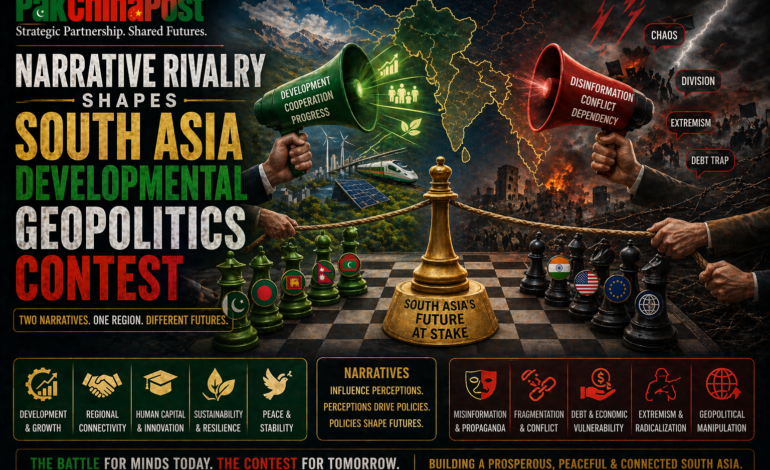
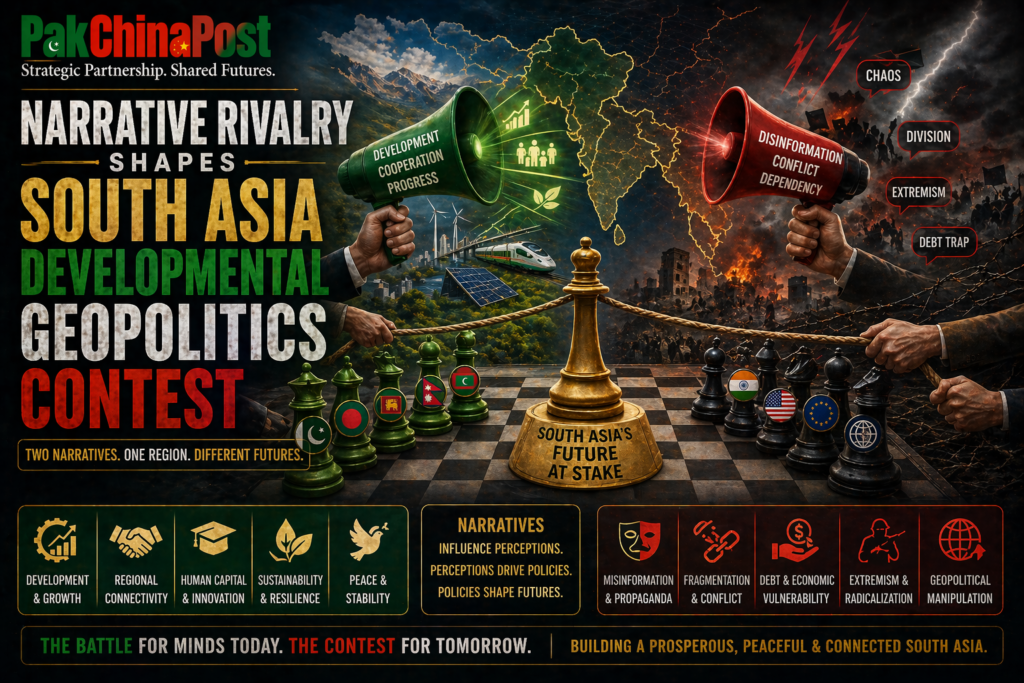
South Asia has entered a phase in which geopolitical competition is no longer defined solely by military balance, alliance formation, or territorial disputes, but increasingly by narrative architecture surrounding development, connectivity, and legitimacy of state performance. In this evolving environment, Pakistan has become a central theatre where competing global stories about progress, dependency, sovereignty, and modernisation are being constructed, contested, and continuously revised.
The most visible dimension of this contest is the growing prominence of China backed developmental diplomacy in Pakistan. Over the past decade and a half, infrastructure investment, energy cooperation, and industrial corridor development have produced not only material transformation but also a powerful narrative claim: that development can be achieved through state led connectivity without requiring ideological convergence with Western liberal institutional frameworks. This claim has gained renewed visibility in 2026 as the China Pakistan Economic Corridor enters its second phase of recalibration, shifting focus from basic infrastructure toward industrial relocation, agricultural restructuring, and digital integration.
This transition matters because it changes the epistemic foundation of development itself. The earlier phase of globalisation, dominated by Western institutional influence, defined development through governance indicators, financial liberalisation, and integration into multilateral regulatory regimes. The emerging China centered model, increasingly visible in Pakistan, defines development through material acceleration, infrastructure density, and production capacity expansion. These are not merely technical differences. They represent fundamentally different theories of how states achieve modernity.
Pakistan sits at the intersection of these competing developmental imaginaries. On one side, Chinese investment provides long horizon planning, physical infrastructure, and industrial policy frameworks that aim to restructure economic geography. On the other side, Western financial institutions and policy frameworks continue to influence macroeconomic stabilisation, fiscal discipline, and governance reform agendas. India, meanwhile, has increasingly positioned itself as a parallel developmental alternative in the region, promoting connectivity initiatives and digital infrastructure expansion aligned with Indo Pacific strategic frameworks.
The result is a triangular narrative competition in South Asia, where Pakistan becomes both subject and site of interpretation. Each major external actor constructs a different story about what Pakistan represents in the global system. For China, Pakistan is a corridor state linking Eurasian production networks to maritime routes. For Western strategic discourse, Pakistan often appears as a case study in debt exposure and institutional fragility within large scale infrastructure diplomacy. For India, Pakistan is frequently framed through the lens of strategic rivalry and alternative regional connectivity visions.
These narratives are not abstract. They directly influence investment flows, diplomatic engagement, and policy perception. Development projects are no longer evaluated only on economic grounds but also on their symbolic meaning within global strategic discourse. A highway, port, or industrial zone becomes simultaneously an economic asset and a geopolitical signal.
China’s approach in this narrative competition is distinctive in that it relies heavily on demonstration effects rather than discursive persuasion alone. Infrastructure delivery, energy generation capacity, and visible industrial projects serve as tangible evidence of developmental effectiveness. In Pakistan, this has created a layered perception environment where physical transformation is directly observable, even as macroeconomic challenges persist.
However, the sustainability of this narrative advantage depends on long term economic outcomes. Infrastructure without export growth, industrial productivity, or fiscal stability risks generating a perception gap between visible assets and structural economic health. This is where the developmental narrative becomes vulnerable to competing interpretations, particularly from Western and Indian analytical frameworks that emphasise debt sustainability, institutional resilience, and diversified partnership models.
In recent years, Western strategic discourse has increasingly framed China backed infrastructure diplomacy as a form of strategic dependency creation, highlighting risks related to debt exposure, fiscal rigidity, and limited economic diversification. India’s narrative approach combines elements of strategic competition with alternative connectivity proposals, particularly through regional initiatives that emphasise maritime routes, digital infrastructure, and Indo Pacific integration.
These competing narratives are not merely descriptive. They function as strategic instruments designed to influence third party perception, investment behaviour, and diplomatic alignment choices. South Asia thus becomes not only a region of geopolitical competition but also a laboratory of narrative warfare, where development itself is contested as an interpretive category.
Pakistan’s position in this environment is particularly complex. It is both a recipient of large scale Chinese infrastructure investment and a participant in Western financial and regulatory frameworks. It is simultaneously engaged with Gulf financial systems that provide critical balance of payments support. This creates a multi layered external dependency structure in which Pakistan is embedded in overlapping systems of economic governance and strategic influence.
This structural positioning limits narrative autonomy. Pakistan cannot fully align with any single developmental narrative without incurring economic or diplomatic costs. Instead, it operates through selective engagement, adapting its external messaging depending on audience, context, and immediate economic necessity.
At the same time, Pakistan’s internal political and economic volatility complicates its ability to consolidate a consistent developmental narrative of its own. Policy discontinuity, fiscal constraints, and institutional fragmentation reduce the state’s capacity to project a stable long term developmental identity. This vacuum is then filled by external narratives, each interpreting Pakistan’s trajectory through its own strategic lens.
The China Pakistan narrative, however, has gained particular durability because it is anchored in physical infrastructure and long term planning cycles rather than short term policy statements. This gives it a degree of resilience in comparison to purely discursive narratives. Yet resilience should not be confused with dominance. Narrative competition remains active, and interpretive authority is continuously contested.
One of the emerging features of this competition is the increasing role of digital media ecosystems in shaping developmental perception. Infrastructure projects are now evaluated not only through official reports but also through real time digital representation, social media framing, and transnational analytical commentary. This accelerates narrative diffusion but also increases volatility in perception cycles.
Another important dimension is the growing integration of climate and sustainability discourse into development narratives. Western frameworks increasingly emphasise environmental impact, green transition pathways, and climate aligned financing structures. China has responded by integrating green infrastructure components into its external projects, including in Pakistan, thereby attempting to align material development with emerging global sustainability standards.
This convergence introduces a new layer of narrative complexity. Development is no longer contested only in terms of economic growth versus institutional reform, but also in terms of carbon intensity, energy transition pathways, and climate resilience metrics. Pakistan, as a developing economy with high energy demand and climate vulnerability, becomes a key site where these competing standards intersect.
Ultimately, the narrative competition in South Asia reflects a deeper transformation in global geopolitics. Power is no longer expressed solely through military alliances or trade dominance, but through the ability to define how development itself is understood. Control over narrative frameworks becomes a form of structural influence.
In this evolving environment, Pakistan is not merely a passive recipient of external narratives. It is also an active site where these narratives are tested, contested, and partially reshaped through implementation realities. Infrastructure outcomes, economic performance, and governance capacity all feed back into how external actors adjust their interpretations.
The future of this narrative competition will depend on whether any single developmental model can translate its claims into sustained, inclusive, and resilient economic outcomes. Until then, South Asia will remain a contested narrative space, and Pakistan will continue to function as one of its most strategically significant interpretive battlegrounds, where infrastructure, ideology, and international perception intersect in real time.
A Public Service Message