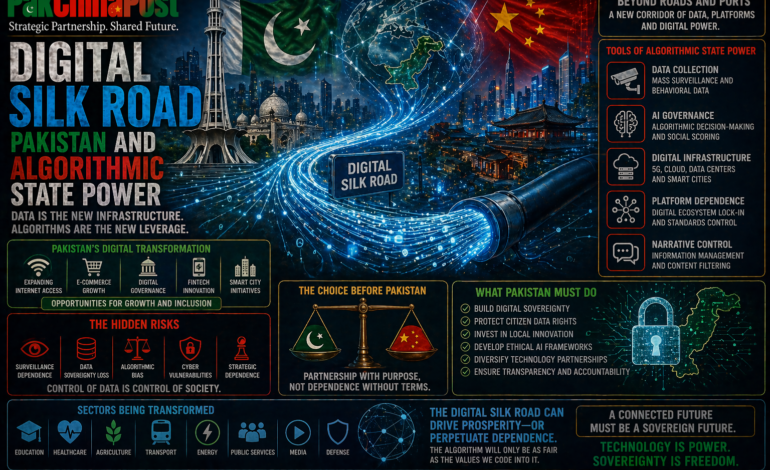
Digital Silk Road Pakistan and Algorithmic State Power

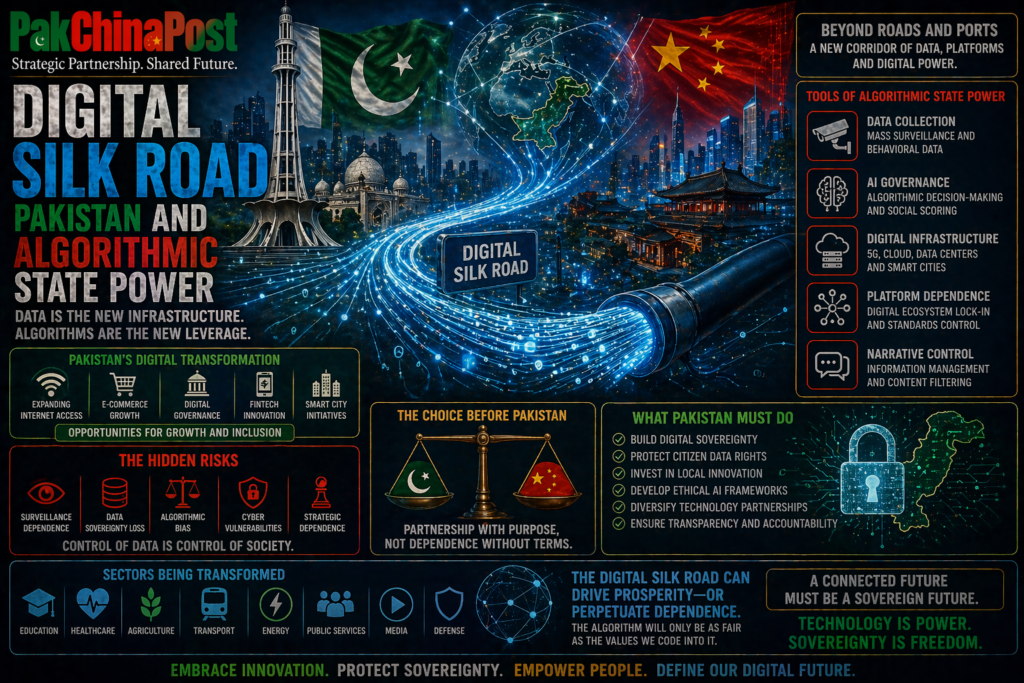
Pakistan’s gradual insertion into China’s Digital Silk Road is no longer a speculative projection of future connectivity. It is an unfolding institutional reality reshaping how the state sees, measures, and governs society. What began as infrastructure cooperation under the China Pakistan Economic Corridor has increasingly evolved into a deeper technological embedding, where digital platforms, artificial intelligence systems, fintech architecture, telecom networks, and surveillance enabled governance tools are converging into a parallel layer of state capacity. This is not merely about faster internet or modernized banking systems. It is about the transformation of sovereignty through data.
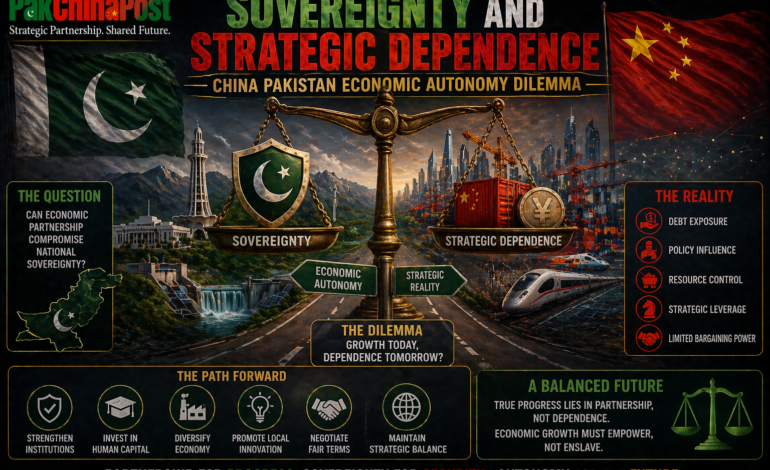
At the heart of this transformation lies a subtle but consequential shift. The traditional state derived authority from territory, population, and administrative hierarchy. The emerging model of governance increasingly derives authority from data extraction, algorithmic prediction, and platform integration. In Pakistan’s case, this shift is being accelerated through Chinese supported digital infrastructure, including expanding fifth generation telecom networks, fiber optic connectivity, smart surveillance deployments in urban centers, and the gradual digitization of financial and identity systems. These are not isolated technological upgrades. They are interconnected components of a broader architecture of digital governance.
The promise attached to this transformation is compelling. Pakistan has long struggled with fragmented administrative systems, tax leakage, weak financial inclusion, and limited institutional reach into informal sectors. Digital integration, in theory, offers a shortcut to state capacity. Mobile banking platforms linked to biometric identity systems can widen fiscal capture. Artificial intelligence based monitoring can improve urban management. Integrated customs and logistics systems can reduce inefficiencies in trade. In this narrative, Chinese digital infrastructure becomes a force multiplier for a state constrained by limited bureaucratic depth.
Yet the same architecture that enhances efficiency also reconfigures control. The expansion of digital systems embedded within critical governance functions raises fundamental questions about dependency, autonomy, and visibility. When core digital infrastructure is designed, financed, and in many cases operated through external technological ecosystems, the question is not only what the state can see, but who enables the state to see.
The Digital Silk Road, as it is materializing in Pakistan, is best understood as a layered ecosystem rather than a single project. At the base layer lies physical infrastructure such as fiber optic cables, data centers, and telecom towers. Above this sits the platform layer, including mobile payment systems, e governance portals, and logistics management tools. At the top is the intelligence layer, where data is aggregated, processed, and translated into actionable insights through artificial intelligence systems. Each layer deepens interdependence, but also embeds structural asymmetries in technological control.
Chinese firms, often in partnership with Pakistani state institutions, are central to this stack. Their role extends beyond construction into system design, maintenance, and algorithmic optimization. This creates a situation where sovereignty is no longer simply about ownership of infrastructure, but about access to the logic embedded within systems that govern daily life. The state may operate these systems, but the architecture of decision making is increasingly encoded in platforms developed elsewhere.
This shift becomes particularly significant in the domain of surveillance and security governance. Urban surveillance systems integrated with facial recognition technologies and predictive monitoring tools are being deployed in major Pakistani cities under public safety narratives. These systems are capable of processing vast streams of visual and behavioral data in real time. In principle, they enhance law enforcement efficiency and deterrence capacity. In practice, they also expand the informational reach of the state in ways previously impossible.
However, surveillance is never purely a domestic instrument when its technological backbone is external. The calibration of algorithms, the storage of data, and the governance of system updates all become sites of transnational interaction. This raises difficult questions about data sovereignty. Who ultimately controls the metadata generated by millions of daily interactions within digital systems. Who defines the thresholds of risk detection. Who audits algorithmic bias. These questions remain largely unresolved within existing regulatory frameworks.
Financial technology represents another critical vector of transformation. Pakistan’s push toward digital payments, mobile wallets, and integrated financial platforms aligns closely with Chinese fintech experience. Digital payment ecosystems reduce friction in transactions and expand formal financial participation. They also generate granular behavioral data on consumption, savings, and mobility patterns. This data becomes a valuable asset not only for domestic policy making but also for external technological partners involved in system architecture.
In traditional economic models, financial systems are instruments of intermediation. In digital ecosystems, they become instruments of behavioral mapping. Every transaction becomes a data point. Every data point becomes a potential input for predictive modeling. This introduces a new form of economic visibility that can strengthen taxation and planning capacity but also intensifies concerns about surveillance capitalism, particularly when platform ownership is not fully domestic.
Telecommunications infrastructure sits at the core of this transformation. The rollout of advanced mobile networks is often presented as a technical upgrade. In reality, it forms the circulatory system of digital governance. Without telecom connectivity, neither fintech systems nor surveillance architectures can function at scale. Chinese telecom firms have played a central role in this expansion, providing both hardware and software ecosystems that underpin national connectivity.
This deep integration creates what can be described as infrastructural lock in. Once a state builds critical systems on a specific technological stack, switching costs become prohibitively high. This is not unique to Pakistan, but the asymmetry becomes more pronounced when domestic technological alternatives remain limited. Over time, dependency shifts from financial to operational and eventually to cognitive, where even policy design begins to assume the presence of certain external technological capabilities.
The implications for state capacity are therefore paradoxical. On one hand, Pakistan gains access to technologies that would otherwise be financially or technically inaccessible. On the other hand, the internal coherence of its digital governance system becomes increasingly intertwined with external actors. This duality defines the contemporary condition of digital sovereignty in many developing states, where capacity expansion and dependency formation occur simultaneously.
There is also a geopolitical dimension that cannot be ignored. The Digital Silk Road is not simply a commercial initiative. It is embedded within a broader contest over global technological standards, data governance regimes, and platform ecosystems. As different models of digital governance compete globally, Pakistan finds itself situated within a Chinese centered technological orbit, while still maintaining economic and diplomatic ties with Western systems. This creates a complex balancing act in which technological alignment and geopolitical alignment are no longer easily separable.
The critical question is not whether digital integration is beneficial or harmful in absolute terms. The more important question is how asymmetries within that integration are structured, governed, and negotiated. If data generated within Pakistan is stored, processed, or monetized outside its regulatory jurisdiction, then the concept of sovereignty requires redefinition. If algorithmic systems embedded in governance processes are opaque to domestic oversight, then accountability structures must evolve accordingly.
At the same time, it would be simplistic to interpret this transformation solely through the lens of dependency. Pakistan is not a passive recipient of technology. It is actively shaping how systems are deployed, adapted, and localized. The effectiveness of digital governance ultimately depends on institutional capacity, regulatory frameworks, and political will. Technology can extend the reach of the state, but it cannot substitute for governance quality.
Moreover, digital systems can also create new opportunities for institutional reform. Tax collection systems linked to digital transactions can broaden fiscal space. Integrated identity systems can reduce duplication and fraud. Logistics platforms can improve trade efficiency. In a constrained fiscal environment, these gains are not trivial. They represent tangible improvements in administrative functionality.
The tension, therefore, is not between technology and sovereignty, but between different models of sovereignty. One model emphasizes autonomy through control over infrastructure and data. The other emphasizes functional capacity through integration into global technological ecosystems. Pakistan’s current trajectory suggests a gradual movement toward the latter, shaped in part by strategic partnership with China.
What remains uncertain is the long term institutional equilibrium that will emerge from this process. Will Pakistan develop sufficient domestic technological expertise to gradually internalize and localize these systems. Or will it remain structurally dependent on external platforms for core governance functions. The answer will depend not only on technology transfer but on education, regulatory design, and industrial policy.
In the broader context of global digital transformation, Pakistan’s experience reflects a wider pattern across developing economies. The diffusion of artificial intelligence, surveillance technologies, and digital finance is creating new hierarchies of capability. States that can integrate these systems effectively may experience rapid gains in administrative efficiency. Those that cannot may find themselves increasingly governed through externally designed infrastructures.
The Digital Silk Road, in this sense, is not just a corridor of connectivity. It is a corridor of governance transformation. It reshapes how states function internally, how they interact externally, and how they conceptualize power in an age where information flows are as strategic as physical borders.
Pakistan stands at an inflection point within this transformation. The choices it makes regarding regulation, localization, and technological capacity building will determine whether digital integration becomes a platform for sovereignty enhancement or a mechanism of structural dependency. The outcome is not predetermined. It is being negotiated in real time, through infrastructure, institutions, and the quiet but powerful logic of algorithms.
A Public Service Message