Sovereignty And Strategic Dependence China Pakistan Economic Autonomy Dilemma

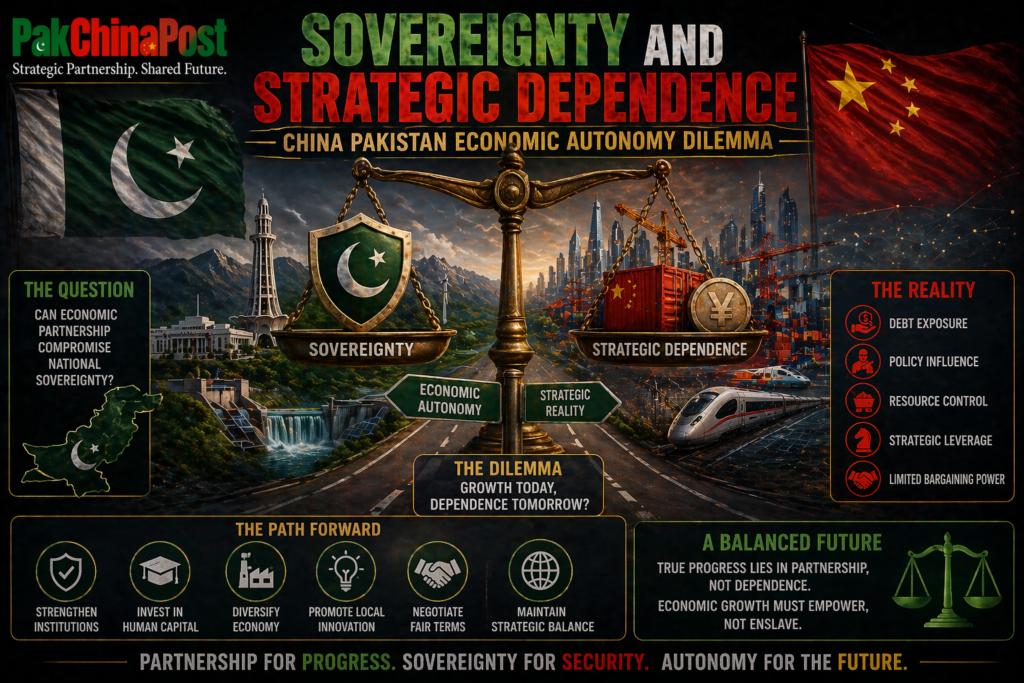
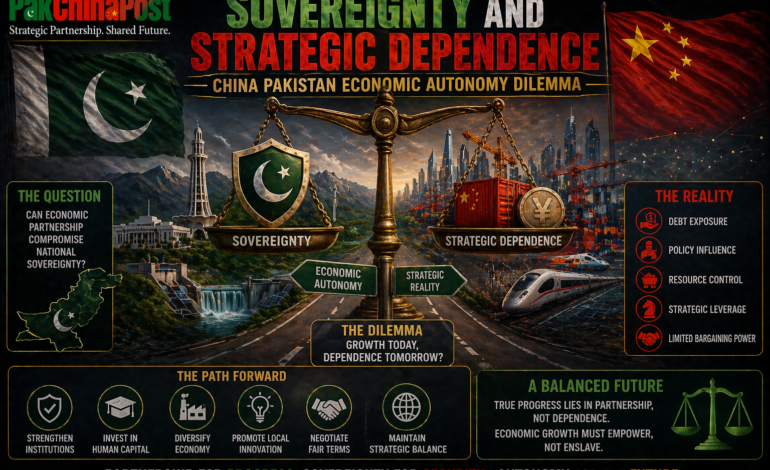
Sovereignty in the twenty first century is no longer a purely juridical condition defined by territorial control or constitutional independence. It has evolved into a more complex and relational construct shaped by financial interdependence, infrastructural embedding, and technological integration. Within this evolving global structure, Pakistan’s deepening engagement with China through CPEC raises a fundamental analytical question: does reliance on Chinese capital, infrastructure, and strategic coordination gradually narrow Pakistan’s autonomous policy space, or does it merely reposition sovereignty within a more multipolar framework?
The answer is not binary, but the trajectory of dependency relations does suggest a gradual tightening of structural constraints on discretionary economic policymaking. This does not imply loss of sovereignty in a formal sense, but rather a reconfiguration of sovereignty into a negotiated and conditional form, where domestic policy decisions increasingly operate within externally shaped parameters of feasibility, expectation, and financial viability.
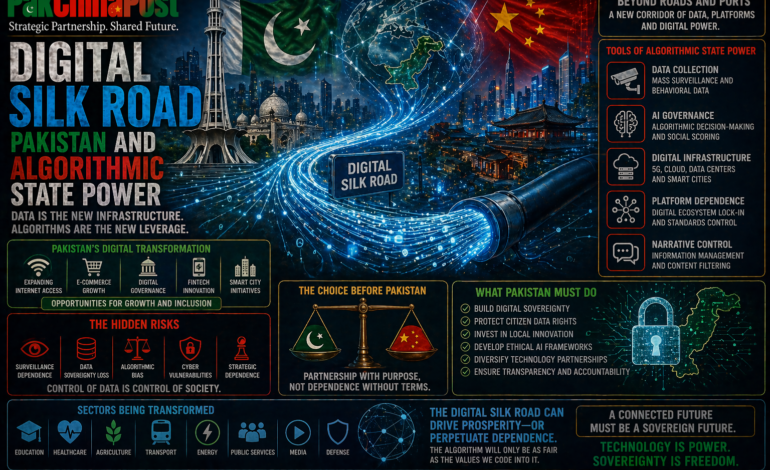
CPEC represents one of the most extensive instances of bilateral economic integration between a developing state and a major global power in recent history. Its scope spans energy generation, transport infrastructure, industrial zones, and emerging digital connectivity frameworks. Such depth of integration inevitably creates interlocking systems of dependency. When infrastructure, energy supply chains, and industrial financing are structurally linked to a single external partner, policy autonomy becomes embedded within that relationship.
This embeddedness is not inherently coercive. China’s approach to overseas development financing is generally characterized by project-based lending rather than explicit political conditionality. Unlike traditional Western financial institutions that often attach governance reforms to macroeconomic assistance, Chinese financing tends to focus on physical outputs. However, absence of formal conditionality does not imply absence of structural influence. Influence in such systems operates through dependency pathways rather than direct policy imposition.
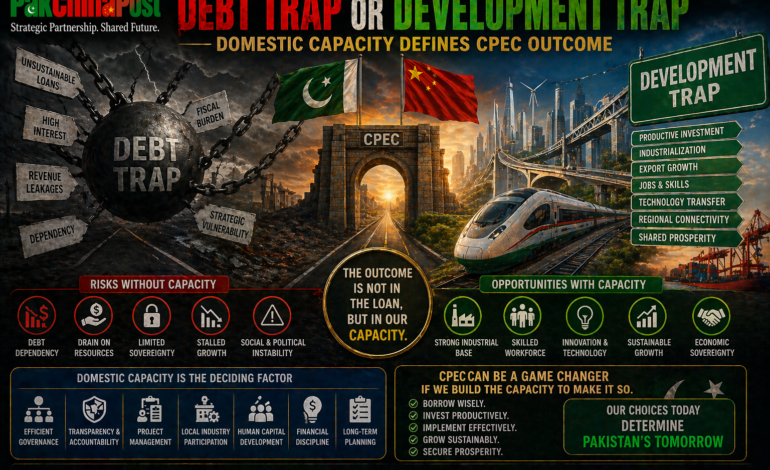
For Pakistan, this dependency manifests most clearly in energy and infrastructure sectors. Long-term power purchase agreements, sovereign guarantees, and repayment obligations create fiscal commitments that must be honored regardless of domestic political cycles. These commitments constrain fiscal flexibility, particularly during periods of external balance stress. When a significant portion of energy infrastructure is tied to external financing structures, domestic policy options regarding pricing, subsidies, and redistribution become narrower.
The strategic dimension of this relationship extends beyond economics. Infrastructure corridors such as CPEC are not neutral economic spaces; they are embedded within broader geopolitical architectures. Connectivity routes linking western China to the Arabian Sea carry strategic implications for regional trade patterns, energy security, and maritime access. This elevates Pakistan’s geographic position from a purely national asset to a component within a larger transregional strategy.
In such contexts, sovereignty becomes partially relational. Policy autonomy is exercised, but within a framework where external strategic interests and domestic economic imperatives intersect. This does not eliminate agency, but it reshapes its contours. Decisions related to tariffs, taxation in Special Economic Zones, regulatory frameworks, and infrastructure prioritization are increasingly influenced by the need to maintain long-term investor confidence and project continuity within the CPEC ecosystem.
One of the most significant mechanisms of indirect influence is anticipatory alignment. Domestic policymakers often adjust regulatory and fiscal decisions in anticipation of external partner expectations, even in the absence of explicit pressure. This form of self-adjustment is subtle but powerful, as it internalizes external preferences into domestic decision-making processes. Over time, such anticipatory behavior can narrow the perceived range of policy options.
However, it is important to distinguish between dependency and determinism. Pakistan retains formal sovereignty and retains the ability to renegotiate, restructure, or diversify its external partnerships. The presence of multiple financial partners, including multilateral institutions and Gulf economies, introduces counterbalancing forces. Yet diversification does not automatically translate into autonomy if internal institutional capacity remains weak. In fragmented institutional environments, multiple dependencies can produce policy incoherence rather than strategic independence.
The critical issue, therefore, is not simply external dependence, but the interaction between external dependence and internal fragmentation. Where governance structures are strong, external capital can be absorbed and managed without significant loss of autonomy. Where institutions are weak, external capital becomes structurally embedded in ways that constrain policy discretion.
Energy sector arrangements under CPEC illustrate this dynamic clearly. Long-term contractual obligations tied to foreign investment in power generation require guaranteed returns, often backed by sovereign commitments. While these arrangements have alleviated chronic energy shortages, they also create rigid fiscal obligations that limit space for discretionary economic planning. During periods of fiscal stress, these obligations become particularly constraining, as they must be prioritized to maintain creditworthiness and contractual credibility.
Industrial cooperation under CPEC 2.0 further extends this structural integration. Special Economic Zones are designed to attract export-oriented manufacturing, but their success depends on regulatory consistency, tax predictability, and institutional coordination. If policy frameworks fluctuate frequently, investor reliance on stable external guarantees increases. This, in turn, deepens the role of the external partner as a stabilizing anchor within the investment environment.
At the macro level, Pakistan’s external account vulnerabilities reinforce this dynamic. Persistent current account deficits, limited export diversification, and narrow tax bases increase reliance on external financing. In such a context, external capital becomes not merely supplementary but stabilizing. When external financing plays a stabilizing role, its strategic importance increases, and with it, its implicit influence over macroeconomic policy direction.
Yet sovereignty is not only constrained externally; it is also shaped internally by governance capacity. Weak tax collection, regulatory inefficiencies, and fragmented institutional authority reduce the state’s ability to independently finance development. This creates a structural dependence that precedes external relationships. In this sense, external partners do not create dependency; they operate within an existing dependency structure.
The geopolitical environment further complicates this equation. As global economic competition intensifies, infrastructure and connectivity projects increasingly acquire strategic significance. Pakistan’s position within these networks enhances its geopolitical relevance but also exposes it to competing expectations from multiple external actors. Managing these competing expectations requires high levels of institutional coordination, which remain uneven.
The central tension, therefore, is between sovereignty as formal independence and sovereignty as functional autonomy. Pakistan retains the former but experiences constraints in the latter. Functional autonomy refers to the ability to independently design and implement economic policy without excessive reliance on external validation or financing conditions. It is in this domain that CPEC introduces both opportunity and constraint.
CPEC can expand economic space by addressing infrastructure deficits, improving energy availability, and enhancing connectivity. At the same time, it can narrow policy space if domestic institutions fail to internalize and manage the resulting structural interdependence. The outcome is not predetermined; it is contingent on governance performance, policy coherence, and institutional reform.
Ultimately, the sovereignty question is not about whether Pakistan is becoming subordinate to China, but about how interdependence is managed within asymmetrical structures. All large-scale infrastructure partnerships generate asymmetries; the critical variable is whether those asymmetries are stabilized through institutional strength or amplified by institutional weakness.
If Pakistan strengthens its fiscal base, diversifies exports, improves regulatory predictability, and consolidates institutional coordination, CPEC can function as an instrument of expanded autonomy through enhanced economic capacity. If these reforms remain incomplete, however, the risk is not loss of sovereignty in a formal sense, but gradual erosion of discretionary policy space within a tightly interwoven external financing architecture.
In this sense, sovereignty under CPEC is neither fully retained nor fully surrendered. It is continuously negotiated, recalibrated, and redefined within the evolving structure of economic interdependence.
A Public Service Message