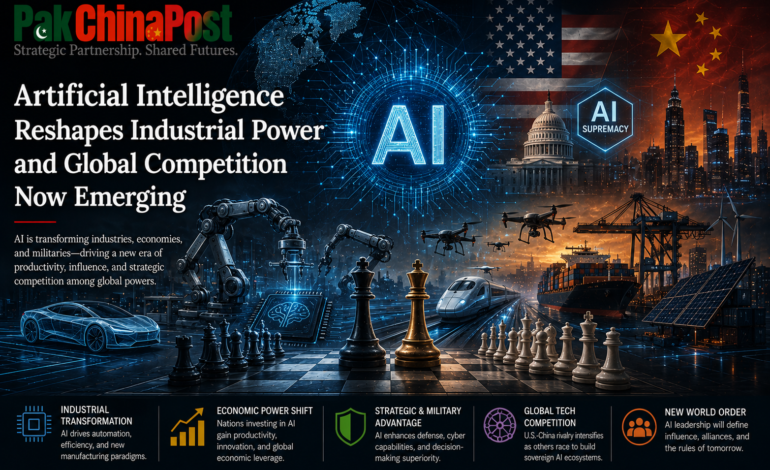
Artificial Intelligence Reshapes Industrial Power and Global Competition Now Emerging

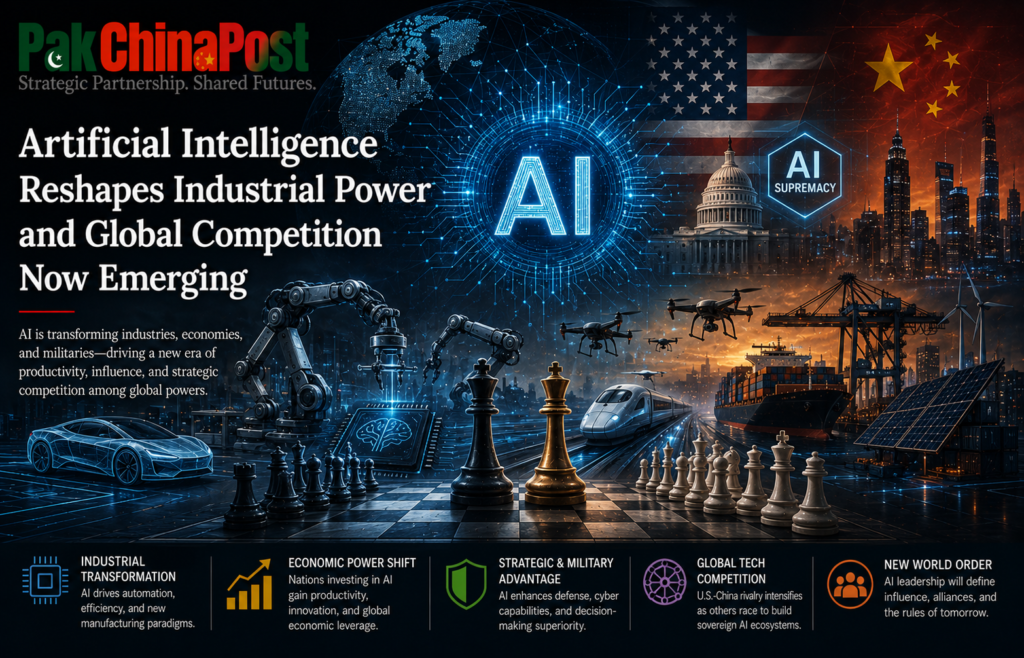
The global economic order is entering a phase in which artificial intelligence is no longer an auxiliary productivity enhancer but a structural determinant of industrial hierarchy, state capacity and geopolitical leverage. What is unfolding is not a linear technological transition but a systemic reconfiguration of power in which computation, data governance and algorithmic sovereignty are becoming as consequential as traditional factors of production such as land, labour and capital. The competitive logic among major economies has shifted decisively from market efficiency to state orchestrated technological accumulation, where industrial policy is no longer a corrective instrument but the central architecture of strategic competition.
The resurgence of industrial policy across advanced economies reflects a profound recalibration of assumptions that defined the post Cold War globalization paradigm. For decades, technological diffusion was assumed to follow market incentives, with capital naturally flowing toward efficiency maximizing outcomes. That assumption has been disrupted by the recognition that artificial intelligence systems depend on concentrated infrastructures of semiconductor fabrication, cloud computing, advanced energy systems and data extraction networks, all of which are increasingly subject to geopolitical control. As a result, states are now actively engineering technological ecosystems rather than merely regulating them.
In the United States, this shift has manifested through large scale public investment in semiconductor manufacturing, strategic export controls on advanced chips, and coordinated efforts to secure dominance in foundational AI model development. The logic underpinning these interventions is not purely economic but strategic, rooted in the belief that computational superiority translates into military, financial and informational dominance. In parallel, European economies are attempting to construct regulatory sovereignty over AI systems, prioritizing ethical frameworks and data protection regimes as instruments of digital autonomy, albeit with limited industrial capacity to match regulatory ambition.
China’s trajectory reflects a different but equally assertive model, in which state led industrial coordination, massive data availability and tightly integrated public private technological ecosystems have enabled rapid advances in AI deployment across surveillance systems, manufacturing optimization and digital commerce platforms. The strategic objective is not only technological parity but the construction of indigenous innovation chains insulated from external chokepoints, particularly in semiconductors and advanced computing infrastructure.
This tri polar configuration is generating a fragmented technological order in which interoperability is increasingly conditional and politicized. The global AI ecosystem is no longer a unified innovation space but a set of overlapping and competing spheres of influence, each governed by distinct regulatory logics, infrastructural dependencies and geopolitical alignments. The consequence is a gradual erosion of technological universality, replaced by a system of controlled access and strategic segmentation.
At the core of this transformation lies the semiconductor industry, which has emerged as the principal battlefield of twenty first century industrial competition. Advanced chips are not merely components but foundational enablers of AI capability, determining the speed, scale and sophistication of algorithmic systems. Control over chip design, fabrication and lithography equipment has therefore become synonymous with control over future computational capacity. This has elevated a handful of firms and states into positions of systemic leverage, while deepening dependencies for others.
Artificial intelligence also introduces a new dimension of asymmetry in global labor markets. As machine learning systems increasingly automate cognitive tasks, the comparative advantage of economies is shifting from labour cost efficiency to data richness, algorithmic sophistication and energy availability. This redefinition of productivity challenges conventional development pathways, particularly for economies that previously relied on labor intensive industrialization as a route to economic ascent.
For developing economies such as Pakistan, this transition presents both structural risks and contingent opportunities. The risk lies in premature technological dependency, where imported AI systems and digital platforms embed external governance structures into domestic economic and informational ecosystems. This creates a form of algorithmic dependency that is less visible than traditional trade dependence but potentially more durable, as it shapes decision making processes, resource allocation mechanisms and institutional behavior.
The opportunity, however, resides in selective integration into emerging AI driven value chains, particularly in sectors where demographic scale, geographic positioning and service-based labor markets can be leveraged. Pakistan’s strategic location within regional connectivity corridors offers potential entry points into logistics optimization systems, digital trade facilitation platforms and AI enhanced agricultural productivity networks. Yet such integration requires deliberate state capacity building, institutional coherence and investment in digital infrastructure that extends beyond surface level digitization.
Industrial policy in this context must evolve from sectoral targeting to ecosystem engineering. This implies not only subsidizing emerging industries but constructing the underlying computational, educational and regulatory foundations necessary for sustained technological absorption. Education systems must be recalibrated toward data literacy, computational reasoning and applied AI integration, while regulatory frameworks must balance innovation facilitation with sovereignty preservation.
Energy systems represent another critical constraint in the AI driven industrial order. The computational intensity of artificial intelligence requires vast and stable energy inputs, linking technological competitiveness directly to energy security. States that fail to secure reliable and scalable energy infrastructures risk exclusion from advanced AI ecosystems regardless of human capital potential. This convergence of energy and computation necessitates integrated policy planning, particularly in economies facing chronic energy volatility.
Global supply chain restructuring further reinforces the centrality of state intervention in technological development. As geopolitical tensions intensify, firms are diversifying production networks away from single point dependencies, leading to the emergence of parallel supply chains organized along geopolitical alignment rather than pure cost efficiency. This phenomenon is reshaping investment flows, manufacturing geography and trade architecture, with significant implications for mid-tier economies attempting to reposition themselves within global value chains.
The strategic logic underpinning these transformations is increasingly defined by resilience rather than efficiency. Redundancy, diversification and political alignment are now prioritized over minimal cost optimization. This shift marks a departure from classical globalization and signals the emergence of a more fragmented, security conscious economic order in which technology serves as both an instrument of growth and a vector of strategic vulnerability.
In this evolving landscape, the governance of artificial intelligence becomes a central issue of international political economy. Questions surrounding data ownership, algorithmic transparency, model training inputs and cross border computational flows are no longer technical concerns but core elements of geopolitical negotiation. The absence of globally coherent regulatory frameworks is likely to intensify fragmentation, as states institutionalize divergent standards and enforcement mechanisms.
For Pakistan, policy coherence in this environment requires a dual strategy of strategic alignment and institutional insulation. Engagement with major technological blocs must be calibrated to avoid unilateral dependency, while domestic capacity must be strengthened in data governance, cybersecurity and AI system development. Participation in regional digital cooperation frameworks may offer a pathway toward mitigating asymmetries, particularly if aligned with broader economic integration initiatives.
Ultimately, the rise of artificial intelligence as a determinant of industrial power signals a deeper transformation in global competition. Power is no longer solely derived from material production or territorial control but from the ability to structure informational environments, govern computational infrastructures and shape algorithmic decision-making systems. The resulting order is one in which sovereignty itself becomes distributed across physical, digital and cognitive domains.
The emerging reality is therefore not simply a technological revolution but a reconstitution of global political economy. States that recognize the structural depth of this transformation and adapt their industrial, educational and energy policies accordingly will position themselves to navigate the volatility of the new order. Those that fail to do so risk structural marginalization in an economy increasingly governed by code, computation and controlled connectivity.
A Public Service Message